Highlight
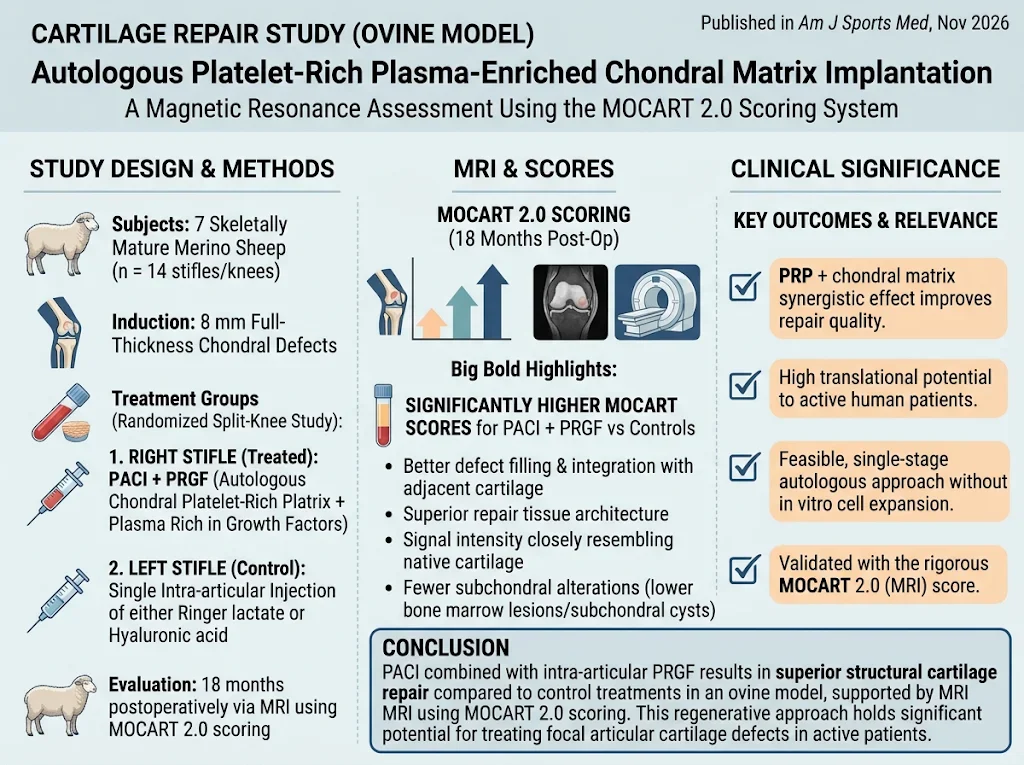
Autologous platelet-rich plasma-enriched chondral matrix implantation (PACI) combined with intra-articular plasma rich in growth factors (PRGF) significantly improves cartilage repair outcomes in an ovine model compared to control treatments. The repair tissue demonstrated superior filling, integration, and architecture, with MRI signal characteristics closely resembling native cartilage. These findings were quantified using the validated MOCART 2.0 scoring system, supporting PACI+PRGF’s clinical translational potential for focal articular cartilage defects.
Study Background
Articular cartilage defects, common in sports medicine and orthopedic practice, have limited intrinsic healing capacity due to the avascular and aneural nature of cartilage tissue. Untreated, these defects frequently progress to degenerative joint diseases such as osteoarthritis, leading to pain and functional impairment. Current surgical interventions aim to restore cartilage structure but vary in efficacy and durability. Regenerative therapies leveraging biologic agents offer promising avenues for enhancing cartilage repair quality. Platelet-rich plasma (PRP) and platelet-rich growth factors have been noted for their regenerative potential by delivering concentrated cytokines and growth factors directly to the lesion site.
Study Design
This controlled laboratory study utilized a clinically relevant ovine model. Full-thickness chondral defects, 8 mm in diameter, were surgically created in the medial femoral condyles of both stifles in 7 skeletally mature Merino sheep (total n = 14 stifles). The right stifles received treatment with autologous chondral platelet-rich plasma matrix implantation (PACI) combined with intra-articular plasma rich in growth factors (PRGF). The left stifles served as controls and were given a single intra-articular injection of either Ringer lactate or hyaluronic acid. The choice of PRGF aimed to augment the healing milieu by providing bioactive factors. Postoperative evaluation was performed at 18 months using magnetic resonance imaging (MRI), assessed specifically with the magnetic resonance observation of cartilage repair tissue (MOCART) 2.0 scoring system, a validated and standardized method for noninvasive cartilage repair tissue quality assessment.
Key Findings
The PACI-treated stifles demonstrated significantly higher mean MOCART 2.0 scores than the control groups, indicating superior repair quality. Important metrics showed that the defects treated with PACI+PRGF had enhanced defect filling with restoration of cartilage thickness, improved integration with adjacent native cartilage, and a more organized and hyaline-like repair tissue architecture.
Specifically, the signal intensity values on MRI were closer to those of native cartilage in the PACI group, which suggests biomechanically appropriate matrix composition and collagen organization. Subchondral bone changes, often associated with poor repair or degeneration, were notably less frequent in the PACI-treated stifles. The overall MOCART 2.0 score, which integrates multiple parameters including surface, structure, signal intensity, and subchondral status, was statistically higher in the intervention group.
Control stifles receiving Ringer lactate or hyaluronic acid did not demonstrate comparable repair quality or integration, underscoring the enhanced biological effect of the platelet-rich plasma-enriched matrix and PRGF combination.
Expert Commentary
This well-designed ovine study provides compelling evidence that augmenting chondral matrix implantation with autologous platelet concentrates and growth factors can significantly enhance cartilage repair quality over standard supportive injections. The use of the MOCART 2.0 scoring system strengthens the validity of the MRI-based assessments, aligning imaging findings with histological and biomechanical repair quality observed in prior studies.
Although the ovine joint model is a well-established analog for human knee cartilage biology due to similarities in weight-bearing mechanics and cartilage thickness, caution is warranted in extrapolating directly to clinical outcomes in humans. Limitations include the small sample size and lack of functional outcome measures, which future clinical trials need to address. Moreover, since the control groups received single injections without matrix implantation, further studies comparing PACI to other advanced cartilage restoration techniques would be valuable.
Biologically, the synergy of platelet-rich plasma and PRGF likely provides a concentrated milieu of anabolic growth factors (e.g., PDGF, TGF-β, VEGF) that stimulate chondrocyte proliferation, extracellular matrix synthesis, and subchondral bone remodeling, all critical for durable cartilage regeneration. This biological plausibility strongly supports translational efforts.
Conclusion
The combination of autologous platelet-rich plasma-enriched chondral matrix implantation with plasma rich in growth factors significantly improves structural cartilage repair in an ovine model, as objectively assessed by the MOCART 2.0 MRI scoring system. These preclinical findings support further clinical investigation of this regenerative approach for managing focal articular cartilage defects, particularly in active patients at risk of degenerative joint disease progression.
Continued research integrating functional assessments, longer follow-up, and direct comparisons with established cartilage repair modalities will be essential to optimize treatment protocols and define patient selection criteria.
Funding and Clinical Trials
No specific funding sources were reported for this laboratory study. Clinical applicability remains to be evaluated through appropriately powered randomized controlled trials registered on clinicaltrials.gov.
References
1. Peláez P, Damiá Giménez E, Torres-Torrillas M, Hernández-Guerra ÁM, Rubio M, Sopena JJ, et al. Autologous Platelet-Rich Plasma-Enriched Chondral Matrix Implantation Improves Cartilage Repair in an Ovine Model: A Magnetic Resonance Assessment Using the MOCART 2.0 Scoring System. Am J Sports Med. 2026 Sep 22;54(13):3246-3253. PMID: 42770530.
2. Marlovits S, Singer P, Zeller P, Babinsky K, Urbanschitz L, Vécsei V. Magnetic resonance observation of cartilage repair tissue (MOCART) for the evaluation of autologous chondrocyte transplantation: correlation to clinical outcome after 2 years. Eur J Radiol. 2006 Mar;57(1):16-27.
3. Filardo G, Kon E, Di Martino A, Di Matteo B, Merli ML, Marcacci M. Platelet-rich plasma: why intra-articular? A systematic review of preclinical and clinical evidence on PRP for joint preservation. J Clin Orthop Trauma. 2018 Sep;9(3):222-228.
4. Fortier LA, Barker JU, Strauss EJ, McCarrel TM, Cole BJ. The Role of Growth Factors in Cartilage Repair. Clin Orthop Relat Res. 2011 Jun;469(10):2706-15.