Combined Septal Extension and Derotation Grafts Provide Superior Long-Term Tip Stability in Asian Rhinoplasty
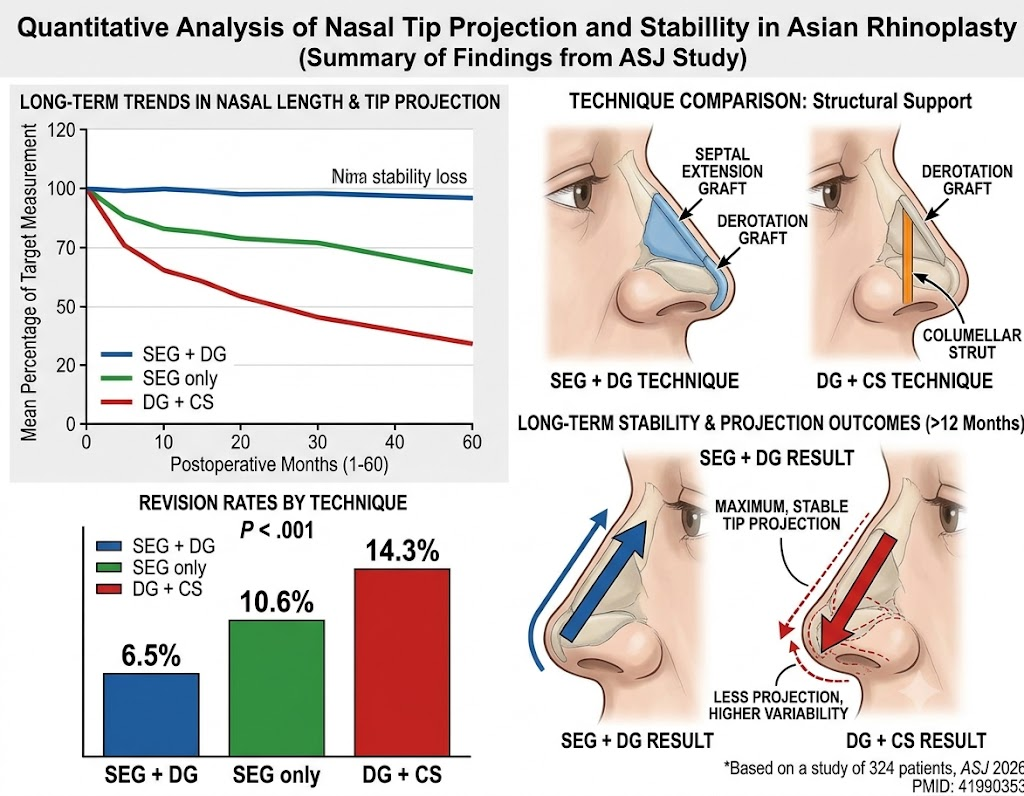
In a retrospective analysis of 324 Asian rhinoplasty patients, combined septal extension and derotation grafts (SEG + DG) provided the most consistent and durable improvements in nasal length and tip projection over a minimum of 12 months follow-up.
SEG + DG and SEG alone both significantly outperformed a derotation graft with columellar strut (DG + CS) for long-term nasal length and tip projection (P < .001).
The combined technique had the lowest revision rate (6.5%) compared with SEG alone (10.6%) and DG + CS (14.3%).
Nasolabial angle changes showed an initial difference among groups that did not persist after pairwise correction.
Correcting short nose deformity in Asian rhinoplasty presents unique challenges: weak septal cartilage, thick skin, and strong postoperative contractile forces often compromise long-term tip stability. A new retrospective study published in Aesthetic Surgery Journal quantitatively compares three tip-plasty techniques and suggests that a combined approach may offer the most reliable and lasting results.
Why This Study Matters
Patients seeking rhinoplasty for short nose correction require durable structural support to maintain tip projection and nasal length over time. Multiple surgical strategies exist, including derotation grafts with columellar struts, septal extension grafts alone, and combined septal extension with derotation grafts. However, head-to-head quantitative comparisons of long-term stability in Asian patients have been limited. This study provides evidence to inform surgical decision-making.
How the Study Was Conducted
The investigators retrospectively analyzed 324 cosmetic rhinoplasty patients treated by a single surgeon between 2015 and 2022. All patients were Asian. Three surgical groups were defined:
Derotation graft with columellar strut (DG + CS) – 70 patients
Septal extension graft alone (SEG only) – 151 patients
Combined septal extension and derotation graft (SEG + DG) – 107 patients
Standardized lateral-view photographs were taken preoperatively and at multiple postoperative intervals. Nasal length, tip projection, and nasolabial angle were measured and normalized to facial length. Outcomes were expressed as percentage change from baseline, and long-term results (more than 12 months) were compared using nonparametric tests. Revision rates were also recorded.
What the Researchers Found
Across all postoperative intervals, the SEG + DG group showed the most consistent and durable improvements in both nasal length and tip projection. The omnibus test revealed significant intergroup differences for long-term nasal length and tip projection (P < .001). Post-hoc comparisons showed that both SEG + DG and SEG alone were superior to DG + CS, but the combined technique exhibited the lowest variability and the most stable trend over time.
For nasolabial angle, a significant omnibus difference was observed (P = .009), but this did not survive post-hoc pairwise correction, meaning the groups were not statistically distinguishable from each other after adjustment for multiple comparisons. Revision rates were lowest in the SEG + DG group (6.5%), followed by SEG alone (10.6%) and DG + CS (14.3%).
Design | Retrospective cohort study |
|---|---|
Setting | Single-surgeon cosmetic rhinoplasty practice |
Population | 324 Asian patients (2015–2022) |
Interventions | DG + CS (n=70), SEG only (n=151), SEG + DG (n=107) |
Primary Outcomes | Change in nasal length, tip projection, nasolabial angle (normalized); revision rate |
Key Result | SEG + DG showed most consistent long-term improvement and lowest revision rate (6.5%) |
Funding | Not reported |
What the Findings May Mean
The findings suggest that the combined use of a septal extension graft and a derotation graft provides more robust and sustained structural support than either the derotation graft with columellar strut or the septal extension graft alone. The lower revision rate and reduced variability in outcomes argue that the combined technique may be particularly advantageous for Asian patients, who often have weaker cartilage and thicker soft tissue. The authors note that the combined graft creates a stronger framework that resists the strong contractile forces known to cause late relapse in short nose correction.
Strengths and Limitations
Strengths of the study include a relatively large sample size, standardized photographic measurements, and a minimum of 12 months follow-up. Quantitative normalization to facial length reduces scaling bias. However, the retrospective, single-surgeon design limits generalizability. All patients were Asian, so findings may not apply to other ethnic groups. Assessments relied on two-dimensional photographs rather than three-dimensional imaging, which could miss subtle changes. The study also lacks patient-reported outcome measures, which are increasingly important in cosmetic surgery. Finally, the lack of randomization introduces potential selection bias, as the choice of technique may have been influenced by preoperative severity or surgeon preference.
Implications for Practice and Research
For surgeons performing Asian rhinoplasty, these data support the use of a combined septal extension and derotation graft as a preferred technique when durable tip projection and nasal length are desired. The low revision rate is clinically meaningful. Future prospective, multi-center studies with longer follow-up and patient-reported outcomes would help confirm these findings and refine patient selection. The study adds to a growing body of evidence that technique choice in short nose correction significantly affects stability and long-term satisfaction.
Funding, Disclosures, and Registration
The source article did not report specific funding or author disclosures. The study is not registered in a clinical trial database due to its retrospective nature.
References
Huang CJ, Tsai TY, Yen CI, Chen HC, Chang CS, Hsiao YC. Efficacy of Combined Septal Extension and Derotation Grafts in Asian Rhinoplasty: A Quantitative Analysis of Tip Projection and Stability. Aesthet Surg J. 2026;46(8):907-915. doi:10.1093/asj/sjag079. PMID: 41990353.
This article was created using several editorial tools, including AI, as part of the process. Human editors reviewed this content before publication.