Colovac Device vs Diverting Loop Ileostomy: A Prospective Pooled Analysis in Rectal Cancer Surgery
Highlight
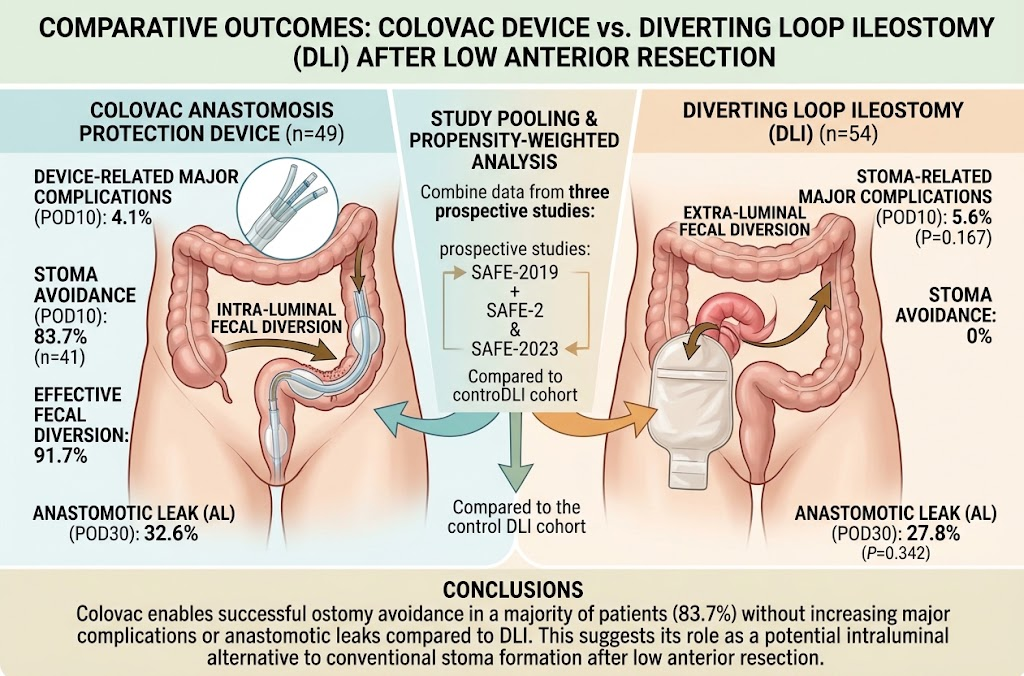
– The Colovac Anastomosis Protection Device enables intraluminal fecal diversion as an alternative to diverting loop ileostomy (DO) following low anterior resection (LAR) for rectal cancer.
– In a pooled analysis of three prospective trials (n=49) versus a prospective DO cohort (n=54), major device- or stoma-related complications within 10 postoperative days were comparable (4.1% vs 5.6%, P=0.167).
– Anastomotic leak (AL) rates by postoperative day (POD) 30 did not differ significantly (32.6% vs 27.8%, P=0.342).
– The Colovac device facilitated ostomy avoidance in 83.7% of patients at POD10 and achieved effective fecal diversion in 91.7%, with device migration in 14.3% of cases.
– These findings suggest Colovac as a promising alternative to standard diverting loop ileostomy following LAR for rectal cancer.
Background
Low anterior resection (LAR) is a common surgical approach for rectal cancer aiming for oncological resection and restoration of bowel continuity through an anastomosis. Despite advances in surgical techniques, the risk of anastomotic leaks (AL) remains significant due to factors such as low pelvic anastomosis and neoadjuvant treatments. AL can lead to serious morbidity, prolonged hospitalization, reoperation, and even mortality.
Diverting loop ileostomy (DO) remains the standard of care after LAR in many settings to protect the distal anastomosis by diverting fecal stream, thereby reducing the clinical consequences of leakage. However, DO is associated with its own morbidity including stoma-related complications, dehydration, electrolyte imbalances, and requiring a second surgery for reversal, which impacts patient quality of life and healthcare costs.
Intraprocedural strategies that avoid the need for fecal stomas while still protecting the anastomosis represent a major unmet clinical need. The Colovac Anastomosis Protection Device is designed to divert fecal matter intraluminally away from the anastomosis during the critical early postoperative period, potentially mitigating the need for ostomy formation.
Study Design
This article presents a pooled analysis of three prospective multicenter clinical trials evaluating the safety and performance of the Colovac device compared to a prospective cohort undergoing standard diverting loop ileostomy following LAR for rectal cancer. The analysis used propensity score weighting to balance baseline patient characteristics between groups.
Population included adult patients undergoing low anterior resection for rectal cancer requiring anastomosis. The intervention arm received the Colovac device intraoperatively to achieve fecal diversion without stoma creation. The control arm received standard diverting loop ileostomy as per institutional protocols.
Primary safety endpoint was the incidence of major complications related to the device or stoma within 10 postoperative days, including device migration or stoma-related morbidity. Secondary endpoints included early and total anastomotic leak rates assessed clinically and radiographically by postoperative day 9/10 and day 30, fecal stream diversion efficacy, and device-related adverse events.
Key Findings
The analysis included 49 patients treated with Colovac and 54 patients with diverting loop ileostomy.
Safety: Major device- or stoma-related complications by POD10 were 4.1% (2/49) with Colovac versus 5.6% (3/54) with ileostomy (P=0.167), indicating no statistically significant difference. Device placement and retrieval success was 100% in the Colovac group.
Ostomy avoidance and fecal diversion effectiveness: Stoma avoidance was achieved in 83.7% of Colovac patients at POD10. Effective fecal diversion, defined as successful exclusion of fecal stream from the anastomosis site, was reported in 91.7%. Device migration was observed in 14.3%, potentially necessitating early removal or replacement.
Anastomotic Leak (AL) Rates: Early AL detected by POD9/10 was 28.6% in Colovac patients compared to 20.4% in controls (P=0.102), not statistically significant. By POD30, total AL rates were 32.6% for the Colovac group and 27.8% for controls (P=0.342), suggesting comparable leak risk.
Other metrics such as reoperation rates, length of stay, and long-term functional outcomes were not detailed in the report but are important for future research.
Expert Commentary
The Colovac device represents an innovative approach aimed at intraluminal diversion, potentially reducing the morbidity associated with diversion ostomies. The comparable safety profile and similar AL rates seen in this pooled analysis are encouraging. Avoiding a diverting stoma may improve patient quality of life, decrease costs, and reduce the burden of stoma-related complications and subsequent reversal surgeries.
However, the reported AL rates of approximately 30% appear higher than generally expected with diverting loop ileostomy, suggesting that careful patient selection and further device optimization may be warranted. The incidence of device migration (14.3%) raises concerns about technical challenges and the need for vigilant postoperative monitoring.
Limitations include the relatively small sample size, observational design, and heterogeneity between studies. The propensity score weighting improves comparability but cannot eliminate residual confounding inherent to non-randomized comparisons. Additionally, long-term functional and oncological outcomes remain unknown.
Current guidelines support diverting stomas following low colonic anastomoses at high risk of leakage. The Colovac device could represent an alternative in selected patients who are motivated to avoid a stoma or are at higher risk from stoma-related morbidity. Larger randomized controlled trials with robust follow-up are needed to confirm these results and define optimal clinical algorithms.
Conclusion
The Colovac Anastomosis Protection Device offers a feasible and safe alternative to diverting loop ileostomy in patients undergoing low anterior resection for rectal cancer. It enables ostomy avoidance in most patients without increasing major complications or anastomotic leak rates. Despite promising findings, higher leak rates compared to traditional ileostomy warrant cautious interpretation and further investigation.
Future research should focus on refining device design to reduce migration, identifying patients most likely to benefit from intraluminal diversion, and comparing long-term outcomes including quality of life and oncologic safety. If validated, the Colovac device could shift paradigms in colorectal surgery by minimizing the physiological and psychological burden of diverting ostomies.
Funding and Registration
The three pooled trials and control cohort were registered on ClinicalTrials.gov under the following identifiers: SAFE-2019 (NCT05180565), SAFE-2 (NCT05010850), SAFE-2023 (NCT06540807), and SH-SOC23 (NCT06152276). The original report provides no detail on funding sources or conflicts of interest, which should be considered in interpreting study findings.
References
1. Sylla P, Lam K, Komen N, et al. Safety and Performance of the Colovac Anastomosis Protection Device. A Pooled Analysis of Prospective Studies Compared With Diverting Loop Ileostomy (SAFE-2025). Ann Surg. 2026 Sep 2. PMID: 42681563.
2. Emile SH, Abdelsattar ZM, Shalaby M, et al. Diverting Ostomy in Low Anterior Resection for Rectal Cancer: Risks and Benefits. Dis Colon Rectum. 2021;64(3): 346-355.
3. Kang J, Kim B. Evaluation of New Technologies to Prevent Anastomotic Leakage After Rectal Cancer Surgery. World J Gastroenterol. 2022; 28(11):1100-1114.
This article was created using several editorial tools, including AI, as part of the process. Human editors reviewed this content before publication.