Study Background
Patients undergoing rehabilitation after sudden-onset neurological and musculoskeletal injuries—including traumatic brain injury (TBI), spinal cord injury (SCI), stroke, and major limb injury or limb loss—experience multifaceted challenges that profoundly impact their quality of life (QOL). Traditionally, rehabilitation efforts and outcome assessments have focused on diagnosis-specific functional impairments and symptom severity. However, patients with different clinical conditions may share common patterns of challenges and adaptations that transcend diagnostic boundaries. Recognizing and understanding these shared profiles of patient-reported outcomes may inform more personalized and effective rehabilitation strategies. This study aimed to identify distinct QOL outcome profiles in a diverse rehabilitation cohort, leveraging latent profile analysis (LPA) to reveal underlying patterns of patient experiences that might inform tailored clinical management beyond diagnosis alone.
Study Design and Population
This was a cross-sectional observational study conducted at an academic research center involving English-speaking adults with a medically confirmed history of TBI, SCI, stroke, or major limb injury/limb loss due to sudden-onset causes. Patients were recruited from three clinical sites in the United States to ensure a diverse sample representative of rehabilitation populations. No interventions were applied as part of the study; instead, data collection focused on patient-reported outcomes and cognitive testing.
The primary outcomes comprised nine standardized factor scores derived from validated patient-reported outcome measures (PROMs). These outcomes captured multiple QOL domains: economic QOL, fatigue and sleep quality, pain intensity, independence in activities of daily living, physical function, negative affect (e.g., depression, anxiety), positive affect (e.g., well-being, satisfaction), social health (participation and support), as well as cognitive performance assessed via the Brief Test of Adult Cognition by Telephone (BTACT).
Key Findings
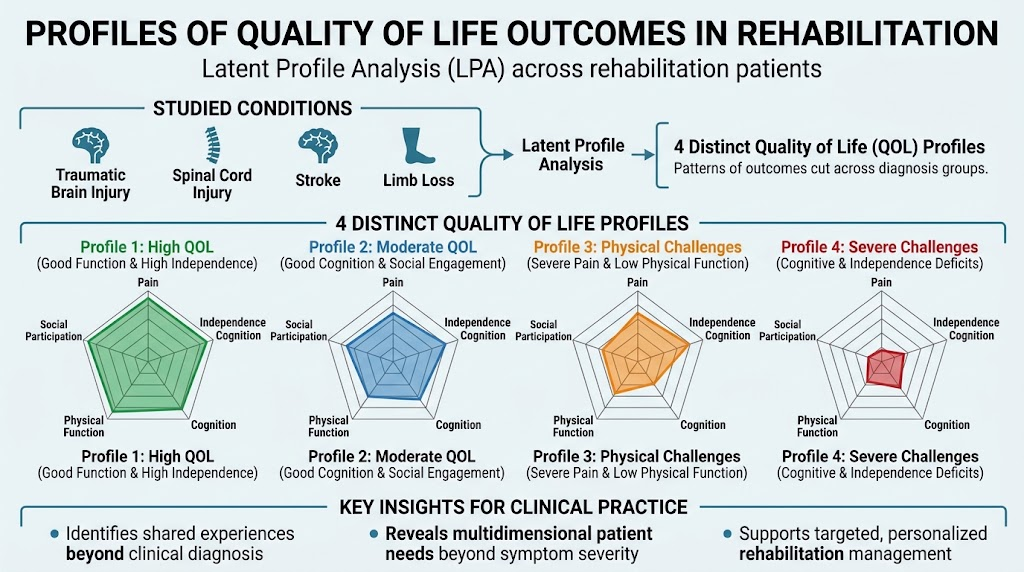
Latent profile analysis identified an optimal four-profile solution that best characterized variations in QOL outcomes across patients regardless of their underlying clinical diagnosis. Importantly, these profiles cut across traditional diagnostic categories, indicating that patients with different etiologies could exhibit similar QOL patterns.
The four profiles demonstrated distinct patterns spanning multiple QOL domains:
– Profile 1: Relatively favorable outcomes with higher physical function, greater independence, better cognitive scores, lower pain levels, and higher positive and social health indices.
– Profile 2: High symptom burden characterized by elevated pain, fatigue, negative affect, and lower independence.
– Profile 3: Cognitive and social participation challenges with moderate physical impairments but pronounced deficits in cognitive function and social engagement.
– Profile 4: Mixed moderate impairment with intermediate levels across domains, representing a more heterogeneous group.
Pain, independence, cognition, and social participation emerged as key differentiators across these profiles beyond mere symptom severity. Notably, profiles with worse social participation and cognition were not restricted to any single diagnosis, highlighting the complexity of rehabilitation needs.
These findings underscore the importance of comprehensive multidomain assessment rather than focusing solely on impairment severity or diagnostic labels. They also suggest that rehabilitation interventions should be adapted to the specific outcome profile a patient belongs to, potentially optimizing resource allocation and treatment efficacy.
Expert Commentary
This innovative application of latent profile analysis in rehabilitation populations reflects a shift toward more nuanced patient characterization. Traditional outcome measures often provide clinicians with fragmented information, whereas clustering related QOL factors offers a holistic view of the patient’s lived experience. Expert opinion increasingly recognizes that addressing cognitive and social participation impairments is critical for long-term functional recovery and quality of life, beyond improving physical symptoms alone.
However, limitations include the cross-sectional study design limiting causal inference, relatively homogeneous sample restricted to English speakers, and reliance on telephone-based cognitive assessments which may not capture all nuances. Future longitudinal research is needed to track profile stability and responsiveness to tailored interventions.
Conclusion
This study validated the utility of latent profile analysis to identify distinct, meaningful QOL outcome clusters among rehabilitation patients with diverse diagnoses. These profiles transcend traditional diagnostic boundaries and highlight key dimensions—pain, independence, cognition, and social participation—that differentiate patient experiences. Integrating such profile-based approaches into rehabilitation assessment and management may enable more personalized and targeted treatments, ultimately enhancing patient-centered outcomes in diverse neurological and musculoskeletal rehabilitation populations.
Funding and Additional Information
The study was conducted by Tyner CE et al. and published in Archives of Physical Medicine and Rehabilitation. Specific funding sources were not detailed in the provided content. No clinical trial registration was noted, as this was an observational study.
References
Tyner CE, Boulton AJ, Kisala PA, Chiaravalloti ND, Taylor HB, Sherer M, Slotkin J, Tulsky DS. Profiles of Quality of Life Outcomes Observed in Rehabilitation Patients Using Latent Profile Analysis. Arch Phys Med Rehabil. 2026 Jun 12;107(10):2895-2905. PMID: 42285333.
Additional relevant literature includes:
1. Tulsky DS, Kisala PA, et al. Overview of Patient-Reported Outcomes Measurement Information System (PROMIS) in Rehabilitation Research. Arch Phys Med Rehabil. 2015.
2. Kisala PA, Tulsky DS. Approaches to Assessment and Rehabilitation of Cognitive and Social Functioning in Brain Injury. NeuroRehabilitation. 2010.
3. Turner-Stokes L. Rehabilitation Outcomes for Patients after Brain Injury: A Longitudinal Perspective. Brain Inj. 2006.