Highlight
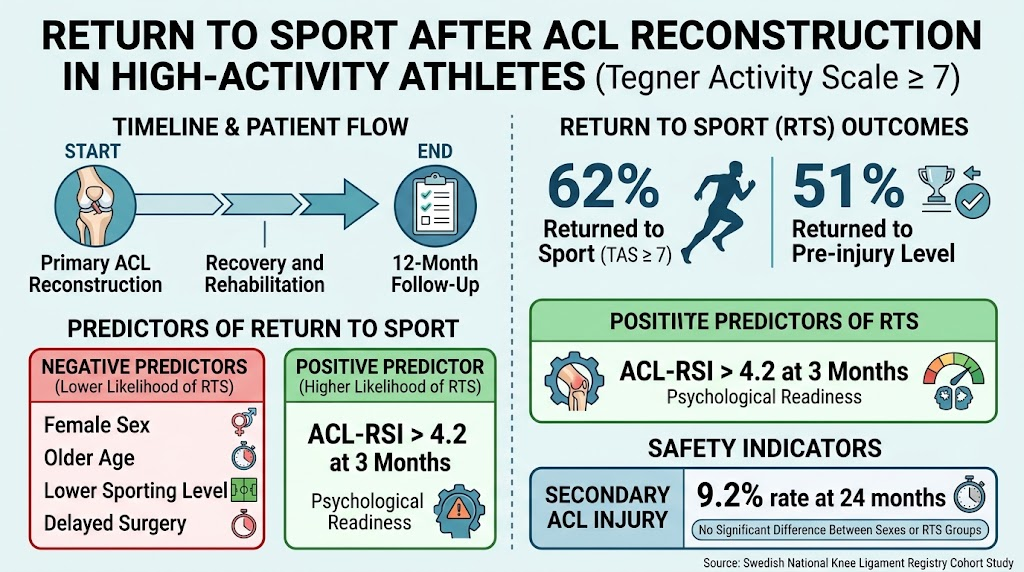
Approximately 62% of high-activity athletes (preinjury Tegner Activity Scale ≥7) return to similar strenuous sports within 12 months after primary ACL reconstruction.
Female sex, older age, lower sporting level, and delayed surgery predict reduced likelihood of return to high-level activity.
Psychological readiness measured by the ACL-Return to Sport after Injury (ACL-RSI) score at 3 months post-operation is a strong, potentially modifiable predictor of return to sport.
Secondary ACL injury rates do not differ by sex or return-to-sport status, with an overall 9.2% incidence within 24 months.
Study Background
Anterior cruciate ligament (ACL) injuries represent a significant clinical challenge in sports medicine due to their prevalence among athletes involved in high-demand pivoting sports and the considerable physical and psychological impact they impose. For athletes with a high preinjury activity level—often quantified using the Tegner Activity Scale (TAS)—return to sport (RTS) is a crucial goal post-reconstruction. Despite advances in surgical techniques and rehabilitation, rates of successful RTS to preinjury levels vary widely in literature, and factors influencing these outcomes are still being elucidated. Furthermore, the balance between a successful return and the risk of secondary ACL injury remains a clinical concern.
Study Design
This prospective longitudinal cohort study utilized data from the Swedish National Knee Ligament Registry, comprising 511 athletes aged 16–40 years who underwent primary ACL reconstruction and had a preinjury TAS score ≥7, indicating participation in knee-demanding sports at a high level. The primary outcome evaluated was achieving RTS at TAS ≥7 within 24 months postoperatively. Secondary outcomes included RTS at exact preinjury TAS level, predictors of RTS, secondary ACL injury rates, and patient-reported outcome measures (PROMs).
The investigators applied log-binomial regression and multivariable Cox proportional hazards models to evaluate associations of demographic, clinical, and psychological variables—including age, sex, time to surgery, sporting level, and the ACL-RSI score measured at 3 months post-surgery—with RTS outcomes.
Key Findings
Among this nationwide cohort, 62% (315/511) of athletes resumed sports with a TAS ≥7 within an average of 12.3 months (SD 4.7), whereas only 51% returned to their exact preinjury TAS level within 12.7 months (SD 4.9). This indicates that while a majority return to knee-demanding activities, a substantial proportion do not reach their previous competitive level within 2 years post-surgery.
Notably, female athletes and those of older age showed lower RTS rates. Similarly, lower baseline sporting level and delays in surgical intervention negatively influenced return rates. These findings underscore demographic and modifiable factors that can influence rehabilitation success.
A significant novel insight was the prognostic value of the ACL-RSI questionnaire scores at 3 months post-ACL reconstruction. Scores above 4.2 were associated with a higher likelihood of RTS to both TAS ≥7 and preinjury levels, suggesting psychological preparedness early in recovery is critical and represents a potential intervention target.
Secondary ACL injury occurred in 9.2% (47 individuals) within 24 months, consistent across sexes and regardless of RTS status. This suggests that returning to high-level activity does not inherently increase reinjury risk, although overall reinjury rates remain clinically significant and warrant ongoing risk-reduction strategies.
Athletes who returned to TAS ≥7 reported significantly better patient-reported outcome measures, indicating that successful RTS aligns with improved subjective knee function and quality of life.
Expert Commentary
This study’s strength lies in its large, nationwide sample reflecting real-world ACL reconstruction outcomes among highly active athletes. The use of the Tegner scale allowed focusing on patients with demanding sport participation, providing insights highly relevant to sports medicine practice.
The identification of psychological readiness at 3 months post-op as a modifiable predictor is particularly clinically actionable. Incorporating early psychological assessment and targeted interventions could enhance RTS rates. However, the findings of delayed surgery reducing RTS odds prompt ongoing debate; while early reconstruction may benefit return outcomes, patient-specific factors must guide timing decisions.
The secondary ACL injury rate of 9.2% is in alignment with previous literature, though longer follow-up and standardized criteria are needed for comprehensive risk assessment. The lack of difference in reinjury between sexes contrasts with some prior reports, meriting further investigation.
Limitations include potential registry-related data biases and unmeasured confounders affecting RTS, such as rehabilitation intensity or socioeconomic factors. Furthermore, while the Tegner scale captures activity level, it cannot fully assess the quality or competitiveness of return.
Conclusion
This registry-based longitudinal study demonstrates that about 3 in 5 athletes with high preinjury activity return to demanding sports following primary ACL reconstruction within one year. Female sex, older age, lower sporting tier, and delayed surgery negatively influence return rates. Psychological readiness early in rehabilitation emerges as a promising modifiable predictor, highlighting the need to integrate mental health strategies into postoperative care. The secondary ACL injury rate remains moderate and unaffected by return status or sex.
These insights support a personalized rehabilitation approach, emphasizing early psychological evaluation and optimizing surgical timing to enhance return-to-sport success. Future research should focus on targeted interventions addressing identified risk factors and longer-term outcomes to better guide clinical decision-making.
Funding and Clinical Trial Registration
No specific funding was reported. The study leverages national registry data without an interventional clinical trial framework.
References
Castellanos Dolk D, Hedevik H, Wretenberg P, Stålman A, Kvist J. Return to sport after primary anterior cruciate ligament reconstruction in athletes with a preinjury Tegner Activity Scale ≥7: a longitudinal, nationwide, registry-based cohort study. Br J Sports Med. 2026 Oct 12;60(20):1570-1580. doi: 10.1136/bjsports-2025-111497. PMID: 42864256; PMCID: PMC13691718.