Cardiovascular Safety and Therapeutic Potential of Orforglipron Versus Insulin Glargine in Type 2 Diabetes with Elevated Cardiovascular Risk: Insights from the ACHIEVE-4 Phase 3 Trial
Highlights
The ACHIEVE-4 phase 3 trial established the cardiovascular safety of orforglipron, a novel oral non-peptide GLP-1 receptor agonist, as non-inferior to insulin glargine in adults with type 2 diabetes and elevated cardiovascular risk.
Orforglipron demonstrated reduced incidence of clinically significant hypoglycaemia compared to insulin glargine, despite a higher rate of gastrointestinal adverse events.
Adjunct evidence from phase 2 studies indicates orforglipron favorably modulates cardiovascular risk biomarkers, including blood pressure, LDL cholesterol, triglycerides, and inflammatory markers.
Orforglipron presents a compelling once-daily oral therapeutic alternative to injectable insulin glargine, potentially improving patient adherence and outcomes.
Background
Type 2 diabetes mellitus (T2DM) remains a major global health challenge, intricately linked to increased cardiovascular (CV) morbidity and mortality. In people with T2DM, intensified glycemic control and mitigation of CV risk factors reduce adverse outcomes. Glucagon-like peptide-1 receptor agonists (GLP-1 RAs), particularly peptide-based injectable forms, have demonstrated robust CV benefits in randomized clinical trials, prompting guideline endorsements for CV risk reduction in diabetes management. However, injectable administration and peptide-associated challenges have limited widespread adoption.
Orforglipron is an innovative, orally administered, non-peptide GLP-1 RA designed to facilitate easier delivery while retaining therapeutic efficacy. Prior to the ACHIEVE-4 trial, orforglipron’s cardiovascular safety profile had not been rigorously established in high CV risk populations. The ACHIEVE-4 trial addressed this gap by directly comparing orforglipron to insulin glargine, a well-known glucose-lowering regimen, focusing on major adverse cardiovascular events (MACE) in adults with T2DM characterized by overweight or obesity and established cardiovascular or chronic kidney disease.
This review synthesizes the ACHIEVE-4 trial findings with supporting evidence from phase 2 studies on biomarker changes to provide a comprehensive perspective on orforglipron’s role in managing T2DM patients with elevated CV risk.
Key Content
Design and Population of the ACHIEVE-4 Trial
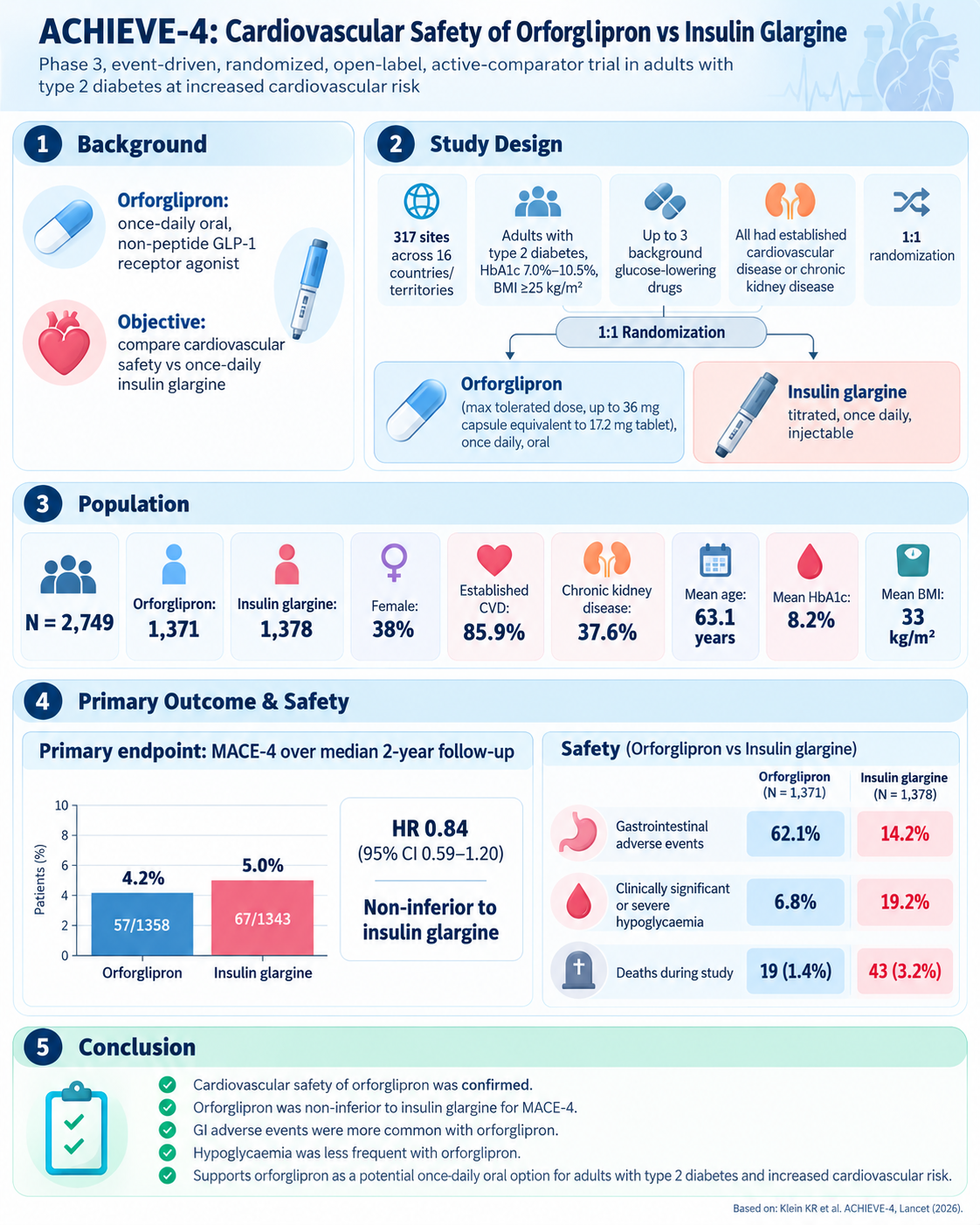
The ACHIEVE-4 study was a phase 3, event-driven, multicenter, randomized, open-label, active comparator trial conducted across 317 sites in 16 countries. Eligible adults with T2DM had HbA1c between 7.0% and 10.5% (53-91 mmol/mol) and BMI ≥25 kg/m2, with established cardiovascular or chronic kidney disease, representing an elevated CV risk cohort. Participants were concurrently treated with up to three glucose-lowering agents including metformin, sulfonylureas, and/or SGLT2 inhibitors but were insulin-naïve or not on injectable GLP-1 RA therapy.
Participants (N=2749) were randomized in a 1:1 ratio to oral orforglipron (max tolerated dose up to 36 mg capsule, equivalent to 17.2 mg tablet) or titrated once-daily injectable insulin glargine. The primary endpoint was time to first four-component MACE event (CV death, non-fatal myocardial infarction, non-fatal stroke, or hospitalization for unstable angina). Safety endpoints included hypoglycemia incidence and adverse events.
Primary Cardiovascular Outcomes and Safety Findings
Over a median 2-year follow-up, MACE-4 events occurred in 57 (4.2%) orforglipron-treated and 67 (5.0%) insulin glargine-treated participants, yielding an HR of 0.84 (95% CI 0.59–1.20), thereby demonstrating clear non-inferiority (p<0.0001) of orforglipron relative to insulin glargine. Importantly, this indicates no excess CV risk associated with orforglipron.
Gastrointestinal adverse events were more frequent with orforglipron (62.1%) versus insulin glargine (14.2%), consistent with GLP-1 RA class effects and were the main reason for treatment discontinuation. Conversely, clinically significant or severe hypoglycemia (glucose <3 mmol/L) occurred less frequently with orforglipron (6.8%) than insulin glargine (19.2%), underscoring orforglipron's favorable hypoglycemia safety profile.
Mortality was numerically lower in the orforglipron group (1.4%) versus insulin glargine (3.2%), with all but one death adjudicated as unrelated to study treatments.
Supporting Evidence from Phase 2 Studies: Cardiovascular Risk Biomarker Modulation
Phase 2 exploratory analyses involving participants with T2DM and overweight/obesity without diabetes evaluated orforglipron’s impact on CV risk markers after 26 to 36 weeks of treatment. These studies revealed significant placebo-adjusted reductions in systolic and diastolic blood pressure, LDL cholesterol, triglycerides, Apolipoprotein B and C3, and inflammatory markers such as high-sensitivity C-reactive protein (hsCRP) and interleukin-6. Reductions were comparable across multiple doses (12–45 mg), indicating a dose-independent beneficial CV biomarker profile.
These biomarker improvements align with the mechanistic rationale of GLP-1 RAs reducing cardiovascular risk via weight loss, improved lipid metabolism, blood pressure lowering, and anti-inflammatory effects, collectively supporting the clinical findings from ACHIEVE-4.
Expert Commentary
The ACHIEVE-4 trial provides pivotal evidence affirming orforglipron’s cardiovascular safety in high-risk T2DM patients, establishing its profile as non-inferior to insulin glargine for MACE. This outcome is clinically significant given the evolving therapeutic landscape favoring GLP-1 RAs for their dual glycemic and CV benefits.
The oral, non-peptide nature of orforglipron offers important practical advantages over injectable peptide-based GLP-1 RAs, potentially enhancing patient preference and adherence. The observed reduction in hypoglycemic events compared with insulin glargine further favors orforglipron’s safety profile, addressing a key limitation of insulin therapy.
Nonetheless, gastrointestinal side effects remain a major consideration for patient management, consistent with established GLP-1 RA profiles, warranting attentive clinical monitoring and patient counseling.
Mechanistically, orforglipron’s impact on CV biomarkers corroborates its translational potential beyond glycemic control, encompassing modulation of hemodynamic, lipid, and inflammatory pathways implicated in diabetic cardiovascular disease.
Current guidelines emphasize CV risk reduction in T2DM beyond glycemic targets; thus, orforglipron’s demonstrated cardiovascular safety and oral administration form support its integration as a versatile therapeutic option in clinical practice.
Limitations include the open-label design and the non-inferiority margin set at an upper HR limit of 1.8, which is comparatively wide; however, the observed HR and narrow confidence intervals provide reassurance on safety.
Conclusion
Orforglipron emerges as a promising oral non-peptide GLP-1 receptor agonist with confirmed cardiovascular safety comparable to insulin glargine in adults with T2DM at elevated cardiovascular risk. The ACHIEVE-4 trial, supported by biomarker data from phase 2 studies, reinforces orforglipron’s therapeutic role in improving glycemic control with lower hypoglycemia risk, alongside beneficial effects on cardiovascular risk factors.
Its oral route facilitates patient convenience and adherence, addressing some challenges posed by injectable therapies. Moving forward, longer-term real-world data and comparative effectiveness studies will be critical to further delineate orforglipron’s place in comprehensive diabetes care, especially for patients with concomitant cardiac and renal disease.
Overall, orforglipron represents an innovative advancement, broadening treatment paradigms towards safer, efficacious, and patient-centered management of type 2 diabetes with cardiovascular comorbidities.
References
Klein KR, Wysham C, Tuttle KR, et al. Cardiovascular safety of orforglipron versus insulin glargine in adults with type 2 diabetes at increased cardiovascular risk (ACHIEVE-4): a phase 3, event-driven, randomised, open-label, non-inferiority, active comparator trial. Lancet. 2026 Sep 30;408(10564):1557-1570. doi:10.1016/S0140-6736(26)01865-9. PMID: 42815506.
This article was created using several editorial tools, including AI, as part of the process. Human editors reviewed this content before publication.