Cardiac Adaptations to Prolonged Spaceflight and Simulated Martian Gravity: Insights from a Longitudinal Observational Study
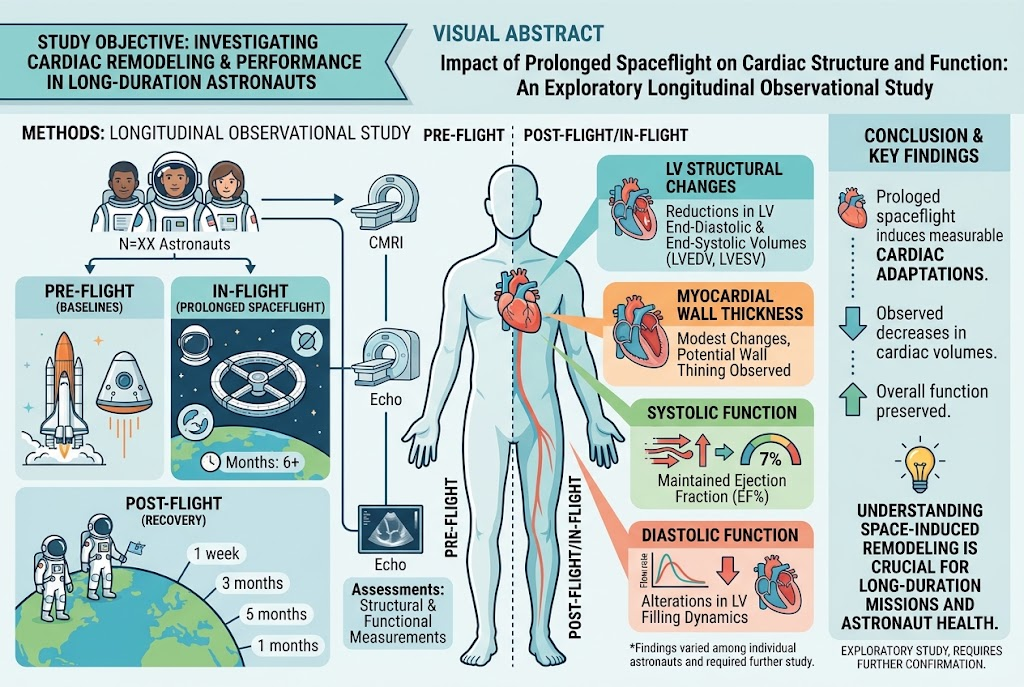
Highlight
1. Prolonged microgravity during spaceflight initially reduces left ventricular volumes and myocardial deformation, reflecting transient cardiac unloading.
2. Left ventricular volumes and stroke volume recover and stabilize during extended periods of microgravity, approaching preflight supine Earth values.
3. Exposure to simulated Martian gravity (0.38 G) after a six-month mission did not impose greater cardiac or hemodynamic stress than upright posture on Earth.
4. The findings suggest effective cardiovascular adaptation with current exercise countermeasures and a low likelihood of orthostatic intolerance upon Mars landing after long-duration spaceflight.
Study Background
The human cardiovascular system is acutely influenced by gravitational forces, which alter hemodynamic load and venous return. On Earth, the normal gravitational load is approximately 1 G, while spaceflight exposes astronauts to microgravity (0 G), fundamentally changing cardiac preload and afterload dynamics. Intermediate gravitational environments, such as Mars at approximately 0.38 G, present unique challenges for cardiovascular adaptation during and after space missions. Understanding cardiac structural and functional responses to these different gravitational stresses has implications for astronaut health, mission planning, and the safety of extraterrestrial colonization.
Long-duration spaceflight is known to induce cardiovascular deconditioning, but the extent and reversibility of myocardial changes remain incompletely characterized. This study aimed to prospectively track cardiac adaptations in astronauts during extended microgravity exposure, compare these to responses elicited by Earth-based gravitational postural changes including simulated Martian gravity, and evaluate the likelihood of orthostatic intolerance upon return to partial gravity.
Study Design
This was a prospective, longitudinal, within-subject repeated-measures observational study involving 13 astronauts (9 male) with a mean age of 49 ± 4 years completing long-duration missions aboard the International Space Station (ISS). The median mission duration was 164 days (interquartile range 126 to 169 days).
Echocardiographic assessments were performed at multiple timepoints: preflight in supine and upright postures, incorporating a 22° head-up tilt to simulate Martian gravity (0.38 G); during early in-flight microgravity exposure (approximately 14 days); throughout the course of spaceflight; post-landing on Earth; and again post-landing during exposure to simulated Martian gravity on Earth. Standardized echocardiographic protocols were applied, including myocardial deformation imaging to assess left ventricular (LV) strain parameters.
Key Findings
Initial spaceflight (microgravity) was associated with significant reductions in LV end-diastolic volume, stroke volume, and measures of myocardial deformation compared with preflight supine rest. These changes are consistent with decreased preload in the microgravity environment. Notably, these reductions approximated values observed when astronauts were upright on Earth before the mission, except for an increased magnitude of LV longitudinal strain (-16.9% versus -14.5%; P=0.006) and a decreased LV circumferential strain (-23.3% versus -26.1%; P=0.016), which suggest subtle alterations in myocardial mechanics induced by microgravity.
As the spaceflight duration progressed, a recovery of LV volumes and stroke volume toward baseline supine values was observed, indicating cardiac adaptation or compensation to sustained microgravity conditions. These adaptations appeared stable and did not worsen over the approximately six-month mission.
Upon exposure to simulated Martian gravity (0.38 G) following return to Earth, astronauts did not exhibit greater cardiac volumetric or hemodynamic load than during preflight upright posture. This suggests that cardiovascular stress imposed by Mars-like gravity is less than or comparable to typical orthostatic stress on Earth in healthy astronauts with standard countermeasures.
Expert Commentary
This detailed longitudinal evaluation provides reassuring evidence that, under current exercise and countermeasure protocols, prolonged microgravity exposure results in transient but stable cardiac adaptations rather than permanent or progressive dysfunction. The transient reductions in preload and stroke volume early in flight reflect well-known hemodynamic shifts in microgravity, but the normalization over time implies physiological remodeling or improved cardiac efficiency.
The differential changes in longitudinal versus circumferential strain highlight complex myocardial mechanics alterations, possibly related to altered loading conditions or autonomic regulation in space. These findings underscore the utility of myocardial deformation imaging in elucidating subtle cardiac changes beyond conventional volumetric measures.
Importantly, the study’s demonstration of comparable hemodynamic responses under simulated Martian gravity and Earth upright posture post-mission suggests that orthostatic intolerance—a common concern during reambulation—may be less problematic upon Mars landing if appropriate countermeasures are employed. This has direct implications for mission planning and astronaut rehabilitation protocols.
Limitations include the small sample size inherent in astronaut research, which may limit generalizability. Additionally, the simulated Martian gravity via 22° tilt does not completely replicate the complex physiological effects of reduced gravity in vivo. Further studies incorporating in situ Martian gravity exposure and larger cohorts are warranted.
Conclusion
This exploratory longitudinal observational study demonstrates that prolonged spaceflight induces initial reductions in cardiac preload and stroke volume which stabilize with time in microgravity. Left ventricular myocardial mechanics exhibit subtle changes but remain within physiologic limits. Exposure to simulated Martian gravity post-mission does not confer additional hemodynamic stress beyond that of Earth’s upright posture.
These findings provide a reassuring framework for cardiovascular function preservation during interplanetary travel and highlight the importance of tailored countermeasures to mitigate deconditioning. Continued research with larger astronaut cohorts and longer Mars-like gravity exposures is essential to confirm these results and optimize cardiovascular health strategies for future missions.
Funding and Clinical Trials
The study was funded by NASA. No registered clinical trial number is reported.
References
Appadurai V, Negishi K, Borowski AG, Popović ZB, Greenberg NL, Martin DS, Bungo MW, Levine BD, Thomas JD. Impact of Prolonged Spaceflight on Cardiac Structure and Function: An Exploratory Longitudinal Observational Study. Circulation. 2026 Sep 15. PMID: 42741837.
This article was created using several editorial tools, including AI, as part of the process. Human editors reviewed this content before publication.