We use cookies

Our website uses essential cookies and, with your consent, additional cookies to measure performance and improve our services. Cookie Policy.

You can change your choice at any time.

MMedXYNews
HomeVideos
MedXY AI/MedXY News/Section: Cardiology

Bringing Cardiac MRI into Everyday Cardiology: Key Recommendations from the 2026 EHJ Consensus
MedXY Editorial Team•Oct 4, 2026•Cardiology
Cardiac Magnetic ResonanceCMRheart failureMINOCAmyocarditis

Introduction and Context

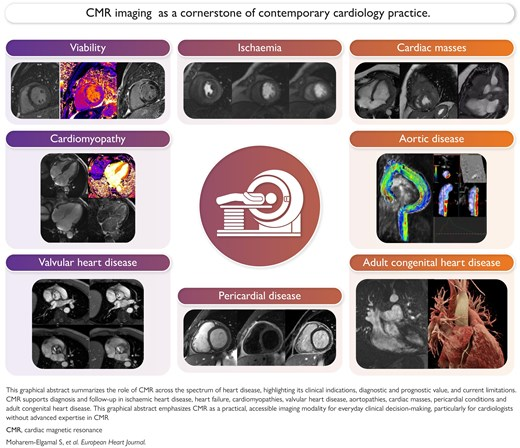
Cardiac magnetic resonance (CMR) is now an essential modality for evaluating a broad range of cardiovascular conditions. The 2026 consensus document by Moharem-Elgamal and colleagues (European Heart Journal, 2026) was written to help general cardiologists incorporate CMR into routine practice. It distils expert recommendations on when to order CMR, which sequences to use, how to interpret key findings, and how to manage common practical issues — including scanning patients with cardiac implantable electronic devices (CIEDs).

Why this consensus matters now
– Rapid advances in CMR technology — especially T1/T2 parametric mapping, quantitative late gadolinium enhancement (LGE), and faster 3D acquisitions — have increased diagnostic and prognostic power.
– Expanding clinical evidence shows that CMR-guided diagnosis changes management for myocardial infarction with non-obstructive coronary arteries (MINOCA), myocarditis, cardiomyopathies, and valve disease.
– Increasing numbers of patients have CIEDs yet often still need CMR. Implementation guidance and safety protocols are now mature enough to broaden access.

MedXY registered readers

Sign in free to continue reading

Create or use your MedXY account to unlock the complete article.

This article was created using several editorial tools, including AI, as part of the process. Human editors reviewed this content before publication.

Related articles

Open language-specific specialty feeds and department pages.

Innovative Early Discharge with Subcutaneous Furosemide for Heart Failure: Enhancing Recovery and Reducing Hospital StayA subcutaneous furosemide minipump-enabled early discharge strategy improves days alive and out of hospital in heart failure patients, reducing inpatient stay without increasing serious adverse events significantly.Oct 19, 2026Prominent V Waves in Heart Failure with Preserved Ejection Fraction: Unveiling Their Impact on Right Ventricular Afterload and Pulmonary Vascular AssessmentProminent left atrial V waves in heart failure with preserved ejection fraction significantly increase right ventricular afterload independent of pulmonary vascular disease, challenging current hemodynamic assessments and impacting patientOct 17, 2026Palmitic Acid and Cardiac Hypertrophy: Unveiling the Epigenetic Memory Driving Heart FailureThis article explores how palmitic acid induces a pro-hypertrophic memory in cardiomyocytes through epigenetic regulation involving KDM5A and H3K4me3 modifications, driving cardiac hypertrophy and heart failure, and highlights potential theOct 16, 2026
Loading comments...
MedXY briefing

Get the free newsletter

Evidence-led clinical news, trends, and analysis—delivered to your inbox.

Ask MedXY AI

Most popular

Intimate Health
Five Benefits for Women Continuing Sexual Activity After Menopause
Intimate Health
Why Some Women Have a Strong Sex Drive—And Why Men Shouldn't Worry About It
Nursing & care
How often should a couple have sex?
Cardiology
Precision Medicine for Long QT Syndrome Type 2: Lumacaftor Corrects Trafficking Defects and Shortens QT Interval
General Surgery
Optimizing Postoperative Opioid Prescriptions After Intra-Abdominal Cancer Surgery: Comparing the 5x-Multiplier and 3-Tier Models
© 2026 MedXY
Contact usAbout usPrivacy PolicyMedXY story
Transforming Outcomes in Severe Tricuspid Regurgitation: Insights from the TRIC-I-HF Trial
Transcatheter tricuspid-valve repair plus medical therapy significantly improves survival, reduces heart failure hospitalizations, and enhances quality of life in patients with severe tricuspid regurgitation compared to medical therapy alon
Oct 15, 2026
Conduction System Pacing vs Biventricular Pacing After AV Node Ablation in AF with Heart Failure: Insights from the CONDUCT-AF TrialThe CONDUCT-AF trial demonstrated that conduction system pacing is non-inferior to biventricular pacing for improving LVEF at 6 months in patients with refractory AF and HF undergoing AV node ablation, with procedural advantages favoring CSOct 10, 2026
Cardiovascular-Kidney-Metabolic Multimorbidity in Heart Failure: Prevalence, Prognostic Impact, and Clinical Implications Across Ejection Fraction PhenotypesMost heart failure patients harbor multiple cardiovascular-kidney-metabolic conditions, which independently escalate mortality and readmission risk, especially in HFrEF, underscoring the need for integrated management strategies tailored byOct 5, 2026