Bridging Evidence-Based and Personalized Medicine in Heart Failure and Cardiomyopathies: Balancing Standardization with Individualization
Introduction
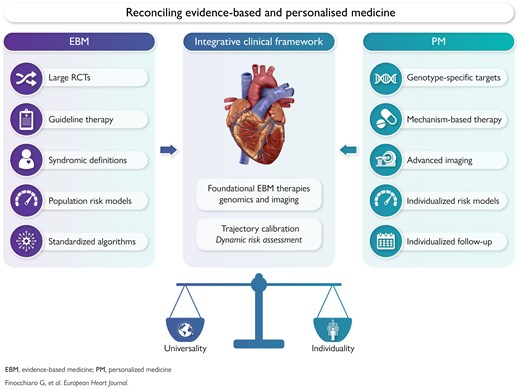
Heart failure (HF) and inherited cardiomyopathies represent complex cardiovascular conditions with significant morbidity and mortality worldwide. The clinical management of these diseases traditionally relies on evidence-based medicine (EBM), which emphasizes the use of therapies validated by robust clinical trials and guideline recommendations. However, the advent of personalized medicine (PM) — focusing on individualized patient characteristics including genetic, molecular, and phenotypic heterogeneity — challenges the uniform application of EBM protocols. This dynamic tension between standardization and individualization is particularly crucial in heart failure and cardiomyopathies due to their heterogeneous etiologies and clinical courses. This article critically examines the philosophical underpinnings and clinical implications of reconciling EBM with PM and proposes strategies to bridge this gap for improved patient outcomes in cardiovascular care.
Highlight
- EBM provides a strong foundation for standardized heart failure treatment but is limited in inherited cardiomyopathies due to scarce high-quality evidence.
- Personalized medicine addresses patient-specific variability especially relevant in inherited cardiomyopathies with genetic and phenotypic heterogeneity.
- A conceptual framework integrating EBM and PM emphasizes dynamic, context-sensitive clinical decision-making.
- Emerging strategies include genomic profiling, biomarker-guided therapy, and adaptive trial designs to optimize individualized patient care.
Disease Burden and Clinical Context
Heart failure affects an estimated 64 million people globally, imposing a substantial healthcare burden through hospitalizations, reduced quality of life, and high mortality. Cardiomyopathies, particularly inherited forms such as hypertrophic cardiomyopathy (HCM), dilated cardiomyopathy (DCM), and arrhythmogenic cardiomyopathy, often culminate in HF but present significant clinical heterogeneity. The genetic and molecular diversity among patients results in variable disease manifestations, progression rates, and therapeutic responses. While EBM has established guideline-directed medical therapies (GDMT) for HF with strong evidence from large randomized controlled trials (RCTs), the evidence base for inherited cardiomyopathies remains limited, complicating treatment decisions. This disparity highlights the unmet need for integrating PM approaches to complement EBM and tailor management to individual patient profiles.
Philosophical Foundations and Paradigm Divergence
EBM is grounded in empiricism and statistical generalizability — therapies with proven benefit in large populations guide clinical practice. In contrast, PM prioritizes individual variability and pathobiology, leveraging genomic, proteomic, and phenotypic data to customize diagnosis and therapy. The epistemological tension arises because EBM often relies on population averages that may obscure meaningful patient-level differences critical in inherited cardiomyopathies. Conversely, PM’s emphasis on unique patient features may lack the rigorous validation that underpins EBM, raising concerns over clinical applicability and reproducibility.
Reconciling EBM and PM in Clinical Practice
To bridge EBM and PM, clinicians should move beyond a binary framework and adopt a complementary model that integrates standardized guidelines with individualized insights. This approach involves:
1. Stratified Medicine and Risk Prediction
Utilizing genetic testing and biomarker profiling to define patient subgroups with differential prognoses and treatment responses enables risk stratification beyond traditional clinical parameters.
2. Adaptive Clinical Trials and Real-World Evidence
Innovative trial designs, such as basket and umbrella trials, allow evaluation of therapies tailored to genetic or phenotypic subpopulations, enhancing evidence generation for personalized interventions. Additionally, integrating real-world data facilitates validation in broader, more heterogeneous patient cohorts.
3. Multidisciplinary Care and Shared Decision-Making
Collaborative teams encompassing genetic counselors, cardiologists, and allied health professionals can holistically interpret complex data and engage patients in informed choices balancing population-level evidence with individual preferences.
4. Dynamic Guidelines Framework
Clinical guidelines should evolve to explicitly incorporate personalized data, offering flexible recommendations conditioned on genetic and biomarker profiles, when available, to allow nuanced therapeutic adaptation.
Clinical Implications in Heart Failure and Cardiomyopathies
In HF, established therapies such as beta-blockers, ACE inhibitors, mineralocorticoid receptor antagonists, and newer agents like SGLT2 inhibitors have demonstrated mortality and morbidity benefits through large-scale RCTs, forming the basis of EBM. However, genetic-driven phenotypes or comorbidities may affect individual efficacy and tolerability, warranting tailored adjustments. In inherited cardiomyopathies, PM is critical given the variability in disease penetrance and progression linked to specific gene mutations. For example, identifying pathogenic variants in sarcomeric proteins informs familial screening, prognosis, and potentially targeted therapies. PM also guides decisions regarding implantable cardioverter-defibrillator placement by refining risk assessment of sudden cardiac death, which may not be adequately addressed by generalized risk scores.
Expert Commentary
Leading cardiology experts emphasize that the future of cardiovascular care hinges on synergizing EBM and PM rather than viewing them as mutually exclusive. The European Society of Cardiology (ESC) guidelines increasingly acknowledge the role of genetic testing and biomarker evaluation in selected cardiomyopathy patients, indicating a paradigm shift. Nevertheless, challenges remain, including limited access to sophisticated diagnostics in routine practice, the need for more high-quality evidence in genetically stratified cohorts, and ethical considerations surrounding genetic data use.
Limitations and Challenges
Despite promising advancements, widespread implementation of PM is constrained by resource requirements, variable evidence quality, and the complexity of integrating multi-omic data into actionable clinical decisions. Additionally, the heterogeneity inherent in inherited cardiomyopathies complicates standardization of personalized approaches. There is also a risk that overemphasis on PM could marginalize therapies validated by robust EBM or delay treatment initiation. Ethical and privacy concerns related to genetic data warrant cautious, patient-centered policies.
Conclusion and Future Directions
Reconciliation of evidence-based and personalized medicine is imperative to optimize care in heart failure and cardiomyopathies. A dynamic, context-sensitive framework that leverages the robustness of EBM and the specificity of PM holds promise to transform cardiovascular management. Future directions include expanding genomics and biomarker research, refining adaptive clinical trial models, and enhancing clinician education to navigate the complexity of integrated care. Bridging this gap will ultimately facilitate precision cardiovascular medicine that improves survival, quality of life, and patient satisfaction.
Funding and Clinical Trials
The referenced article does not specify funding sources or clinical trial registrations. Implementation of PM strategies will benefit from investment in translational research and infrastructure to facilitate genomic screening and adaptive therapeutics evaluation.
References
1. Finocchiaro G, Perotto M, Merlo M, Lüscher TF, McKenna WJ, Sinagra G. Reconciling evidence-based and personalized medicine: perspectives in heart failure and cardiomyopathies. Eur Heart J. 2026 Sep 7:ehag596. doi: 10.1093/eurheartj/ehag596. Epub ahead of print. PMID: 42702502.
2.Yancy CW, Jessup M, Bozkurt B, et al. 2017 ACC/AHA/HFSA Focused Update of the 2013 ACCF/AHA Guideline for the Management of Heart Failure. Circulation. 2017;136(6):e137-e161.
This article was created using several editorial tools, including AI, as part of the process. Human editors reviewed this content before publication.