We use cookies

Our website uses essential cookies and, with your consent, additional cookies to measure performance and improve our services. Cookie Policy.

You can change your choice at any time.

MMedXYNews
HomeVideos
MedXY AI/MedXY News/Section: Cardiology

Balancing Stroke and Cardiac Risks: DOACs versus Warfarin in Atrial Fibrillation with Mitral Stenosis

MedXY Editorial Team•Aug 11, 2026•Cardiology
anticoagulation safetymitral stenosisstroke preventionWarfarinDirect Oral Anticoagulantsatrial fibrillation
Highlight

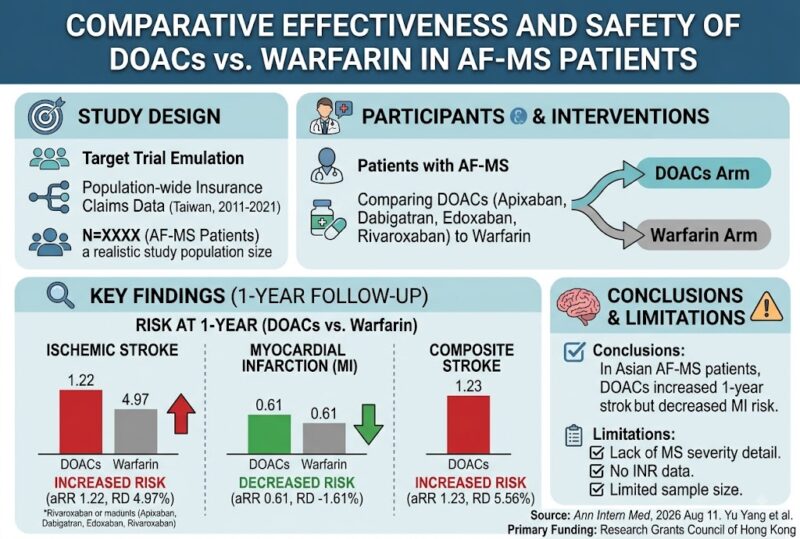
– Direct oral anticoagulants (DOACs) showed a higher 1-year risk of ischemic and composite stroke compared to warfarin in patients with atrial fibrillation and mitral stenosis (AF-MS).
– DOACs were associated with a lower risk of myocardial infarction at 1 year.
– No significant difference was found between DOACs and warfarin regarding bleeding complications or all-cause mortality.
– Rivaroxaban, a specific DOAC, was linked to increased ischemic stroke risk in both short- and long-term follow-up.

Study Background

MedXY registered readers

Sign in free to continue reading

Create or use your MedXY account to unlock the complete article.

This article was created using several editorial tools, including AI, as part of the process. Human editors reviewed this content before publication.

Related articles

Open language-specific specialty feeds and department pages.

Stroke and Systemic Embolism Following Atrial Fibrillation Ablation: Insights from the EMBOL-AF Global Registry and Contemporary EvidenceThe EMBOL-AF Global Registry provides comprehensive data on stroke and systemic embolism post-atrial fibrillation ablation, highlighting incidence, timing, risk factors, and procedural impacts alongside evolving ablation strategies and longSep 27, 2026The ULYSSES Trial: Ultrasound Guidance Significantly Reduces Vascular Complications in Atrial Fibrillation AblationThe ULYSSES trial demonstrates that ultrasound-guided femoral venous puncture markedly lowers vascular access complications compared to conventional palpation-guided techniques in patients undergoing atrial fibrillation ablation, enhancingSep 25, 2026Cardiac Resynchronization Therapy With or Without Atrioventricular Node Ablation in Atrial Fibrillation: The CAAN-AF TrialThis trial evaluated whether atrioventricular node ablation improves outcomes of cardiac resynchronization therapy in heart failure patients with permanent atrial fibrillation, finding no significant benefit over medical rate control.Sep 25, 2026
Loading comments...
MedXY briefing

Get the free newsletter

Evidence-led clinical news, trends, and analysis—delivered to your inbox.

Ask MedXY AI

Most popular

Intimate Health
Five Benefits for Women Continuing Sexual Activity After Menopause
Intimate Health
Why Some Women Have a Strong Sex Drive—And Why Men Shouldn't Worry About It
Nursing & care
How often should a couple have sex?
General Surgery
Optimizing Postoperative Opioid Prescriptions After Intra-Abdominal Cancer Surgery: Comparing the 5x-Multiplier and 3-Tier Models
Intimate Health
Classic Intimacy Recommendations: How to Help Women Reach Orgasm and Enjoy Mutual Pleasure
© 2026 MedXY
Contact usAbout usPrivacy PolicyMedXY story
Breast Cancer-Derived ADAM10: A Novel Mediator of Atrial Fibrillation Through Atrial Fibrosis
Breast cancer independently increases atrial fibrillation risk via tumour-secreted ADAM10, which induces atrial fibrosis through the Ephrin B2 signaling pathway, offering a potential new therapeutic target.
Sep 21, 2026
Carotid Artery Stenting Emerges as a Proven Adjunct to Intensive Medical Therapy in Stroke Prevention: Insights from CREST-2The CREST-2 trial substantiates carotid artery stenting plus intensive medical management significantly reduces stroke risk in high-grade asymptomatic carotid stenosis compared to medical therapy alone, emphasizing patient selection and proSep 17, 2026
Genotype-Dependent Risk and Impact of Atrial Fibrillation in Dilated Cardiomyopathy: Insights from the SHaRe RegistryThis study reveals genotype-specific differences in atrial fibrillation (AF) risk among dilated cardiomyopathy (DCM) patients, highlighting LMNA mutations as a major predictor of incident AF and its association with worse clinical outcomes,Sep 15, 2026