Highlight
This large, pragmatic international trial demonstrated that implementing the guideline-recommended 0/1-hour high-sensitivity cardiac troponin (hs-cTn) pathway is as safe as the conventional 0/3-hour pathway for diagnosing myocardial infarction in the emergency department, as evidenced by similar 30-day outcomes. However, the 0/1-hour pathway did not significantly reduce emergency department length of stay compared to the 0/3-hour protocol.
Study Background
Chest pain suggestive of myocardial infarction (MI) is a common and challenging presentation in emergency departments worldwide. Accurate and rapid diagnosis is critical to optimize patient management, resource allocation, and outcomes. High-sensitivity cardiac troponin assays have revolutionized early detection of myocardial injury, enabling the development of accelerated diagnostic algorithms.
Current international guidelines advocate use of the 0/1-hour hs-cTn pathway, which involves measuring troponin at presentation (0 hour) and again at 1 hour, allowing earlier rule-in or rule-out of acute MI compared to traditional 0/3-hour protocols. Despite guideline endorsement, many hospitals still utilize a 0/3 hour serial sampling approach. The clinical impact of switching to the 0/1-hour approach in real-world settings remained inadequately studied, particularly regarding safety and emergency department workflow efficiency.
Study Design
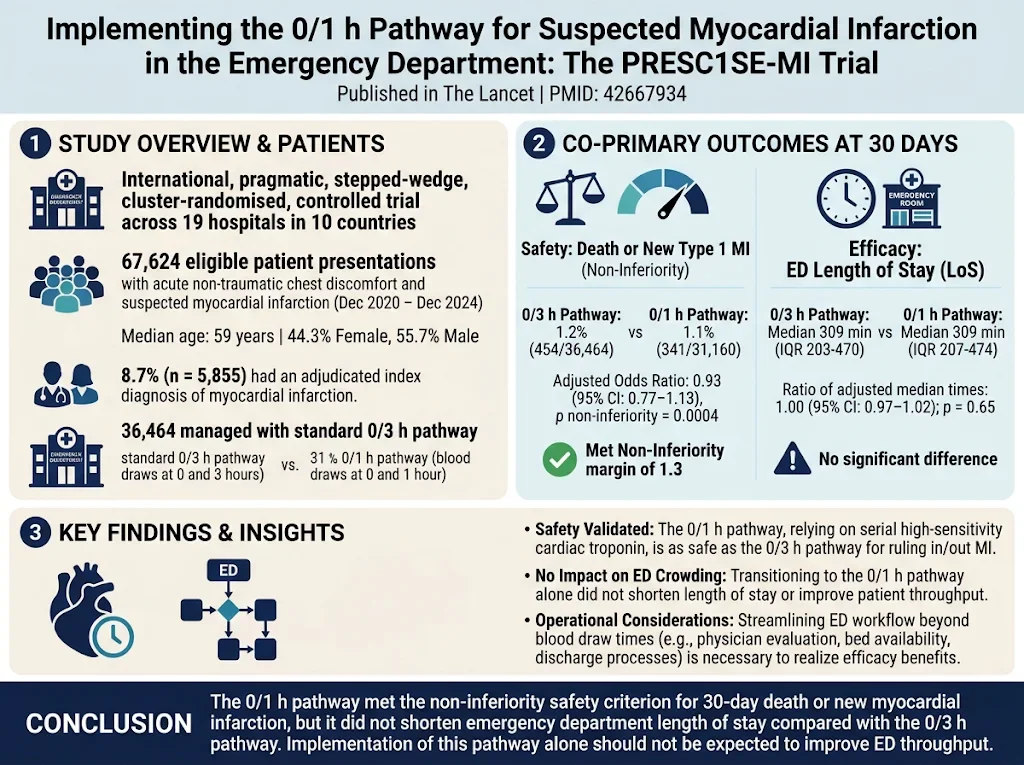
The PRESC1SE-MI trial was an international, pragmatic, stepped-wedge, cluster-randomized controlled study conducted across 19 hospitals in 10 countries from December 2020 to December 2024. The study enrolled consecutive adults presenting to emergency departments with acute, non-traumatic chest discomfort suspicious for myocardial infarction.
All participating sites initially used a standard 0/3-hour sampling protocol as routine care, involving hs-cTn measurements at presentation and 3 hours later. Hospitals were randomized to implement the 0/1-hour hs-cTn pathway—blood samples at 0 and 1 hour—either at 6 months (early implementation) or 12 months (late implementation) into the study period.
The trial’s coprimary endpoints were safety, defined as a composite of all-cause death or new type 1 myocardial infarction within 30 days, and efficacy, measured as emergency department length of stay (ED LOS). The non-inferiority margin for safety was set at an odds ratio of 1.3. Masked adjudication of outcomes was performed. The study included 67,624 eligible patient presentations, with baseline clinical and demographic characteristics well balanced between groups.
Key Findings
Regarding safety, 454 events (1.2%) of death or new type 1 MI occurred in the 0/3-hour group, versus 341 events (1.1%) in the 0/1-hour group. The adjusted odds ratio was 0.93 (95% confidence interval [CI], 0.77 to 1.13), meeting the prespecified criterion for non-inferiority (p=0.0004). This robust finding confirms that the accelerated 0/1-hour protocol does not increase the risk of adverse outcomes within 30 days.
In terms of emergency department throughput, the median ED length of stay was identical between groups: 309 minutes (IQR 203–470) for the 0/3-hour pathway and 309 minutes (IQR 207–474) for the 0/1-hour pathway. The ratio of adjusted median times was 1.00 (95% CI 0.97 to 1.02, p=0.65), indicating no statistically significant or clinically meaningful improvement in ED LOS with the faster sampling protocol.
Additional findings include patient demographics with a median age of 59 years and a balanced male-to-female ratio. Approximately 22% had known coronary artery disease, and 8.7% were ultimately adjudicated to have myocardial infarction, reflecting a representative ED chest pain cohort.
Expert Commentary
The PRESC1SE-MI trial provides high-quality evidence supporting the safety of the 0/1-hour hs-cTn diagnostic pathway in varied international healthcare settings. These results corroborate earlier single-center or observational studies showing rapid rule-out protocols do not compromise patient safety. However, the anticipated benefit of improved ED efficiency was not realized, possibly reflecting multifactorial determinants of patient flow beyond the speed of biomarker testing alone.
Operational factors such as bed availability, downstream testing, consultation delays, and institutional workflow may blunt the impact of early troponin measurement on length of stay. Thus, the 0/1-hour pathway should be integrated as part of broader ED optimization strategies rather than relied upon as a sole measure to reduce crowding.
Limitations include the pragmatic cluster-randomized design which may introduce heterogeneity in pathway adherence and local care processes. Nonetheless, the large sample size and international scope enhance generalizability.
Conclusion
Implementation of a 0/1-hour hs-cTn pathway is as safe as the traditional 0/3-hour serial sampling in the emergency assessment of patients with suspected myocardial infarction. However, this accelerated pathway does not shorten emergency department length of stay by itself. Healthcare systems considering adoption should anticipate that improvements in patient flow will require multifaceted interventions beyond mere biomarker timing adjustments.
Future research could explore combined diagnostic, clinical, and operational strategies to enhance ED efficiency while maintaining patient safety.
Funding and ClinicalTrials.gov
The PRESC1SE-MI trial was funded by the Swiss National Science Foundation, Swiss Heart Foundation, University Hospital Basel, University of Basel, Foundation for Cardiovascular Research Basel, Fondazione Ricerca Molinette, Idorsia, and Roche. The study is registered under ClinicalTrials.gov identifier NCT05649384 and is currently active but no longer enrolling.
References
1. Boeddinghaus J, Bima P, Crisanti L, et al. Safety and efficacy of the 0/1 h pathway for myocardial infarction in the emergency department: an international, pragmatic, stepped-wedge, cluster-randomised, controlled trial. Lancet. 2026;408(10567):1941-1952. doi:10.1016/S0140-6736(26)00567-X
2. Thygesen K, Alpert JS, Jaffe AS, et al. Fourth Universal Definition of Myocardial Infarction (2018). Circulation. 2018;138(20):e618-e651.
3. Kavsak PA, Worster A, Ko DT. Advances in high-sensitivity troponin assays and clinical decision-making pathways in myocardial infarction. J Am Coll Cardiol. 2021;77(14):1885-1897.