Highlight
This large Finnish registry study assessed the risks of recurrent intracranial bleeding, ischemic stroke, and mortality in atrial fibrillation (AF) patients with prior intracranial bleeding using direct oral anticoagulants (DOACs), warfarin, or no anticoagulation. Key findings include: 1) DOACs significantly reduce ischemic stroke and mortality risk without increasing intracranial bleeding risk; 2) Warfarin reduces stroke and death risk but increases intracranial bleeding risk; 3) Optimal warfarin management (high time in therapeutic range) is associated with better outcomes; 4) Anticoagulation decisions in this vulnerable group should be individualized given the competing risks and potential confounding.
Study Background
Atrial fibrillation (AF) is a common arrhythmia conferring a substantial risk of ischemic stroke that warrants oral anticoagulation to reduce embolic events. However, patients with prior intracranial bleeding represent a particularly challenging subgroup due to their elevated risk of recurrent hemorrhage if anticoagulated. Current guidelines recommend caution with anticoagulants in these individuals, leaving clinicians uncertain about optimal management strategies that balance stroke prevention against bleeding risk. Direct oral anticoagulants (DOACs) have demonstrated superior safety profiles compared with warfarin in general AF populations, but data are sparse for those with previous intracranial hemorrhage. This study addresses this critical evidence gap by assessing benefits and harms associated with different anticoagulant strategies in a nationwide cohort.
Study Design
This retrospective cohort study analyzed linked administrative health registries in Finland, selecting patients with first-ever atrial fibrillation diagnosed between 2010 and 2018 who had a history of intracranial bleeding at least 120 days before AF diagnosis. Follow-up began 90 days post-AF diagnosis to allow a washout period from acute events. The study categorized patients into three groups based on their oral anticoagulation (OAC) status: direct oral anticoagulants (DOACs), warfarin, or no anticoagulation, determined from pharmacy dispensing records.
Warfarin users were further stratified by time in therapeutic range (TTR), with ≥70% considered well-controlled. Inverse probability of treatment weighting (IPTW) was applied to balance baseline differences and confounders across groups. The primary outcomes were the competing risks of recurrent intracranial bleeding, ischemic stroke, and death from other causes. Analyses employed adjusted cumulative incidence functions and cause-specific Cox proportional hazards regression models.
Key Findings
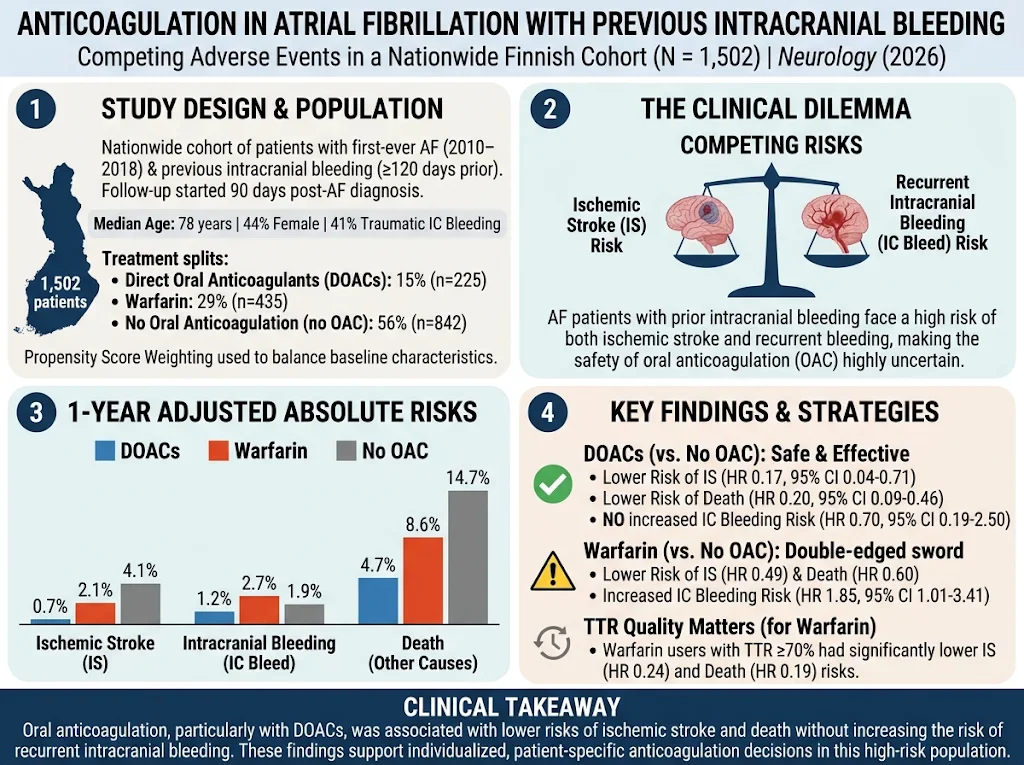
The cohort comprised 1,502 patients, median age 78 years, 44% female, and 41% with only traumatic intracranial bleeding. Distribution of treatment was 15% DOACs, 29% warfarin, and 56% no anticoagulation.
At 1-year adjusted absolute risks:
Ischemic stroke: 0.7% (DOAC), 2.1% (warfarin), 4.1% (no OAC)
Recurrent intracranial bleeding: 1.2% (DOAC), 2.7% (warfarin), 1.9% (no OAC)
Death from other causes: 4.7% (DOAC), 8.6% (warfarin), 14.7% (no OAC)
Hazard ratios (HRs) versus no anticoagulation (adjusted):
DOACs: Significantly reduced ischemic stroke risk (HR 0.17; 95% CI 0.04-0.71) and mortality (HR 0.20; 95% CI 0.09-0.46) without a statistically significant increase in intracranial bleeding risk (HR 0.70; 95% CI 0.19-2.50).
Warfarin: Lower risks of ischemic stroke (HR 0.49; 95% CI 0.26-0.93) and death (HR 0.60; 95% CI 0.44-0.80) but increased risk of intracranial bleeding (HR 1.85; 95% CI 1.01-3.41).
Within Warfarin users: Optimal TTR (≥70%) correlated with markedly lower stroke (HR 0.24; 95% CI 0.08-0.79) and mortality (HR 0.19; 95% CI 0.10-0.36) risks. Poorer or missing TTR attenuated these benefits.
These results underscore that among high bleeding-risk AF patients with prior intracranial hemorrhage, DOACs may offer a safer and more effective anticoagulation option than warfarin, which carries a trade-off with increased bleeding.
Expert Commentary
This study provides valuable real-world evidence in a difficult clinical scenario with limited randomized data. The use of nationwide health registries and IPTW enhances generalizability and addresses confounding, although residual bias remains possible due to the observational design. The findings concur with emerging literature favoring DOACs over warfarin in patients with bleeding risks, consistent with the broader evidence base from randomized controlled trials indicating DOACs’ superior safety and efficacy profiles.
Importantly, optimal warfarin management—as reflected by high TTR—mitigates some bleeding risk, highlighting the role of careful monitoring and dose adjustment where warfarin remains in use. Nonetheless, the increased intracranial bleeding risk with warfarin supports preferential DOAC use when feasible.
Limitations include lack of granular data on bleeding severity, cerebral amyloid angiopathy presence, and details on intracranial lesion location or size, which may affect bleeding risk. The study’s external validity is strongest for European and similar healthcare settings and may differ in populations with varying genetics or healthcare access.
Conclusion
In patients with atrial fibrillation and prior intracranial bleeding, oral anticoagulation with DOACs is associated with reduced ischemic stroke and mortality without a significant increase in intracranial bleeding risk, contrasting with warfarin’s increased bleeding hazard. These findings support individualized anticoagulation decisions prioritizing DOACs where appropriate, and meticulous warfarin management when used. Further prospective studies are warranted to refine risk stratification and optimize therapeutic strategies in this vulnerable population.
Reference
Tiili P, Lehto M, Halminen O, Lehtonen O, Haukka J, Linna M, Satopää J, Korja M, Niemelä M, Kinnunen J, Aro A, Mustonen P, Hartikainen JEK, Airaksinen JKE, Putaala J. Anticoagulation in Atrial Fibrillation With Previous Intracranial Bleeding: Competing Adverse Events in a Nationwide Cohort. Neurology. 2026 Nov 24;107(10):e218719. doi: 10.1212/WNL.0000000000218719. Epub 2026 Oct 21. PMID: 42906071.