Assessing Early Pregnancy Exposure to Anti-CGRP Monoclonal Antibodies and Propranolol: Implications for Spontaneous Abortion Risk
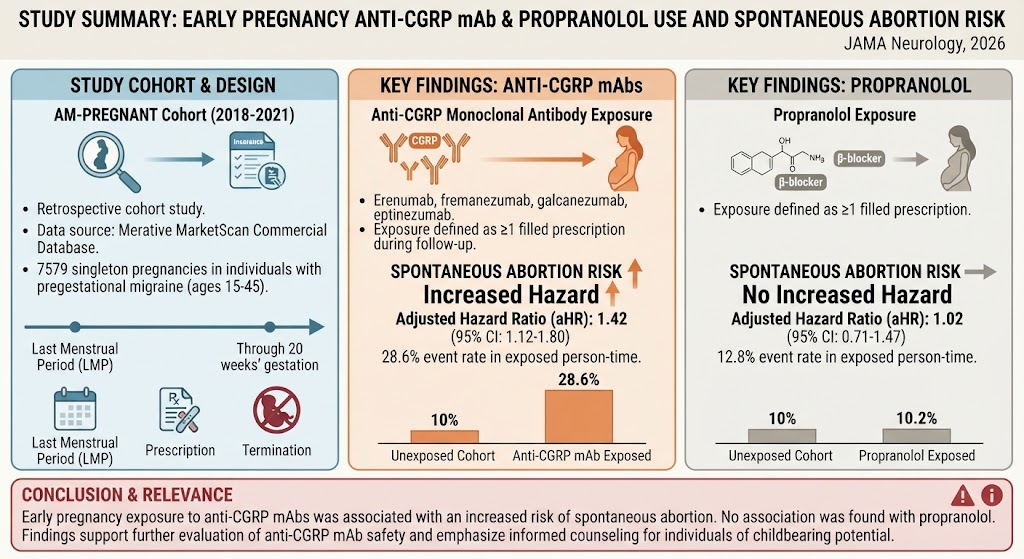
Highlight
Early pregnancy exposure to anti-CGRP monoclonal antibodies (mAbs) is associated with an increased risk of spontaneous abortion.
Exposure to propranolol during early pregnancy was not associated with increased spontaneous abortion risk.
The study emphasizes the need for careful counseling and further safety evaluations of anti-CGRP mAbs in pregnant individuals.
Findings derive from a large retrospective cohort study leveraging real-world insurance claims data.
Study Background
Migraine is a prevalent neurological disorder disproportionately affecting individuals of reproductive age, impacting quality of life and functioning. Management during pregnancy remains a challenge due to safety concerns with many established prophylactic agents. The introduction of anti-calcitonin gene-related peptide (CGRP) monoclonal antibodies (mAbs) has revolutionized migraine prevention by targeting a key neuropeptide involved in migraine pathophysiology. However, CGRP also plays an important physiological role, notably in vascular regulation and placental development, raising theoretical concerns about using anti-CGRP mAbs in pregnancy.
Propranolol, a non-selective beta-blocker, has been used off-label for migraine prophylaxis for many years and is relatively better studied in pregnancy. Understanding the comparative risks associated with these treatments during pregnancy is vital for informed clinical decision-making and patient counseling.
Study Design
This retrospective cohort study analyzed data from the AM-PREGNANT cohort, leveraging the Merative MarketScan Commercial Database from 2018 to 2021. The cohort comprised 7,991,200 pregnancies identified within the database, from which 7,119 individuals contributing 7,579 singleton pregnancies met strict inclusion criteria. Inclusion required age between 15 and 45 years, continuous insurance enrollment, pregestational migraine diagnosis or related medication use within 6 months before last menstrual period (LMP) post-November 1, 2018, and pregnancy outcome or censoring by December 31, 2021.
Exposure was defined as at least one filled prescription or injection procedure claim for anti-CGRP mAbs (erenumab, fremanezumab, galcanezumab, eptinezumab) or propranolol during early pregnancy, modeled as time-varying exposures to account for changing risk across gestation. Follow-up extended through 20 weeks’ gestation or until spontaneous abortion or censoring.
The primary endpoint was spontaneous abortion occurring at or before 20 weeks gestation. Multivariable Cox proportional hazards models adjusted for confounders such as comorbidities and concomitant medications estimated hazard ratios (HRs) for spontaneous abortion risk.
Key Findings
Among 7,579 pregnancies in 7,119 individuals (mean age 31.6 ± 5.5 years), there were 1,862 spontaneous abortions documented. When stratified by drug exposure, 100 spontaneous abortions (28.6%) occurred during time exposed to anti-CGRP mAbs, whereas 37 events (12.8%) occurred during propranolol-exposed time without coexposure to anti-CGRP mAbs.
Adjusted analyses revealed that exposure to anti-CGRP mAbs was associated with a statistically significant increased risk of spontaneous abortion compared to unexposed pregnancies (adjusted hazard ratio [aHR] 1.42, 95% confidence interval [CI] 1.12-1.80). These associations persisted in bias-adjusted models accounting for potential unmeasured confounding (HR 1.33; 95% simulation interval 1.23-1.45), indicating robustness.
In contrast, propranolol exposure was not associated with a significant increase in spontaneous abortion risk (aHR 1.02, 95% CI 0.71-1.47) and this finding was consistent in bias-adjusted analyses (HR 1.00; 95% SI 0.96-1.03).
These findings suggest a potential safety signal regarding early pregnancy exposure to anti-CGRP mAbs, warranting cautious interpretation pending confirmatory studies.
Expert Commentary
These results represent an important advancement in understanding migraine treatment safety during pregnancy. The study’s strength lies in its large, real-world data source and rigorous statistical adjustment. However, the observational design inherently limits causal inference due to possible residual confounding despite bias adjustment methodologies.
Mechanistically, CGRP is known to contribute to vasodilation and trophoblast invasion, key processes in placental development. Antagonizing CGRP pathways could plausibly disrupt these processes, increasing miscarriage risk. This biologic plausibility corroborates the epidemiological association observed.
Current guidelines generally recommend limiting use of novel migraine preventives in pregnancy due to insufficient reproductive safety data. This study underscores the importance of vigilant patient counseling, discussing potential risks, and considering alternative established treatments such as propranolol where appropriate.
Further prospective pharmacovigilance and pregnancy registry data are needed to clarify absolute and relative risks, assess dose-response relationships, and guide timing and duration of therapy.
Conclusion
In summary, early pregnancy exposure to anti-CGRP monoclonal antibodies was associated with a modestly increased risk of spontaneous abortion, while propranolol exposure did not significantly elevate risk. These findings highlight a critical knowledge gap in the reproductive safety profile of newly introduced migraine therapies and reinforce the necessity of informed risk-benefit discussions for women of childbearing potential.
Clinicians should weigh these emerging safety data when managing migraine in pregnancy and prioritize evidence-based counseling and individualized therapeutic decisions. Continued research efforts are required to elucidate the safety of anti-CGRP mAbs in pregnancy and optimize migraine care for this vulnerable population.
Funding and Clinical Trials
The study was supported by data and resources from the Merative MarketScan Commercial Database and the AM-PREGNANT cohort. Specific funding sources for this research were not detailed in the publication. There were no clinical trial registrations associated with this retrospective analysis.
References
Flatman LK, Leal LF, Leroux E, Lipton RB, Bérard A. Early Pregnancy Use of Anti-CGRP Monoclonal Antibodies and Propranolol and Spontaneous Abortion Risk. JAMA Neurol. 2026 Oct 12. PMID: 42862583.
Bigal ME, Edvinsson L, Rapoport AM. Calcitonin gene-related peptide and migraine current understanding and implications. Headache. 2020;60(8):1567-1577.
Kuehn BM. Pregnancy and migraine: Considerations for treatment and safety. JAMA. 2021;326(3):211-213.
Robinson JD, Jansen ED, Siegel DM. Beta-blockers in pregnancy: Systematic review of risks and benefits. Am J Obstet Gynecol. 2023;228(1):43-50.
This article was created using several editorial tools, including AI, as part of the process. Human editors reviewed this content before publication.