Highlights
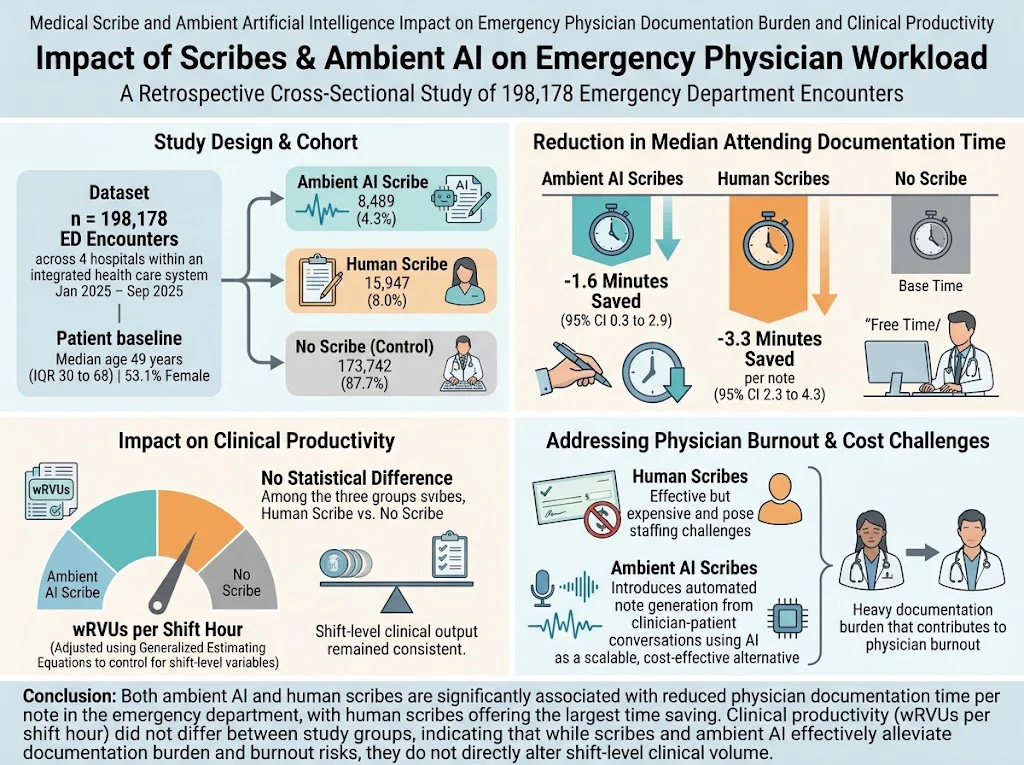
Both ambient AI and human scribes significantly reduce emergency physicians’ documentation time, with human scribes yielding a greater reduction.
Clinical productivity, measured by work relative value units (wRVUs) per hour, remains unchanged regardless of scribe use.
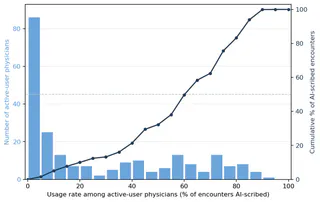
Ambient AI scribe adoption is higher in lower acuity and telemedicine settings, with more frequent use among trainees compared to attending physicians.
Future studies are essential to evaluate long-term productivity gains, workflow integration, and impacts on physician burnout.
Background
The documentation burden on emergency physicians is a well-recognized contributor to physician burnout and decreased job satisfaction. Traditionally, human medical scribes have been employed to mitigate this workload by documenting clinical encounters in real time, though their high costs and staffing challenges limit scalability. Emergent ambient artificial intelligence (AI) scribes, which automatically generate clinical notes from clinician-patient conversations using natural language processing and generative AI, offer a promising alternative. Understanding how these modalities affect documentation efficiency and clinical productivity in real-world emergency department (ED) settings is critical to inform workflows and technology adoption.
Key Content
Chronological Development of Evidence
The earliest real-world data on ambient AI scribes in EDs reported by White et al. (2025) demonstrated selective adoption across physicians, zones, and patient acuity. This retrospective observational study of 8,740 encounters showed 11.2% utilization, favoring lower-acuity, telemedicine, and noninterpreter cases. Notably, median on-shift documentation time decreased by approximately 1 minute (28% reduction), and total electronic health record (EHR) time decreased by 16%, with shorter note length for AI-assisted encounters (PMID: 41665590).
Subsequently, Guan-Ting You et al. (2026) performed a single-arm observational study introducing an AI-scribe platform to ED physicians and trainees over five weeks. Uptake was higher among trainees (48%) compared to consultants (22.5%). The AI-scribe produced extensive automated notes that required clinician review and editing with an average net documentation time savings of 4.9 to 7.1 hours depending on typing speed. The most revised note sections were the history of presenting illness and management plan, underscoring areas where contextual accuracy remains a challenge (PMID: 42087797).
The most comprehensive comparative study by Dutta et al. (2026) retrospectively analyzed nearly 200,000 ED encounters across four hospitals, categorizing encounters as ambient AI scribe, human scribe, or no scribe. After risk adjustment, ambient AI scribes reduced documentation time by 1.6 minutes per note, whereas human scribes reduced it by 3.3 minutes compared with no scribe use. Crucially, clinical productivity assessed by wRVUs per shift hour was statistically similar across groups, indicating no tradeoff in clinical throughput (PMID: 42283666).
Evidence by Intervention Class
Human Medical Scribes: Consistently shown to reduce physician documentation burden effectively. Their presence allows physicians to focus more on direct patient care; however, cost, training, and scheduling remain barriers to universal implementation.
Ambient AI Scribes: Employ AI and natural language processing to automatically generate draft clinical notes from conversations, minimizing manual data entry. Current platforms demonstrate modest but significant documentation time savings. The necessity of clinician review and editing highlights limitations in contextual understanding and accuracy.
Integration and Physician Adoption
Physician adoption of ambient AI scribes remains variable and tends to cluster among high-frequency users, less complex cases, and settings such as telemedicine or ambulatory zones rather than high-acuity areas. Trainees appear more willing to incorporate AI scribes into practice than attending physicians. Notably, AI-scribed notes require clinician verification, with the history and management plan most frequently edited, indicating current AI limitations in clinical reasoning and accuracy.
Clinical Productivity and Workflow Impact
Despite reductions in documentation time, overall clinical productivity as measured by wRVUs per hour remains consistent across AI scribe, human scribe, and no scribe groups. This suggests that noted time savings primarily relieve physician administrative load without necessarily increasing patient throughput. The implications for physician burnout mitigation and cognitive workload reduction warrant further longitudinal studies.
Expert Commentary
The data collectively establish that ambient AI scribes provide a tangible reduction in physician documentation burden, albeit not equal to that achieved by human scribes. While the reduction of approximately 1.6 minutes per note may appear modest, cumulative time savings across multiple encounters could meaningfully improve physician work-life balance. Moreover, AI scribes circumvent human scribe limitations related to cost, variability, and staffing. However, AI notes often require substantial clinician editing, particularly in complex or nuanced clinical scenarios, reflecting current natural language understanding boundaries.
Adoption bias towards lower acuity and noninterpreted encounters suggests physicians’ trust in ambient AI scribes is context-dependent. Validation in more diverse and challenging clinical contexts is required. Additionally, current evidence demonstrates no enhancement in direct clinical productivity metrics, underscoring that AI scribes function primarily to alleviate documentation burden, not increase patient throughput.
From a translational standpoint, integration of ambient AI scribes into electronic health record systems and workflow processes is imperative to optimize use and acceptance. Advances in AI accuracy, context comprehension, and natural dialog processing will be crucial to extend utility. Furthermore, research should focus on measuring downstream effects on physician cognitive load, burnout prevalence, and patient outcomes.
Limitations across studies include observational designs with potential confounding, modest adoption rates, and short study durations. The retrospective analyses rely on surrogate metrics (documentation time, wRVUs) without direct assessment of note quality or error rates, which are essential for clinical safety evaluations.
Conclusion
Recent evidence robustly indicates that both human medical scribes and ambient AI scribes significantly reduce emergency physician documentation time. While human scribes confer a larger reduction, AI scribes offer scalable, technology-based alternatives with promising efficiency benefits. Clinical productivity remains stable irrespective of scribe use, emphasizing documentation burden alleviation rather than throughput enhancement. Physician adoption of AI scribes favors less complex settings, highlighting the need for ongoing improvement in AI note accuracy and contextual understanding. Future research priorities include long-term outcomes, workflow integration, cost-benefit analyses, and effects on physician well-being and patient care quality.
References
Dutta S, You JG-T, Dunham L, et al. Medical Scribe and Ambient Artificial Intelligence Impact on Emergency Physician Documentation Burden and Clinical Productivity. Ann Emerg Med. 2026;88(5):570–576. doi:10.1016/j.annemergmed.2026.04.022. PMID: 42283666.
You JG-T, Dunham L, Meeker M, et al. Evaluation of an AI Scribe Tool in the Emergency Department: A Single-Arm Observational Study. Emerg Med Australas. 2026;38(3):e70272. doi:10.1111/1742-6723.70272. PMID: 42087797.
White BA, Joseph JW, Cash R, et al. Ambient Artificial Intelligence Scribe Adoption and Documentation Time in the Emergency Department. Ann Emerg Med. 2026;87(5):569–574. doi:10.1016/j.annemergmed.2025.12.017. PMID: 41665590.