Introduction and Context
Acute brain injury (ABI) — a group that includes traumatic brain injury, large ischemic stroke, intracerebral hemorrhage and other catastrophic neurologic insults — frequently leads to respiratory failure and the need for invasive mechanical ventilation. Decisions about when and how to attempt liberation from mechanical ventilation are central to neurocritical care, but the literature addressing the optimal strategies is fragmented. Trials of weaning and extubation protocols in neurocritical care have used diverse outcomes and inconsistent endpoint definitions, making trial results hard to compare or pool. Against that background, Fong and colleagues convened an international, multidisciplinary consensus process to define a Core Outcome Set (COS) and a hierarchical composite endpoint specifically for ventilation trials in critically ill adults with acute brain injury (Intensive Care Medicine, 2026). The resulting COS is the first field-specific consensus aimed at harmonizing outcome selection and reporting in this area.
Why this consensus matters now
– Outcome heterogeneity limits meta-analysis, slows evidence-based practice change, and hampers guideline development.
– Neurocritical care patients are heterogeneous: neurologic state affects respiratory drive, airway protection, and risk of re-intubation, so general ICU outcome sets may miss neurologic priorities.
– Increasing trial activity in ventilator liberation approaches for ABI (different sedation strategies, extubation criteria, early tracheostomy approaches, targeted respiratory protocols) makes a standardized outcome framework timely.
How the consensus was developed
Fong et al. followed recognized standards for core outcome set development (the study reports adherence to COS-STAD and COS-STAP principles and was registered with the COMET Initiative, registration #2320). Key elements of the methodology:
– Scoping review of existing ventilation and neurocritical-care trials to assemble candidate outcomes.
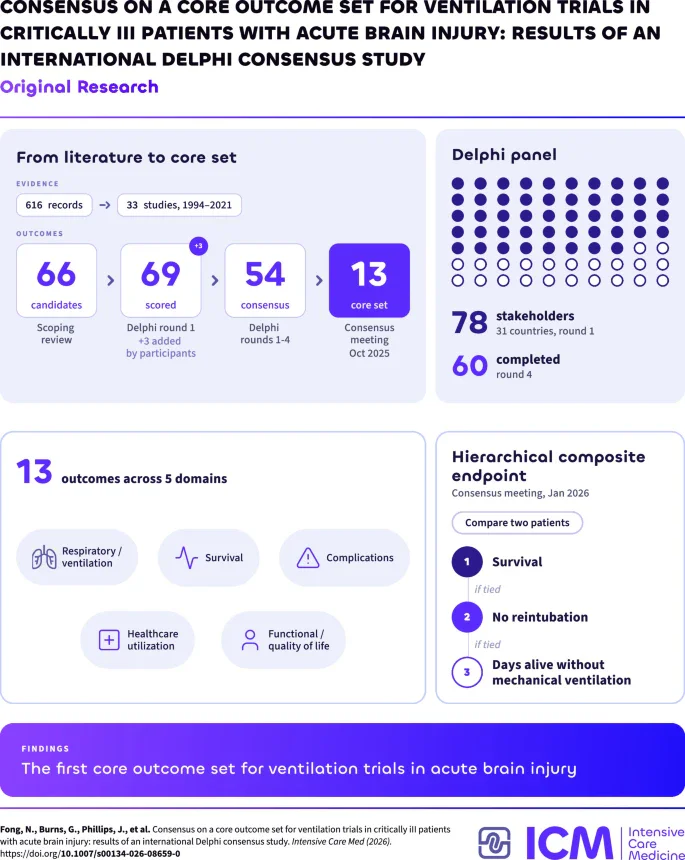
– A 4-round international Delphi survey involving stakeholders from 31 countries: critical care physicians, neurointensivists, neurologists, neurosurgeons, respiratory therapists, trialists, methodologists, and patient/public representatives.
– Delphi scoring used a 9-point GRADE-style scale: scores 7–9 = “critical”, 4–6 = “important but not critical”, 1–3 = “not important.” Inclusion criterion was >70% rating an outcome as critical and ≤15% rating it not important.
– Two consensus meetings refined categories, selected representative measures, and ratified a hierarchical composite endpoint.
– Attrition was moderate: 78 participants started and 60 completed all rounds (23.1% attrition).
Methodological anchors and credibility
– The initiative adhered to COMET and COS development best-practice (Williamson et al., COMET Handbook) and to COS-STAD recommendations for transparency and stakeholder representation (Kirkham et al., PLoS Med 2017).
– Use of a 4-round Delphi plus consensus meetings is a widely accepted approach for COS definition in clinical research.
New Guideline Highlights (Top-line outcomes and recommendations)
Major consensus outputs reported by the authors:
– A Core Outcome Set (COS) for ventilation liberation trials in adults with ABI comprising 13 outcomes organized across five domains: respiratory function, survival, complications, functional status, and quality of life.
– A 3-level hierarchical composite endpoint intended for primary endpoint use in randomized trials of ventilation liberation strategies in ABI patients:
1) Intensive care unit survival,
2) No reintubation within 72 hours after extubation,
3) Days alive without mechanical ventilation.
– The study documents 54 outcomes that reached Delphi consensus before being distilled into category representatives; three candidate outcomes were explicitly not ratified for the final set because they lacked general applicability (NIH Stroke Scale — disease-specific; brain death — variable legal/clinical definitions; coma-free days — did not achieve universal applicability).
Key takeaways for clinicians and trialists
– Use the COS as minimum reporting requirements for ventilation liberation trials in ABI to improve comparability.
– Consider adopting the 3-level hierarchical composite endpoint as the primary outcome in randomized trials when appropriate; it combines survival, short-term extubation success, and ventilator burden in a prespecified order.
– Pre-specify measurement instruments and timepoints for each COS outcome in trial protocols (the consensus process selected representative measures where possible; future work should formalize standard instruments/timepoints).
Updated Recommendations and Key Changes from Prior Practice
There is no prior, internationally endorsed COS specifically for ventilation trials in acute brain injury. The principal advances of this consensus are:
– Focused, neurocritical-care–specific outcome recommendations rather than borrowing general critical care outcome sets.
– Introduction of a pragmatic 3-level hierarchical composite endpoint that balances mortality, immediate extubation success, and ventilator-free time—a structure designed to be robust to competing risks (death vs ventilator duration) and to reflect clinical priorities in ABI.
– Explicit rejection of some previously used but disease-limited or non-generalizable outcomes (e.g., NIH Stroke Scale, brain death) for a generic ABI ventilation COS.
Why those changes matter
– Prior trials frequently reported ventilator duration, reintubation rates, pneumonia, ICU length of stay and mortality but with variable definitions (start/stop times, thresholds for reintubation, diagnostic criteria for pneumonia). The new COS pushes trials toward harmonized outcome constructs and, where possible, common definitions.
Topic-by-Topic Recommendations
Below we summarize the practical recommendations emerging from the consensus relevant to trialists, with pragmatic notes for clinicians who interpret or design trials.
1) Primary endpoint recommendation
– Consider the 3-level hierarchical composite endpoint as primary: (1) ICU survival, (2) no reintubation within 72 hours, (3) days alive without mechanical ventilation.
– Rationale: Prioritizes survival, then immediate extubation success (early reintubation is a key adverse outcome), then quantifies ventilator burden among survivors.
– Implementation note: Trials must prespecify how to handle competing events (e.g., death before extubation) and analytic approach for hierarchical endpoints (e.g., win ratio or other rank-based methods).
2) Core outcomes to report (COS backbone)
– The final COS comprises 13 outcomes across five domains: respiratory function, survival, complications, functional status, and quality of life. The consensus paper distilled many candidate outcomes to representative, cross-cutting measures that are applicable across ABI etiologies.
– Recommended reporting: All trials should report these 13 outcomes (the COS as a minimum). Investigators remain free to include additional, disease-specific endpoints as secondary outcomes.
3) Respiratory function domain
– Emphasis on standardized reporting of extubation success and reintubation within a prespecified window (72 hours was selected for the composite endpoint).
– Ventilator-free days / days alive without mechanical ventilation recommended as a patient-centered metric capturing ventilator burden.
4) Survival domain
– ICU survival is prioritized within the hierarchy and should always be reported; 28- and 90-day survival remain important secondary timepoints for longer-term perspective.
5) Complications domain
– Major ICU complications relevant to ventilation (e.g., ventilator-associated pneumonia, unplanned tracheostomy, airway trauma, aspiration events) should be reported using standardized definitions.
6) Functional status and quality-of-life domains
– Functional recovery and health-related quality of life are essential: trials should report validated, generic or neurological outcome scales at pre-specified timepoints (e.g., 90 days) to capture patient-centered outcomes beyond the ICU.
7) Measurement timing and instruments
– The authors selected representative measures where possible and stressed the need to pre-specify instruments and timepoints in protocols. While the consensus provides the outcome domains, harmonizing exact instruments and follow-up intervals (e.g., 28 days/90 days) is a next step for the field.
8) Exclusions and non-recommended outcomes
– The consensus explicitly did not retain NIH Stroke Scale (too disease-specific for a cross-ABI COS), brain death (variable between systems), and coma-free days (limited universal applicability) as core outcomes.
Expert Commentary and Insights
What the panel said
– The multidisciplinary panel emphasized usability: the COS should be practical, feasible to collect in multicenter trials, and relevant across ABI etiologies.
– There was strong endorsement for prioritizing survival and early extubation success—the two outcomes clinicians and families often consider most meaningful in the immediate ICU phase.
Points of controversy and limits acknowledged by the authors
– Choice of time windows (e.g., 72-hour reintubation threshold) and selection of measurement instruments require careful local validation and may be contested in specific subgroups.
– Some stakeholders argued for inclusion of disease-specific neurologic scales for stroke or TBI; the steering committee responded that disease-level endpoints are appropriate as secondary outcomes but would reduce the generalizability of a single COS for all ABI trials.
– The consensus defines what to measure, not how best to analyze complex hierarchical endpoints; statistical methodology for these endpoints is evolving and trials will need clear prespecified analytic plans.
Future research needs identified by the panel
– Harmonization of measurement instruments and timepoints for each COS item (e.g., which functional scale at 90 days).
– Validation of the hierarchical composite endpoint in prospective datasets and trials, including statistical performance (power, interpretability) compared with single-component endpoints.
– Engagement with regulators and funding bodies to encourage COS adoption in trial funding and registration requirements.
Practical Implications for Clinicians, Trialists, and Research Funders
For clinicians who read trial reports
– Expect improving consistency in outcome reporting over time if this COS is adopted. When reading trials, check whether the COS outcomes and the hierarchical composite were reported; absence should prompt caution when comparing results across studies.
For trialists and trial designers
– Adopt the COS as a minimum outcome set in all ventilation liberation trials in adults with ABI. Prespecify instruments/timepoints, define event windows (e.g., reintubation within 72 hours), and include a clear statistical analysis plan for hierarchical endpoints.
– Consider including disease-specific neurological outcomes as secondary endpoints where relevant.
For research funders and journals
– Funders and journals can accelerate harmonization by encouraging or requiring COS adherence in funding calls and trial reporting guidance. Registration of trial outcomes on registries like ClinicalTrials.gov could reference the ABI ventilation COS.
A brief vignette to illustrate application
John is a 58-year-old man admitted with severe traumatic brain injury who receives mechanical ventilation. A randomized trial of a new extubation protocol uses the ABI ventilation COS as its minimum reporting set and adopts the 3-level hierarchical composite as the primary endpoint. The trial reports ICU survival (level 1), reintubation within 72 hours (level 2), and days alive without mechanical ventilation to 28 days (level 3), alongside 90-day functional status and health-related quality of life. Because outcomes are standardized, clinicians and guideline developers can more confidently compare results with other ABI extubation trials.
References
1) Fong N, Burns G, Phillips J, Digitale J, Ghasemian A, Cinotti R, Bösel J, Robba C, Stevens RD, Pirracchio R. Consensus on a core outcome set for ventilation trials in critically ill patients with acute brain injury: results of an international Delphi consensus study. Intensive Care Med. 2026 Nov 5. PMID: 42986439. https://pubmed.ncbi.nlm.nih.gov/42986439/
2) Williamson PR, Altman DG, Blazeby JM, Clarke M, Devane D, Gargon E, Tugwell P. The COMET Handbook: version 1.0. Trials. 2017;18(Suppl 3):280. doi:10.1186/s13063-017-1978-4.
3) Kirkham JJ, Gorst S, Altman DG, Blazeby JM, Clarke M, Devane D, Gargon E, Williamson PR. Core Outcome Set–STAndards for Development: The COS-STAD recommendations. PLoS Med. 2017 Nov 28;14(11):e1002447. doi:10.1371/journal.pmed.1002447.
4) Guyatt GH, Oxman AD, Vist GE, Kunz R, Falck-Ytter Y, Alonso-Coello P, Schünemann HJ; GRADE Working Group. GRADE: an emerging consensus on rating quality of evidence and strength of recommendations. BMJ. 2008 Apr 26;336(7650):924-926.
5) Brain Trauma Foundation; Carney N, Totten AM, O’Reilly C, et al. Guidelines for the Management of Severe Traumatic Brain Injury, Fourth Edition. Neurosurgery. 2017;80(1):6-15.
6) Boles JM, Bion J, Connors A, et al. Weaning from mechanical ventilation. Eur Respir J. 2007;29(5):1033-1056.
Closing
The COS and hierarchical composite endpoint defined by this international Delphi provide a practical and widely supported platform for standardizing outcome measurement in ventilation liberation trials for adults with acute brain injury. Their broad adoption should enhance trial comparability, strengthen meta-analyses, and help translate trial findings into clearer clinical guidance for a vulnerable patient population. Moving forward, defining the exact instruments and follow-up intervals for each core outcome and validating the composite endpoint analytically are the highest priorities to make the new standard fully operational.