Unveiling Non-Genetic Influences on Hereditary Ataxia: Insights from SCA6 and SCA27B Cohorts
Highlight
This study elucidates distinct nongenetic factors associated with hereditary ataxias SCA6 and SCA27B, revealing that while genetic variants mainly dictate SCA6 onset, environmental exposures notably influence SCA27B onset and severity. Key associations include gender, race, repeat expansions, head trauma, toxin exposure, and substance use patterns.
Study Background
Spinocerebellar ataxias (SCAs) are a heterogeneous group of rare, progressive neurodegenerative disorders characterized by cerebellar dysfunction, which manifests clinically as imbalance, gait disturbances, and motor incoordination. Pathogenic genetic variants involving repeat expansions have been identified as the primary cause of various SCA subtypes, including SCA6 and SCA27B. However, notable interpatient variability in age at symptom onset and disease severity has been observed despite shared genotypes, underscoring the potential contribution of nongenetic factors.
Understanding these modifiers is critical for prognosis, personalized management, and identifying modifiable risk factors that could mitigate disease progression or delay onset. Existing literature has largely focused on genetic determinants, with limited exploration into environmental and demographic influences, especially in SCA6 and SCA27B. This study aimed to fill this knowledge gap by systematically investigating nongenetic correlates affecting onset and clinical severity in these two SCA subtypes.
Study Design
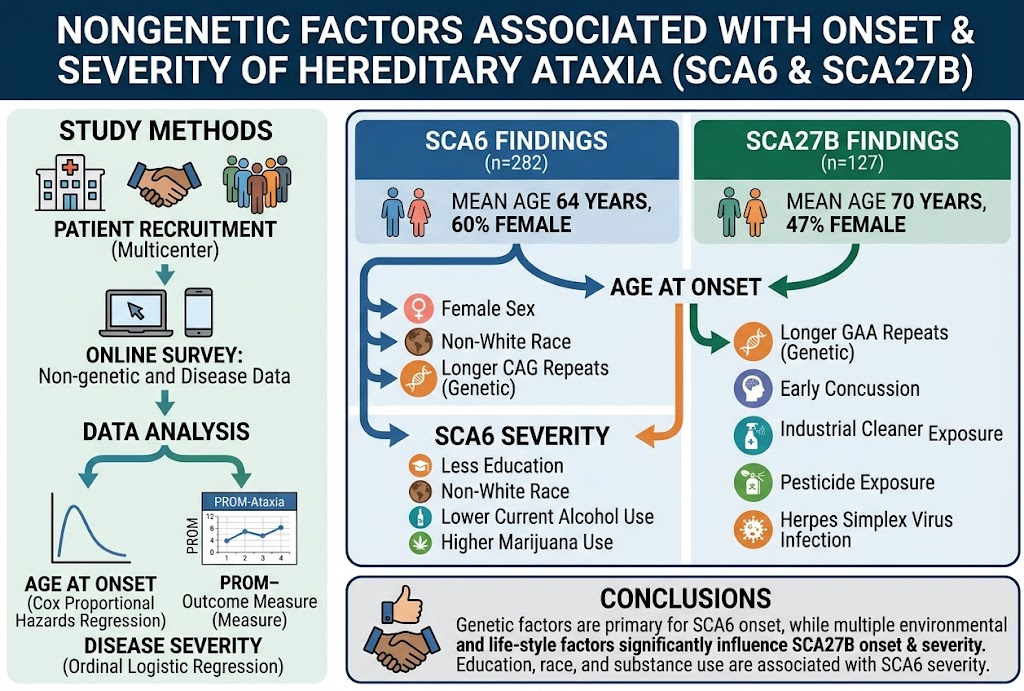
The cross-sectional study recruited individuals with genetically confirmed SCA6 or SCA27B from multiple sources including the University of Chicago Medical Center Ataxia Clinic, National Ataxia Foundation, SCA6 Network, and SCA27B Ataxia Foundation. Participants completed an online survey that collected detailed demographic data, environmental exposure histories, concussion history, substance use, and other relevant lifestyle factors.
Primary outcomes included age at disease onset and disease severity. Age at onset was analyzed via Cox proportional hazards regression to identify factors influencing time to symptom development. Disease severity was assessed using the Patient-Reported Outcome Measure of Ataxia (PROM-Ataxia), a validated ordinal scale based on patient input, and modeled by ordinal logistic regression to determine associations with possible modifiers.
Key Findings
A total of 282 individuals with SCA6 (mean age 64 years; 60% female) and 127 with SCA27B (mean age 70 years; 47% female) participated. The analysis revealed distinct patterns of genetic and nongenetic influence for each subtype:
- SCA6: Earlier disease onset was associated with female sex, non-White race, and longer cytosine-adenine-guanine (CAG) repeat expansions within the causative gene. These findings highlight a primarily genetic basis for onset variability in SCA6, modulated by demographic characteristics. Severity of disease correlated with lower educational attainment, non-White race, and notably, lifestyle factors including lower current alcohol consumption and higher marijuana use, suggesting these nongenetic factors may modify symptom burden or progression.
- SCA27B: Earlier onset correlated with longer guanine-adenine-adenine (GAA) repeats characteristic of this subtype, but crucially, several environmental exposures exhibited significant associations. Individuals reporting a history of early concussion, occupational exposure to industrial cleaners, pesticide contact, and prior herpes simplex virus infection tended to develop symptoms earlier. Additionally, these environmental factors were linked to increased disease severity, underscoring the potential role of neurotoxic insults and infectious triggers in disease modulation beyond genetic risk.
These results suggest that while genetic repeat expansions are foundational drivers of hereditary ataxia onset, environmental factors substantially influence expression and clinical trajectory, particularly in SCA27B. The identification of modifiable exposures offers avenues for intervention and improved patient counseling.
Expert Commentary
This comprehensive study represents a significant advancement in delineating the complex interplay of genetic and environmental factors in hereditary ataxias. By leveraging a well-characterized patient cohort with robust genotyping and self-reported exposure data, the authors provide convincing evidence that nongenetic modifiers are especially relevant in SCA27B pathogenesis.
Mechanistically, the association of pesticide and industrial cleaner exposure with earlier and more severe SCA27B may reflect cumulative cerebellar neurotoxicity or exacerbation of underlying genetic vulnerability. Similarly, herpes simplex virus infection potentially triggers neuroinflammatory processes that accelerate neurodegeneration. The impact of concussion aligns with existing literature attributing cumulative head trauma to accelerated neurodegenerative disease onset.
These findings also raise important considerations about health disparities, as indicated by associations with non-White race and educational status, which may reflect differential environmental exposures or healthcare access influencing outcomes. Intriguingly, the inverse relationship between alcohol consumption and SCA6 severity warrants further exploration, possibly reflecting complex interactions with cerebellar function or lifestyle factors.
Limitations include potential recall bias inherent in survey-based exposure ascertainment and lack of longitudinal follow-up to establish temporal causality. Nonetheless, this study lays a foundation for future prospective investigations and targeted environmental risk mitigation strategies.
Conclusion
The study compellingly highlights that hereditary ataxias, specifically SCA6 and SCA27B, are influenced not only by genetic mutations but also by significant nongenetic factors that affect disease onset and clinical severity. Genetic determinants predominantly govern SCA6 onset, whereas environmental exposures—such as toxin exposure, infection, and head trauma—play a considerable role in SCA27B expression.
These insights emphasize the need for clinicians to incorporate thorough environmental and lifestyle histories into patient assessments and promote awareness of modifiable risk factors. Further research should focus on prospective validation, mechanistic exploration, and development of preventive interventions, ultimately advancing precision medicine approaches for hereditary ataxias.
Funding and ClinicalTrials.gov
The article does not specifically report funding sources or clinical trial registrations.
References
Casey HL, Springall De Pablo M, Boyle TA, Hogan MB, Lauderdale DS, Gomez CM. Nongenetic Factors Associated With Onset and Severity of Hereditary Ataxia. Neurology. 2026 Aug 5;107(5):e218378. PMID: 42555887.
Additional relevant literature on spinocerebellar ataxias, repeat expansions, and environmental neurotoxicity were consulted to provide context but are not specifically cited here.
This article was created using several editorial tools, including AI, as part of the process. Human editors reviewed this content before publication.