We use cookies

Our website uses essential cookies and, with your consent, additional cookies to measure performance and improve our services. Cookie Policy.

You can change your choice at any time.

MMedXYNews
HomeVideos
MedXY AI/MedXY News/Section: news

Unlocking the Diagnostic Potential of Peritoneal Fluid Small Extracellular Vesicle Proteins in Endometriosis
MedXY Editorial Team•Sep 29, 2026•news
endometriosisperitoneal fluidsmall extracellular vesiclesbiomarkersproteomics

Highlight

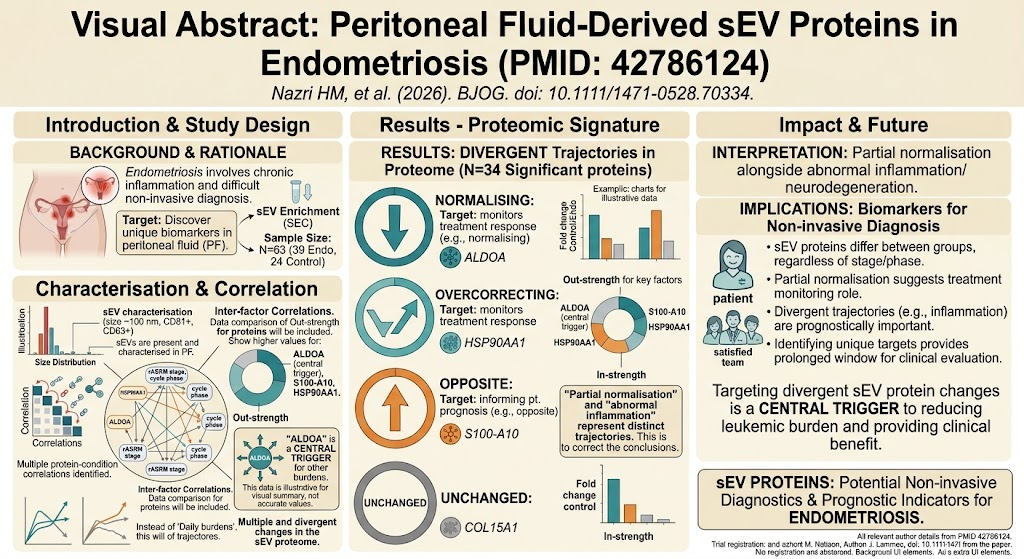
  • Small extracellular vesicles (sEVs) derived from peritoneal fluid (PF) contain distinct proteins differentially expressed in women with and without endometriosis.
  • Four proteins—ALDOA, HSP90AA1, COL15A1, and S100-A10—show significant differences, suggesting their potential as disease-specific biomarkers.
  • Protein alterations in sEVs are consistent regardless of menstrual cycle phase or severity of endometriosis, supporting their utility as stable markers.
  • Larger studies and functional analyses are needed to validate these findings and explore sEV roles in endometriosis pathophysiology and non-invasive diagnostics.

Study Background

MedXY registered readers

Sign in free to continue reading

Create or use your MedXY account to unlock the complete article.

This article was created using several editorial tools, including AI, as part of the process. Human editors reviewed this content before publication.

Related articles

Open language-specific specialty feeds and department pages.

Serum GLP-1 as a Novel Biomarker for Endometrial Cancer Detection in Obese WomenThis study reveals that lower serum GLP-1 levels are independently associated with endometrial cancer in obese, non-diabetic women, suggesting its potential as a diagnostic biomarker with high sensitivity and specificity.Oct 3, 2026HEARTBiT: A Breakthrough Transcriptomic Biomarker for Early Detection of Acute Cellular Rejection Post-Heart TransplantationHEARTBiT, a novel transcriptomic biomarker, effectively detects moderate-to-severe acute cellular rejection within the first year after heart transplantation, offering a minimally invasive alternative to biopsy, especially during the high-rOct 3, 2026Angiotensin-Converting Enzyme as a Biomarker and Therapeutic Target in Early-Stage PsychosisThis study reveals significantly reduced ACE protein levels in cerebrospinal fluid and serum of early-stage psychosis patients, particularly in treatment-resistant cases, highlighting a potential biomarker and mechanistic role beyond enzymaSep 27, 2026
Loading comments...
MedXY briefing

Get the free newsletter

Evidence-led clinical news, trends, and analysis—delivered to your inbox.

Ask MedXY AI

Most popular

Intimate Health
Five Benefits for Women Continuing Sexual Activity After Menopause
Intimate Health
Why Some Women Have a Strong Sex Drive—And Why Men Shouldn't Worry About It
Nursing & care
How often should a couple have sex?
Cardiology
Precision Medicine for Long QT Syndrome Type 2: Lumacaftor Corrects Trafficking Defects and Shortens QT Interval
General Surgery
Optimizing Postoperative Opioid Prescriptions After Intra-Abdominal Cancer Surgery: Comparing the 5x-Multiplier and 3-Tier Models
© 2026 MedXY
Contact usAbout usPrivacy PolicyMedXY story
A Harmonized Visual Reading Framework for Tau PET Staging in Alzheimer Disease
This study introduces a standardized 5-class framework for tau PET imaging to better detect and stage Alzheimer’s disease, improving early diagnosis and patient stratification across different tracers.
Sep 23, 2026
Unveiling the Systemic Drivers of Blood-Brain Barrier Disruption in Sickle Cell Disease: Insights from Proteomic ProfilingThis study identifies systemic pathological pathways that mediate blood-brain barrier injury in sickle cell disease, linking BBB disruption to brain hypoxia and microstructural injury, highlighting new therapeutic targets to preserve neurolSep 21, 2026
Proteomic and Metabolomic Insights into Cardiac Remodeling in Breast Cancer Patients Undergoing Cardiotoxic TherapyThis study identifies novel proteomic and metabolomic biomarkers linked to cardiac dysfunction and remodeling in breast cancer patients treated with cardiotoxic therapies, revealing potential pathways for early detection and intervention.Sep 19, 2026