Treadmill Stress Test Identifies Symptoms in 15% of Asymptomatic Severe Aortic Stenosis Patients, but One in Five Remain Untreated at One Year
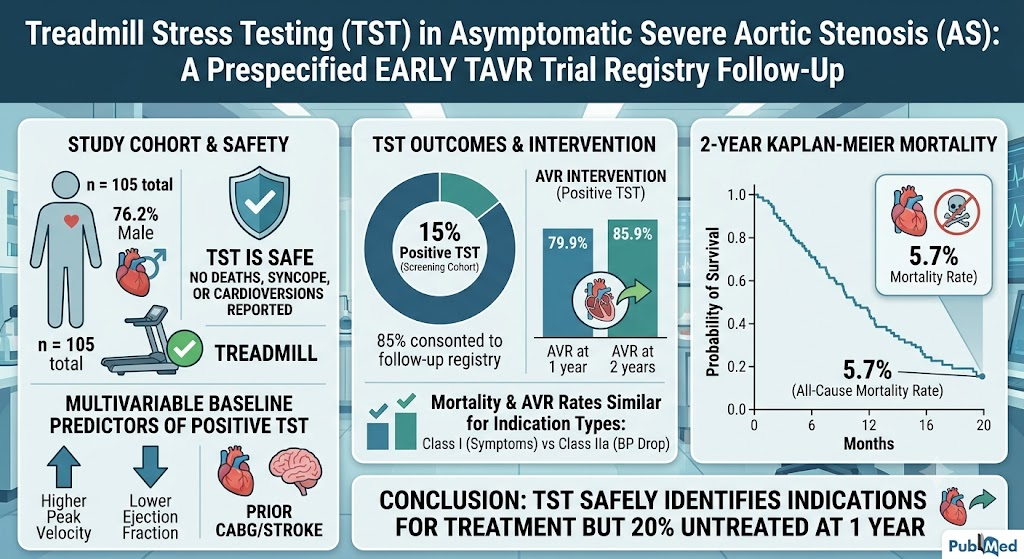
Among apparently asymptomatic patients with severe aortic stenosis, a standardized treadmill stress test (TST) induced symptoms or hemodynamic changes in 15.2% of screened individuals, confirming an indication for aortic valve replacement (AVR).
TST was safe in this cohort: no deaths, syncope, or cardioversions occurred during testing.
At 2 years, all-cause mortality among 105 patients with a positive TST was 5.7%.
While 79.9% and 85.9% underwent AVR within 1 and 2 years, respectively, about 20% remained untreated at 1 year despite a guideline-recommended indication for intervention.
Predictors of a positive TST included higher aortic valve peak velocity, lower ejection fraction, prior coronary artery bypass grafting, and prior stroke.
Study Snapshot
Design: Prespecified registry-based follow-up of the EARLY TAVR randomized clinical trial.
Population: 105 apparently asymptomatic patients with severe aortic stenosis who had a positive treadmill stress test and consented to registry enrollment.
Exposure: Positive TST result (symptoms or drop in systolic blood pressure during exercise).
Primary Outcomes: TST safety, 2-year all-cause mortality, rates of subsequent AVR.
Secondary Analysis: Multivariable logistic regression for baseline predictors of positive TST.
Funding/Registration: Trial funded by Edwards Lifesciences; ClinicalTrials.gov NCT03042104.
Why Treadmill Testing Matters in Severe Aortic Stenosis
Current guidelines recommend exercise stress testing for patients with severe aortic stenosis who deny symptoms, because the onset of exertional symptoms or a drop in blood pressure can unmask latent hemodynamic compromise and inform the timing of valve intervention. Despite this recommendation, exercise testing is underused in clinical practice, partly due to concerns about safety and uncertainty about its yield. The EARLY TAVR trial provided a unique opportunity to evaluate treadmill stress testing systematically in a large, multicenter cohort.
Inside the EARLY TAVR Treadmill Registry
This prespecified registry was nested within the Evaluation of TAVR Compared to Surveillance for Patients With Asymptomatic Severe Aortic Stenosis (EARLY TAVR) trial, which enrolled patients across 75 U.S. sites from July 2017 to December 2021. Patients who were apparently asymptomatic underwent a standardized modified Bruce protocol treadmill test. Those with a normal TST result proceeded to randomization in the main trial. The 146 patients (15.2%) who had a positive TST—defined as exercise-induced symptoms or a sustained drop in systolic blood pressure—were invited to enroll in the prospective registry. Of those, 105 consented and were followed for 2 years. The mean age was 76.1 years, and 76.2% were male.
TST Safely Identified Symptoms in One of Every Six Patients
No deaths, syncopal episodes, or cardioversions occurred during or immediately after any treadmill test. Among the 105 registry patients, 28.6% had a class I indication for AVR (symptoms during testing) and 71.4% had a class IIa indication (asymptomatic with a drop in systolic blood pressure). Baseline characteristics that independently predicted a positive TST included higher peak aortic jet velocity (odds ratio per 0.5 m/s, 1.57; 95% CI, 1.14–2.17), lower left ventricular ejection fraction (per 5% decrease, OR 1.16; 95% CI, 1.05–1.28), prior coronary artery bypass grafting (OR 2.37; 95% CI, 1.32–4.24), and prior stroke (OR 3.08; 95% CI, 1.20–7.88).
High AVR Rates but a 20% Untreated Gap at One Year
During follow-up, 79.9% of patients with a positive TST underwent aortic valve replacement within 1 year, and 85.9% within 2 years. The 2-year Kaplan-Meier estimate for all-cause mortality was 5.7%. Importantly, mortality and AVR rates did not differ significantly between patients who had symptoms during testing (class I indication) and those who had only a blood pressure drop (class IIa), suggesting that both abnormalities carry similar prognostic weight. However, approximately one in five patients who had a clear guideline-recommended reason for prompt intervention did not receive AVR within the first year.
Clinical Implications and Unanswered Questions
These results reinforce the safety and diagnostic utility of treadmill stress testing in asymptomatic severe aortic stenosis. The test unmasks a need for valve replacement in about 15% of patients who appear asymptomatic at rest. Yet the finding that 20% of these patients remained untreated at 1 year highlights a gap between guideline recommendations and real-world practice. Whether this represents patient preference, provider hesitation, comorbidity burden, or system-level barriers is not addressed by the registry.
Limitations of the analysis include its registry design (no comparator arm for positive TST patients), the modest cohort size, a predominantly male population, and the possibility that patients who consented to the registry may differ from those who declined. In addition, longer follow-up is needed to determine whether earlier AVR in positive TST patients translates into a survival benefit compared with expectant management.
Funding, Registration, and Source
The EARLY TAVR trial and this registry were funded by Edwards Lifesciences. The trial is registered at ClinicalTrials.gov (NCT03042104). The findings were published in JAMA Cardiology in July 2026 (Généreux P, et al. PMID: 42485012).
This article was created using several editorial tools, including AI, as part of the process. Human editors reviewed this content before publication.