Highlight
– Dapagliflozin significantly improved the slope of estimated glomerular filtration rate (eGFR) over 12 months in heart transplant recipients.
– The DAPARHT trial was a rigorous, multicenter, double-blind, placebo-controlled randomized study conducted in six Northern European heart transplant centers.
– Treatment with dapagliflozin showed no unexpected safety concerns or increased adverse events, including infections.
– This represents the first large-scale evidence supporting SGLT2 inhibitors as a renal protective approach in the heart transplant population.
Study Background
Chronic kidney disease (CKD) is a prevalent and challenging complication in patients who undergo heart transplantation. Calcineurin inhibitors—critical immunosuppressive agents used post-transplant—are known to contribute to progressive nephrotoxicity. Additionally, heart transplant recipients often have multiple comorbidities such as hypertension and diabetes that further exacerbate renal decline. Kidney impairment in this population correlates with increased morbidity and mortality, underscoring the imperative to develop effective renoprotective treatments.
Sodium-glucose cotransporter-2 (SGLT2) inhibitors, originally developed for glycemic control in type 2 diabetes, have shown promising kidney protective effects in chronic kidney disease and heart failure patients. Their mechanisms include reducing glomerular hyperfiltration, mitigating inflammation, and improving metabolic parameters. However, data on the use of SGLT2 inhibitors in heart transplant recipients have been limited, leaving uncertainty in routine clinical practice. The DAPAgliflozin for Renal Protection in Heart Transplant recipients (DAPARHT) trial sought to address this gap through a high-quality randomized clinical trial design.
Study Design
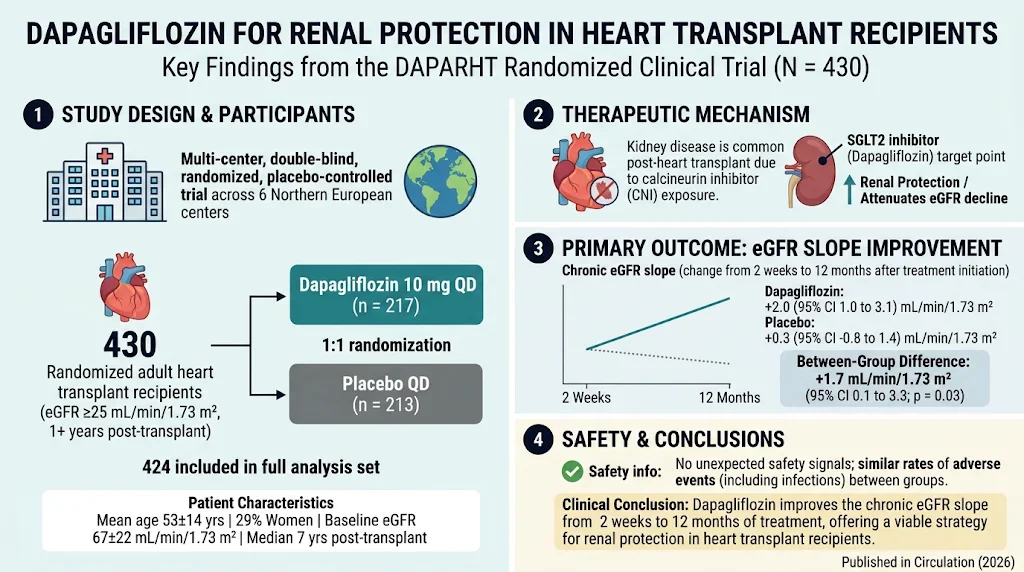
The DAPARHT trial was a randomized, double-blind, placebo-controlled study involving 430 adult heart transplant recipients recruited from six transplant centers in Northern Europe between June 2022 and September 2025. Eligible patients were at least one year post-transplant and had a baseline estimated glomerular filtration rate (eGFR) ≥25 mL/min/1.73 m².
Participants were randomized in a 1:1 fashion to receive either dapagliflozin 10 mg once daily or matching placebo for 12 months. Baseline characteristics included a mean age of 53 years, 29% female, with an average eGFR of 67 mL/min/1.73 m² and a median transplantation time of 7 years. The primary endpoint was the slope of eGFR from two weeks after starting treatment to 12 months, evaluated to capture the chronic effect on kidney function while excluding acute initial changes.
Key Findings
Out of 430 randomized participants, 424 had at least one follow-up eGFR measurement and were included in the analysis. The dapagliflozin group demonstrated a statistically significant improvement in eGFR slope compared to placebo. Specifically, the chronic change in eGFR was 2.0 mL/min/1.73 m² (95% CI, 1.0 to 3.1) in the dapagliflozin arm versus 0.3 mL/min/1.73 m² (95% CI, -0.8 to 1.4) in placebo, resulting in a between-group difference of 1.7 mL/min/1.73 m² (95% CI, 0.1 to 3.3; p=0.03).
This finding indicates that dapagliflozin slowed the decline or even slightly improved renal function over 12 months relative to placebo, a clinically meaningful benefit in a population at high risk of progressive kidney disease.
Safety analyses revealed no unexpected adverse events. Rates of infections and other known side effects were similar between the groups, underscoring the favorable safety and tolerability profile of dapagliflozin in heart transplant recipients.
Expert Commentary
The DAPARHT trial provides compelling evidence for the efficacy of SGLT2 inhibitors in preserving renal function among heart transplant recipients—a group historically vulnerable to kidney impairment due to immunosuppressive regimens and comorbid conditions. This study extends the renal protective paradigm established in other cardiac and CKD populations to the transplantation field, marking a significant advancement in post-transplant nephroprotection.
Mechanistically, SGLT2 inhibition reduces intraglomerular pressure and mitigates nephrotoxic pathways induced by calcineurin inhibitors. The trial’s rigorous methodology and multicenter design enhance the generalizability of findings across diverse clinical settings.
Nevertheless, longer-term studies are warranted to confirm sustained benefits and to evaluate impacts on transplant graft survival, cardiovascular outcomes, and quality of life. Additionally, investigating potential interactions with varying immunosuppressive protocols will be essential to optimize individualized therapy.
Conclusion
The DAPARHT trial conclusively demonstrates that dapagliflozin confers renoprotective benefits in heart transplant recipients, significantly improving the trajectory of kidney function over a year without compromising safety. These findings support incorporating dapagliflozin into the therapeutic arsenal for managing CKD in this vulnerable population, promising enhanced long-term outcomes and reduced renal complications.
Future research should focus on extended follow-up, combination strategies with other nephroprotective agents, and integration into transplant care guidelines.
Funding and Clinical Trials Registration
The Daparht trial was conducted without details of external funding listed in the abstract. The clinical trial registration information was not specified in the provided data.
References
Holmen S, Manintveld O, Damman K, Haugen Löfman I, Szymanski M, Braun O, Lando M, Bjørkelund E, Brugts JJ, Taverne YJHJ, Ter Maaten JM, Thorvaldsen T, Melin M, van der Meer MG, Fagerland MW, Ravnestad H, Gude E, Andreassen AK, Gullestad L, Broch K. Dapagliflozin for Renal Protection in Heart Transplant Recipients: A Randomized Clinical Trial. Circulation. 2026 Nov 8. PMID: 42999953. Available at: https://pubmed.ncbi.nlm.nih.gov/42999953/