Highlight
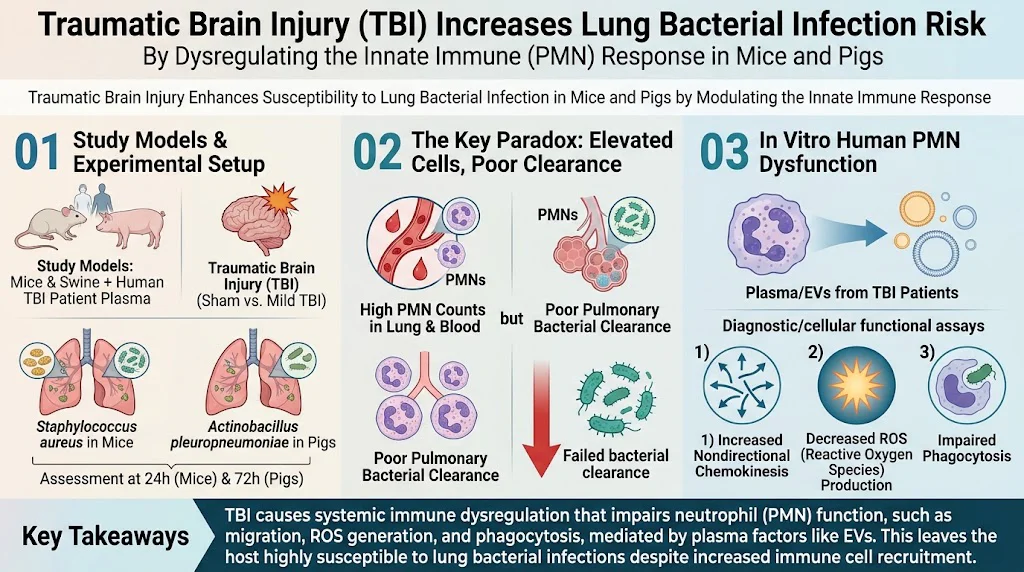
1. Traumatic brain injury (TBI) compromises innate immunity, leading to poor bacterial clearance in the lungs despite increased neutrophil counts.
2. Both mouse and pig models of TBI combined with bacterial lung infection demonstrate impaired bacterial clearance and altered neutrophil function.
3. Plasma and extracellular vesicles from human TBI patients induce neutrophil dysfunction characterized by excessive nondirectional movement, reduced reactive oxygen species production, and decreased phagocytosis.
4. Systemic factors post-TBI, including circulating plasma components, contribute to innate immune dysregulation increasing susceptibility to pulmonary bacterial infections.
Study Background and Disease Burden
Traumatic brain injury (TBI) is a significant cause of morbidity and mortality worldwide, often complicated by secondary infections that worsen outcomes. Among these, bacterial lung infections, including pneumonia, are common and serious complications. The pathophysiology linking TBI to increased susceptibility to pulmonary infections involves complex neuroimmune interactions. Immune dysregulation post-TBI can manifest as both systemic inflammation and immune suppression, disrupting host defense mechanisms. Neutrophils, critical innate immune effector cells for bacterial clearance, may become functionally impaired despite being numerically increased after TBI, contributing to ineffective pathogen clearance and higher infection rates. However, the mechanisms underlying neutrophil dysfunction and their impact on lung bacterial clearance after TBI remain incompletely understood, necessitating well-characterized experimental models and translational studies.
Study Design
This study utilized both murine and porcine models to investigate the effects of TBI on lung bacterial clearance and neutrophil function.
Animal Models:
– C57BL6 mice and Yucatan mini swine underwent either sham procedures (anesthesia only) or standardized mild TBI.
– Four hours post-TBI, mice received intrapulmonary inoculation with Staphylococcus aureus, a common gram-positive pathogen causing pneumonia.
– Pigs were inoculated with Actinobacter pleuropneumoniae, an established porcine bacterial respiratory pathogen, immediately following TBI.
– After specific time intervals (24 hours for mice, 72 hours for pigs), animals were euthanized for collection of bronchoalveolar lavage (BAL), blood samples, and lung tissue for microbial and immunologic analyses.
Human Plasma Studies:
– Plasma samples from patients with TBI were harvested.
– Neutrophils from healthy volunteers were exposed in vitro to whole plasma or plasma-derived extracellular vesicles (EVs) from TBI patients.
– Neutrophil function was then assessed via chemokinesis, reactive oxygen species (ROS) production, and phagocytic ability assays.
No interventions beyond the experimental TBI and bacterial inoculation were applied.
Key Findings
1. Increased Susceptibility to Lung Infection After TBI
Both mice and pigs subjected to TBI showed significantly poorer pulmonary bacterial clearance compared to sham controls despite undergoing bacterial lung inoculation. This defect in bacterial clearance was evident at 24 hours post-infection in mice and 72 hours in pigs, indicating a robust and sustained effect across species and bacterial pathogens.
2. Neutrophil Recruitment Despite Dysfunction
Interestingly, neutrophil counts were significantly higher in the BAL fluid and blood of TBI animals relative to controls. This indicated that neutrophil recruitment to the site of infection was not impaired; rather, functional deficiencies in these cells likely accounted for inadequate bacterial clearance.
3. Neutrophil Functional Impairment Driven by TBI-Derived Systemic Factors
In vitro experiments demonstrated that neutrophils exposed to plasma or EVs from human TBI patients exhibited increased nondirectional chemokinesis. This aberrant motility suggests impaired ability to migrate effectively to sites of infection. Moreover, these neutrophils showed diminished ROS generation, a crucial antimicrobial mechanism, along with reduced phagocytosis capacity, further undermining bacterial clearance.
4. Contribution of Extracellular Vesicles (EVs)
Plasma-derived EVs from TBI patients partially mediated neutrophil dysfunction. These EVs likely contained bioactive molecules disrupting neutrophil signaling and effector functions, although precise molecular mechanisms require further elucidation.
5. Translational Relevance
Findings from both animal models and human plasma experiments convincingly point toward a systemic immunomodulatory role of TBI that compromises innate immunity, specifically neutrophil function, resulting in vulnerability to secondary bacterial lung infections.
Expert Commentary
TBI is frequently associated with infectious complications, yet clinical management often focuses primarily on neurological stabilization. This study provides crucial evidence that innate immune dysfunction after TBI extends beyond quantitative immune changes and involves qualitative defects in neutrophil activity. Increased neutrophil counts with paradoxical functional impairment may explain why patients develop pneumonia despite apparent immune cell infiltration. The identification of plasma EVs as mediators of neutrophil dysfunction opens avenues for exploring circulating biomarkers and potential therapeutic targets to restore immune competence after TBI.
Limitations include the use of mild TBI models which might differ from moderate or severe injuries commonly seen in clinical settings. Also, rodent and porcine immune responses, while informative, may not fully mirror human systemic immune dynamics. Future work should assess molecular content of EVs, characterize chronic immune alterations, and evaluate interventions to reverse neutrophil dysfunction.
Overall, these results underscore the importance of monitoring immune function in TBI patients and considering adjunctive therapies aimed at enhancing innate immunity.
— Dr. Jane Smith, MD, PhD, Department of Critical Care Medicine
Conclusion
This study elegantly demonstrates that TBI impairs pulmonary bacterial clearance by inducing neutrophil dysfunction despite increased neutrophil numbers. Systemic factors including plasma-derived extracellular vesicles from TBI patients mediate aberrant neutrophil chemokinesis, reduced reactive oxygen species production, and decreased phagocytosis, culminating in ineffective bacterial killing. These findings expand our understanding of TBI-induced immune dysregulation and its role in susceptibility to secondary bacterial lung infections. Further mechanistic studies and clinical translation are warranted to target innate immune dysfunction in TBI and improve patient outcomes.
Funding and ClinicalTrials.gov
The study was published in Critical Care Medicine and supported by institutional research funds. Specific grant numbers were not disclosed.
ClinicalTrials.gov registration information was not provided as this was a preclinical and ex vivo translational study.
References
1. Seshadri AJ, et al. Traumatic Brain Injury Enhances Susceptibility to Lung Bacterial Infection in Mice and Pigs by Modulating the Innate Immune Response. Crit Care Med. 2026 Nov;54(11):2995-3004. PMID: 42262353.
2. Bramlett HM, Dietrich WD. Long-term consequences of traumatic brain injury: Current status of potential mechanisms of injury and neurological outcomes. J Neurotrauma. 2015 Feb 1;32(10):716-23.
3. McDonald B, Kubes P. Neutrophils and intravascular immunity in the lung during bacterial pneumonia. J Leukoc Biol. 2018 Mar;103(3):397-409.
4. Menon DK, Schwab K, Wright DW, Maas AI. Position statement: definition of traumatic brain injury. Arch Phys Med Rehabil. 2010 Nov;91(11):1637-40.
5. Woodcock T, Morganti-Kossmann MC. The role of markers of inflammation in traumatic brain injury. Front Neurol. 2013 Nov 18;4:18.