Introduction
Universities worldwide are confronting an unprecedented surge in mental health disorders among students. Recent epidemiologic studies reveal that a substantial proportion of first-year students meet diagnostic criteria for psychiatric conditions that significantly impair their academic performance and quality of life. Traditional campus mental health services, predominantly face-to-face counseling, are overwhelmed by escalating demand, prompting a critical re-examination of care models. Concurrently, unregulated generative artificial intelligence (AI) tools increasingly attract students seeking support, raising concerns regarding safety, equity, and efficacy. This article critically appraises emerging evidence on student mental health and digital interventions and proposes an integrated, AI-augmented stepped-care model designed for institutional implementation and governance within universities.
Background: Rising Burden of Student Mental Health Disorders
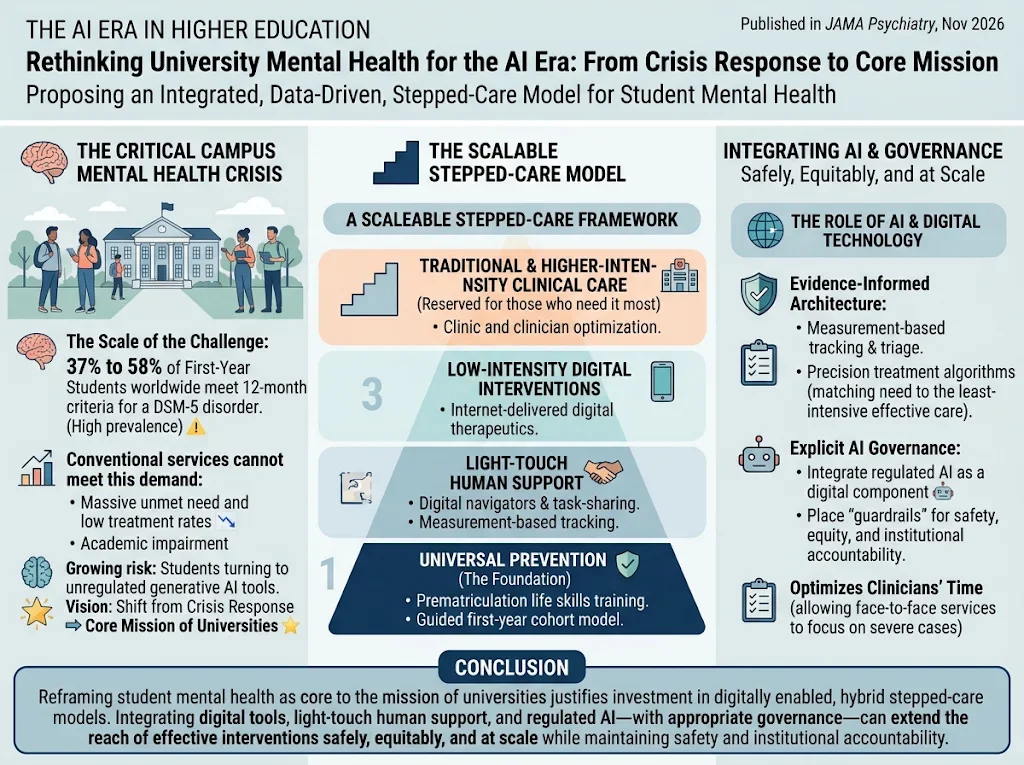
The transition to university life represents a vulnerable period, with global data from the World Mental Health International College Student (WMH-ICS) initiative reporting that between 37% and 58% of first-year students fulfill 12-month DSM-5 criteria for at least one psychiatric disorder. Common diagnoses include anxiety disorders, major depression, and substance use disorders, often co-occurring and resulting in marked academic and social impairment. Despite this high prevalence, treatment engagement remains suboptimal, with conventional counseling services unable to meet demand due to resource constraints. As mental health crises escalate, universities are compelled to explore innovative, scalable, and safe approaches to mental healthcare delivery that transcend traditional paradigms.
Study Design and Evidence Review
This synthesis draws upon epidemiologic datasets from WMH-ICS, national student mental health surveys, randomized controlled trials (RCTs) evaluating digitally delivered interventions, and implementation research investigating models such as digital navigators and task sharing. Additionally, early-stage evaluations of AI-supported mental health systems informed our conceptual framework. The reviewed literature emphasizes not only the epidemiology and intervention efficacy but also system-level governance considerations necessary for ethical AI integration.
Key Findings
High psychiatric morbidity and low treatment rates: Across international cohorts, up to half of first-year students screen positive for mental disorders, yet fewer than one-third receive adequate care, underscoring a critical treatment gap.
Limitations of traditional services: Even expanded face-to-face counseling and telehealth modalities with extended staffing cannot proportionally address demand, emphasizing the necessity for disruptive innovation.
Effectiveness of digital interventions: RCTs demonstrate that internet-delivered cognitive behavioral therapy (iCBT) and other digital platforms yield modest to moderate depression and anxiety symptom reductions, with adherence enhanced by light-touch human support such as digital navigators.
Hybrid stepped-care models: A stratified approach that begins with universal prevention through prematriculation life skills training and guided cohort programs, followed by precision-matched digital and human interventions, optimizes resource allocation. This model enhances reach, clinical efficiency, and outcomes by reserving intensive clinician involvement for students with higher acuity.
AI integration and governance: Emerging AI applications facilitate dynamic measurement-based care, individualized treatment algorithm selection, and deployment of conversational agents. However, unregulated use risks misinformation and safety concerns. Embedding AI within an institutional governance framework ensures adherence to equity, privacy, and clinical standards while maximizing technology benefits.
Expert Commentary
Experts emphasize that reframing student mental health from crisis response to a core institutional mission promotes sustainable funding and policy prioritization. The proposed integrated stepped-care framework aligns with broader public health objectives of early intervention and prevention. Notably, the success of AI augmentation hinges upon explicit governance mechanisms, continual outcome monitoring, and readiness to address disparities in digital literacy and access. Limitations include variability in digital intervention adherence and the evolving regulatory landscape for AI tools, necessitating ongoing evaluation and adaptation.
Conclusion
University student mental health demands urgent systemic transformation. The high prevalence of psychiatric disorders among entering students cannot be adequately managed by traditional counseling services alone. Digitally enabled, AI-supported stepped-care models represent a promising paradigm shift, expanding access, optimizing clinician time, and tailoring care intensity to individual need. Institutional governance and regulatory safeguards are critical to integrating AI safely and equitably. Ultimately, embedding mental health as a core university mission justifies dedicated investment in this innovative ecosystem, with the potential to improve student well-being and academic success at scale.
Funding and Disclosures
The original study by Kessler and Ono did not specify funding sources in its abstract. Readers are encouraged to consult the full article for detailed disclosures.
References
1. Kessler RC, Ono SJ. Rethinking University Mental Health for the AI Era: From Crisis Response to Core Mission. JAMA Psychiatry. 2026; PMID: 43013291.
2. Auerbach RP, et al. Mental disorders among college students in the World Health Organization World Mental Health Surveys. Psychol Med. 2016 Feb;46(14):2955-2970.
3. Farrer L, Gulliver A, Chan JK, et al. Technology-based interventions for mental health in tertiary students: systematic review. J Med Internet Res. 2020;22(4):e17217.
4. Schueller SM, et al. Digital mental health interventions: a regulatory and accessibility review. Curr Opin Psychol. 2020 Jun;36:152-157.
5. Naslund JA, Aschbrenner KA, Marsch LA, Bartels SJ. The future of mental health care: peer-to-peer support and social media. Epidemiol Psychiatr Sci. 2016 Jun;25(2):113-122.