Highlights
Dialogical ‘Talking with Voices’ therapy (TwV), a lived-experience informed intervention, significantly improves personal recovery in adults experiencing distressing auditory hallucinations compared to treatment as usual (TAU).
TwV demonstrates broad positive effects on voice-related distress measures, negative self-beliefs, and PTSD symptoms, with moderate to large standardized effect sizes.
The therapeutic approach is safe, with serious adverse events comparable between TwV plus TAU and TAU alone, and is feasible for delivery across diverse community mental health settings.
Complementary evidence from AVATAR therapy trials supports the utility of dialogical and relational approaches engaging directly with voices to empower affected individuals and alter voice-hearer relationships.
Background
Auditory hallucinations, commonly termed “hearing voices,” occur frequently in serious mental health problems (SMHPs) including schizophrenia spectrum disorders, bipolar disorder, and personality disorders. These experiences are often distressing and persistent, contributing to hospitalizations, suicidality, and impaired functioning. Standard treatments such as antipsychotic medications and cognitive behavioral therapy (CBT) offer only modest symptom relief and have variable long-term outcomes. Importantly, these treatments often neglect personal recovery, a multidimensional process focusing on individuals’ meaningful life improvements beyond symptom reduction.
Novel psychosocial interventions that address the interpersonal nature of voices and the relational dynamics between voice hearer and voices have emerged from the Hearing Voices Movement and patient-centered research. Dialogical therapies, including the Talking with Voices (TwV) approach, involve therapists engaging in direct dialogue not only with patients but also with their voices, aiming to transform distressing voice-hearer relationships and promote recovery.
Key Content
Chronological Development and Evidence for Dialogical Therapies
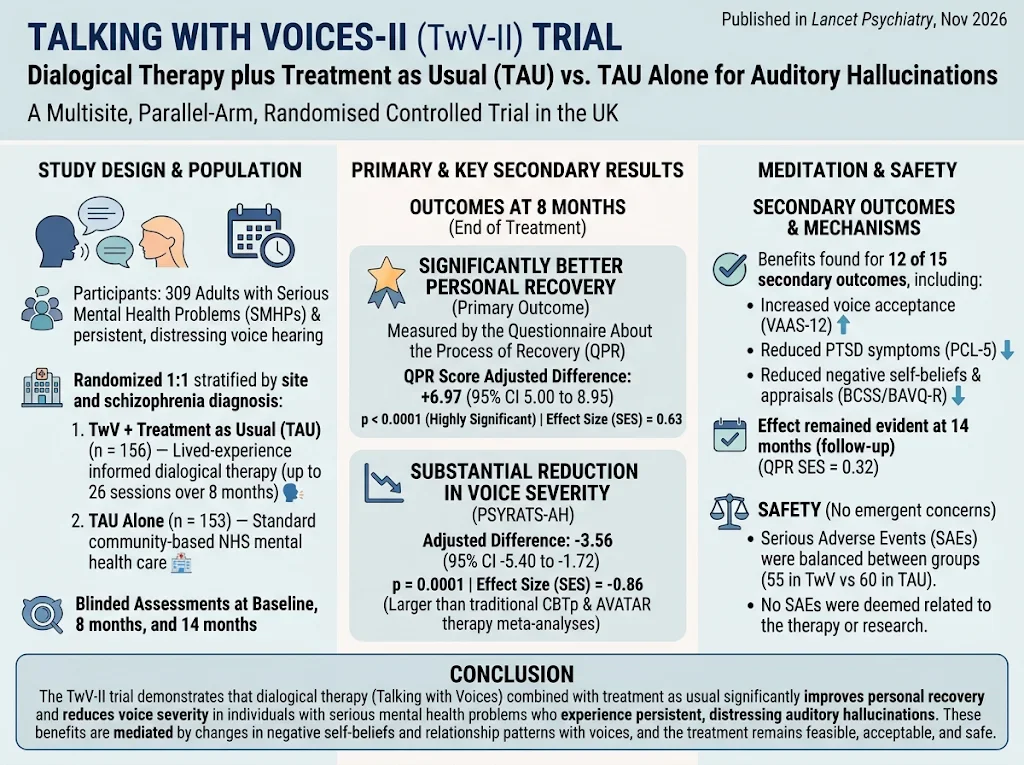
Initial feasibility studies of TwV therapy (Longden et al., 2022) established acceptability and safety in adults with schizophrenia spectrum disorders. Positive signals included reduced voice distress, improvements in dissociation, and enhanced recovery perceptions. Building upon this, the multisite Talking with Voices-II (TwV-II) randomised controlled trial (Longden et al., 2026) was conducted across four UK National Health Service (NHS) mental health sites, enrolling 309 adults with SMHPs and distressing, persistent auditory hallucinations. Participants were randomized 1:1 to receive up to 26 sessions of TwV plus treatment as usual (TAU) or TAU alone, with assessments at baseline, 8 months (post-treatment), and 14 months.
Trial Design and Outcomes
The primary outcome was self-reported personal recovery measured by the Questionnaire about the Process of Recovery at 8 months. Secondary measures included multiple voice-related scales, self-beliefs (positive and negative), dissociation, and PTSD symptoms. Analyses followed an intention-to-treat principle with prespecified mediation and moderation analyses. Therapy was delivered by trained clinicians with lived experience input embedded in the therapeutic process.
Main Findings
At 8 months, TwV participants showed significantly greater improvement in personal recovery compared to TAU alone (adjusted difference 6.97, 95% CI 5.00–8.95; p<0.0001; standardized effect size 0.63), indicating a moderate-to-large effect. Among secondary outcomes, 12 of 15 measures favored TwV, including all voice-related distress scales, reductions in negative self-beliefs, and PTSD symptom improvements, with effect sizes ranging 0.18 to 0.86. No significant effects were observed for dissociation measures or positive self-beliefs. At 14 months, a sustained albeit attenuated benefit on personal recovery persisted (adjusted difference 3.55, SES 0.32).
Serious adverse events were comparable between groups, and none were considered attributable directly to TwV therapy, supporting safety.
Qualitative Evidence and Mechanistic Insights
Nested qualitative analyses within TwV trials (Corstens et al., 2023) reveal patient narratives highlighting the importance of therapeutic alliance, safety, and active engagement with voices. Many participants described gaining greater control, insight, and improved voice-hearer relationships post-therapy. These findings align with hypothesized mechanisms involving enhanced relating to voices and modifications of negative beliefs underpinning voice distress.
Complementary Evidence from AVATAR Therapy
Evidence from AVATAR therapy trials (Craig et al., 2026; Craig et al., 2022) provides converging support for dialogical approaches. AVATAR therapy employs digital representations of voices enabling face-to-face dialogical engagement facilitated by therapists. Randomised trials demonstrated reduced voice distress and empowered coping, with qualitative studies underscoring the therapeutic alliance and experiential dialogue as key active ingredients. These studies further elucidate the process of shifting voice-hearer power dynamics from submissive to assertive.
Expert Commentary
The TwV-II trial represents a significant advance in psychosocial intervention for auditory hallucinations within SMHPs by prioritizing personal recovery and directly engaging distressing voices. The moderate-to-large effect on recovery is clinically meaningful given the challenging nature of persistent voice hearing and limited effectiveness of existing treatments.
The dialogical approach resonates with contemporary models conceptualizing voices as relational phenomena reflecting trauma, dissociation, and interpersonal dynamics. By addressing negative beliefs and fostering assertive voice relationships, TwV appears to target core mechanisms underpinning distress and disability.
Safety and feasibility across multiple community services affirm its practical clinical applicability. Mediation analyses, although awaited in full detail, promise clarification of key psychological mechanisms and patient subgroups most likely to benefit.
However, limitations include reliance on treatment as usual as control, without an active psychological comparator, and the predominance of White participants limiting generalizability. Longer-term maintenance of benefits beyond 14 months remains to be established.
Future research should compare TwV with active relational therapies, explore cost-effectiveness, and assess implementation in routine clinical pathways. Integration with digital modalities, as seen in AVATAR therapy, may further enhance accessibility and engagement.
Conclusion
Dialogical Talking with Voices therapy offers a novel, evidence-supported psychosocial approach that significantly enhances personal recovery and reduces distress in adults with persistent auditory hallucinations across serious mental health conditions. This trial advances clinical practice by incorporating lived experience, targeting voice-hearer relationships, and prioritizing recovery-oriented outcomes. Continued research and clinical uptake could substantially improve outcomes for this underserved population.
References
Longden E, Branitsky A, Glen C, et al; Talking with Voices Science Group. Dialogical therapy plus treatment as usual versus treatment as usual in adults with distressing and persistent auditory hallucinations in the UK (Talking with Voices-II): a randomised controlled trial. Lancet Psychiatry. 2026 Nov 10. doi:10.1016/S2215-0366(26)00330-5. PMID: 43008764.
Corstens D, Longden E, May R, et al. When therapists talk to voices: Perspectives from service-users who experience auditory hallucinations. Psychol Psychother. 2023 Dec;96(4):967-981. doi:10.1111/papt.12489. PMID: 37551953.
Craig TKJ, Rus-Calafell M, Ward T, et al. AVATAR therapy for auditory verbal hallucinations in people with psychosis: a single-blind, randomized controlled trial. Lancet Psychiatry. 2018;5(1):31-40. doi:10.1016/S2215-0366(17)30427-3. PMID: 29232856.
Craig TKJ, Straight H, Rus-Calafell M, et al. The Impact of AVATAR Therapy on Voice Hearing in Everyday Life: ESM Outcomes of the AVATAR2 Trial. Schizophr Bull. 2026 Jan 16;52(1). doi:10.1093/schbul/sbaf100. PMID: 41391105.
Longden E, Corstens D, Escher S. Dissociation, trauma and the role of psychological therapies in healing voice-hearing experiences. In: E. Longden et al., eds. Understanding Voices: What can neuroscience teach us? Oxford University Press, 2015.