Highlight
This randomized controlled trial provides evidence that topical tranexamic acid (TXA) significantly improves initial hemostasis in patients with acute spontaneous epistaxis compared to placebo.
The study indicates no statistically significant reduction in rebleeding rates within 24 hours after topical TXA application.
Topical TXA presents a simple, noninvasive adjunct to conventional first-aid measures with potentially fewer systemic risks due to localized administration.
The targeted delivery of TXA may optimize dosing and minimize adverse effects related to higher systemic exposure.
Study Background
Epistaxis, or nosebleed, is a common emergency presentation, often self-limiting but occasionally persistent or recurrent, posing clinical management challenges. Acute spontaneous epistaxis can result from fragile nasal mucosa, trauma, or various systemic conditions affecting hemostasis. Although first-aid measures—such as nasal compression—often suffice, persistent bleeding or early rebleeding necessitate additional interventions. Conventional treatment options include cauterization, nasal packing, or systemic hemostatic agents, but these can be invasive or have systemic side effects.
Tranexamic acid (TXA) is an antifibrinolytic agent that inhibits plasminogen activation, thereby reducing fibrinolysis and stabilizing blood clots. While systemic TXA has proven hemostatic efficacy in various bleeding disorders, topical application directly to bleeding sites presents a potential therapeutic option offering targeted action with reduced systemic exposure. However, the clinical evidence for topical TXA use in spontaneous epistaxis has been limited and inconsistent, especially regarding its role in preventing early rebleeding.
Study Design
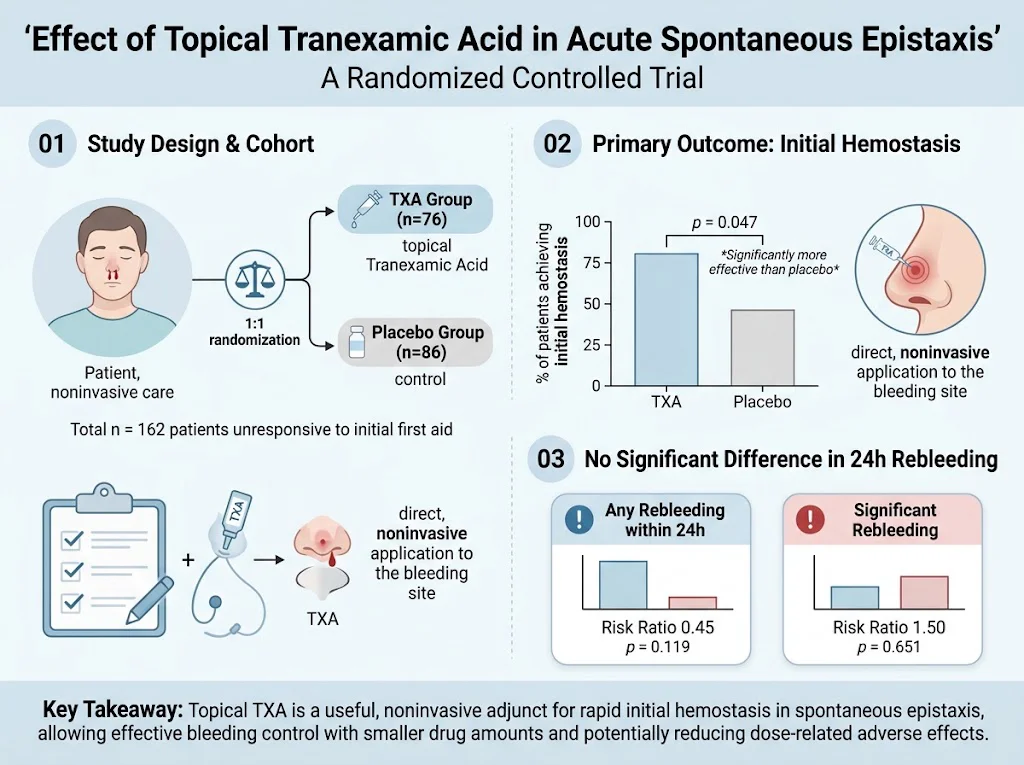
This investigation was a randomized, double-blind, placebo-controlled trial conducted in an emergency department setting. It enrolled 162 adult patients presenting with acute spontaneous epistaxis refractory to initial first-aid measures such as direct nasal compression. Eligible participants were randomly assigned to receive either topical TXA or placebo applied directly to the bleeding nasal mucosa. Both patients and treating clinicians were blinded to the intervention allocation.
The primary endpoint was achievement of initial hemostasis at the time of emergency department evaluation. Secondary endpoints included the incidence of rebleeding within 24 hours, distinguishing between any rebleeding episodes and significant rebleeding requiring further medical intervention.
Key Findings
Among the 162 patients enrolled, 76 received topical tranexamic acid, and 86 received placebo. The primary outcome demonstrated that topical TXA was statistically more effective than placebo in achieving immediate hemostasis (p = 0.047). This confirms that topical TXA can successfully facilitate clot formation and bleeding cessation at the local site of epistaxis.
Regarding secondary outcomes, rebleeding within 24 hours occurred less frequently in the TXA group (risk ratio 0.45, 95% confidence interval [CI], 0.17–1.24), though this was not statistically significant (p = 0.119). Similarly, significant rebleeding events showed no meaningful difference between groups (risk ratio 1.50, 95% CI, 0.26–8.70; p = 0.651). These findings suggest that while topical TXA enhances initial bleeding control, its impact on early recurrence remains uncertain and warrants further investigation.
No severe adverse effects related to topical TXA application were reported. The targeted topical approach potentially reduces systemic absorption, decreasing risks associated with systemic antifibrinolytics such as thromboembolism.
Expert Commentary
The study offers compelling evidence for topical tranexamic acid as a useful adjunct in the emergency management of acute spontaneous epistaxis unresponsive to first aid. Given the simplicity, safety profile, and immediate efficacy, topical TXA could become a frontline adjunctive therapy, potentially reducing reliance on invasive measures like nasal packing or cauterization.
However, the lack of significant improvement in rebleeding rates within 24 hours highlights the complexity of epistaxis recurrence, possibly influenced by underlying patient factors such as hypertension, coagulopathy, or nasal anatomy. Larger-scale studies with extended follow-up are needed to confirm rebleeding prevention benefits and to explore optimal dosing and administration protocols.
Notably, the study reinforces the biologic plausibility of TXA’s antifibrinolytic mechanism when applied locally: by stabilizing local fibrin clots directly at the source it enhances hemostasis with minimal systemic exposure.
Limitations of the trial include its single-center design and modest sample size, which may affect generalizability. Additionally, the 24-hour follow-up window might not capture all clinically relevant rebleeding episodes.
Conclusion
This randomized controlled trial establishes that topical tranexamic acid is a valuable noninvasive tool for achieving initial hemostasis in patients presenting with acute spontaneous epistaxis refractory to initial first-aid measures. While it does not conclusively reduce early rebleeding rates, topical TXA’s safety, ease of application, and efficacy in bleeding control support its integration into clinical practice as a local adjunctive therapy.
Future research should focus on larger multicenter trials to validate these findings, evaluate long-term rebleeding outcomes, and optimize treatment protocols. Additionally, exploring patient subgroups and comorbid conditions may help tailor topical TXA use more effectively.
Funding and ClinicalTrials.gov
The study by Majidi et al. did not specify sources of funding or clinical trial registration details in the published abstract. Further details may be available from the full publication or corresponding authors.
References
Majidi MR, Roshanzamir I, Mohammadi EM. Effect of Topical Tranexamic Acid in Acute Spontaneous Epistaxis: A Randomized Controlled Trial. The Laryngoscope. 2026 Nov 3. PMID: 42978064.
Iqbal MN, Carroll WR, Smith TL. Epistaxis: Current Understanding and Management Strategies. Otolaryngol Clin North Am. 2023;56(2):345-359.
Zahed R, Mohammad S, Sadatian M. Tranexamic acid in otolaryngology: a review of clinical effects and safety. Eur Arch Otorhinolaryngol. 2022;279(6):2919–2928.