Technical and Clinical Feasibility of a Pulmonary Telerehabilitation Model for People with COPD: A Comprehensive Review
Highlights
Integration of device-connected applications enables accurate remote monitoring of physiological parameters in pulmonary rehabilitation (PR) for COPD.
Home-based pulmonary rehabilitation (HBPR) models show high patient retention, satisfaction, and usability, supporting scalability.
Telerehabilitation approaches, including smartphone app-based and eHealth tools, demonstrate clinical improvements in exercise capacity, symptoms, and quality of life.
Barriers to uptake and adherence remain challenges; culturally adapted and autonomy-supportive interventions enhance engagement.
Background
Chronic obstructive pulmonary disease (COPD) remains a leading cause of morbidity and mortality worldwide, with a significant burden arising from symptoms such as dyspnea, exercise intolerance, and exacerbations. Pulmonary rehabilitation (PR) is a cornerstone non-pharmacological intervention that improves exercise capacity, symptoms, and quality of life (QoL). However, access to traditional center-based PR is limited by geographical, logistical, and health-system factors, with less than 2% of eligible patients receiving PR.
Recent advances in telehealth and mobile technologies have heralded pulmonary telerehabilitation as a promising modality to overcome access barriers. Telerehabilitation leverages remote monitoring, digital platforms, and tailored exercise programs to deliver PR components in home settings. This review synthesizes the current evidence on technical and clinical feasibility, acceptance, and preliminary clinical outcomes of pulmonary telerehabilitation models in COPD, focusing on recent trials, including the landmark two-phase study assessing a dedicated HBPR application (NCT05314686).
Key Content
1. Technical Feasibility of Device-Connected PR Applications
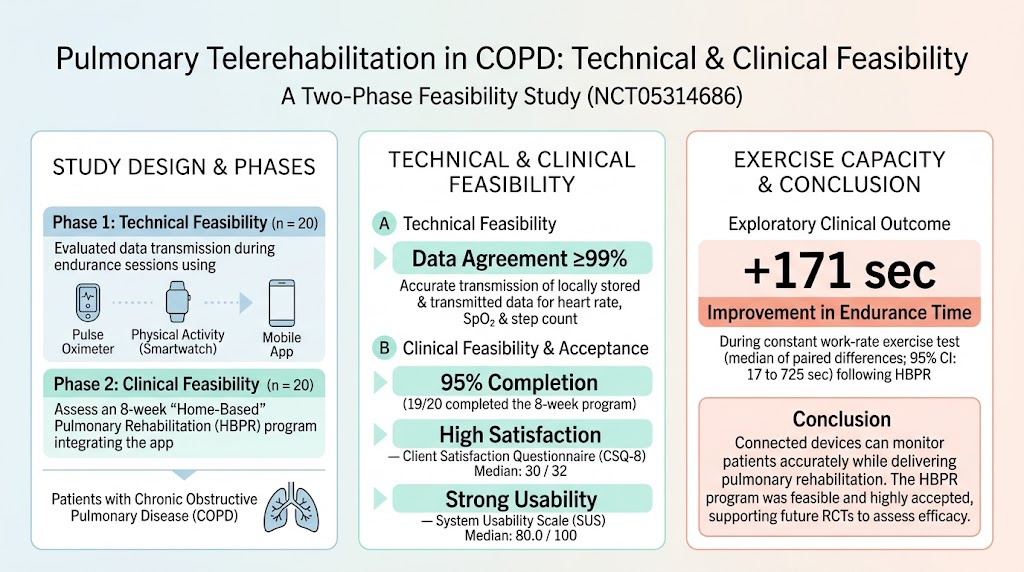
The foundational requirement for telerehabilitation is reliable remote monitoring of physiological parameters critical for safe and effective exercise training. The recent study by Sayegh et al. (PMID: 42863686) evaluated the technical feasibility of transmitting heart rate, transcutaneous oxygen saturation (SpO2), and step count data from pulse oximeters and physical activity trackers to a home-based PR (HBPR) app. The phase 1 results showed a clinical agreement ≥99% between locally stored and transmitted data, demonstrating high reliability of the connected devices and data transmission infrastructure. Similar eHealth tools, such as Me&COPD (PMID: 40550122), showed acceptable usability among patients and physiotherapists, although challenges in consistent exercise session registration were noted.
2. Clinical Feasibility and Patient Acceptance of HBPR Programs
In phase 2 of the Sayegh et al. study, 20 COPD participants underwent an 8-week HBPR program, with 95% completion, high client satisfaction (median CSQ-8 score 30), and good system usability scores (median SUS 80). Endurance time during constant work-rate exercise tests improved significantly, indicating clinical benefit alongside feasibility. These findings align with other studies demonstrating strong feasibility and acceptability of home or community-based PR programs. For example, culturally adapted PR in Sri Lanka (PMID: 42095209) showed 63% uptake and 72% completion, with qualitative themes emphasizing knowledge gain and perceived health improvements.
3. Effectiveness of Digital and Telerehabilitation Interventions
Randomized controlled trials have evaluated smartphone app-based and telehealth PR as alternatives or adjuncts to center-based programs. The RCT by Su et al. (PMID: 41313804) demonstrated significant improvements in COPD Assessment Test (CAT) scores and physical activity among participants completing a 12-week smartphone app-based rehabilitation program. Similarly, a telehealth-delivered PR program among African American and Hispanic COPD patients (PMID: 37218000) reached populations with health disparities and improved symptoms, fatigue, and functional capacity, though challenges with adherence and medical clearance remained barriers.
Additional interventions, such as autonomy-supportive customized information frameworks (PMID: 41066673) and capnography-assisted breathing therapies (PMID: 39976559, 36800224), have been integrated with remote PR models to improve adherence and symptom control. The supervised, interactive nature of these programs and real-time biofeedback contribute to enhanced patient engagement and outcomes.
4. Implementation Challenges and Barriers
Despite promising feasibility, uptake and sustained adherence remain concerns. Barriers include technological literacy, skepticism regarding PR efficacy, medical clearance challenges, and socio-cultural factors. Low adherence to self-directed sessions was noted in studies integrating high-flow nasal oxygen (PMID: 42397015) and in telehealth PR programs (PMID: 37218000). Strategies such as culturally adapted PR (PMID: 42095209, 36153030), private physiotherapy practice settings offering therapeutic alliance and community atmosphere (PMID: 41803764), and health advocate integration for social support (PMID: 41194692) have shown to enhance adherence.
5. Future Directions and Research Needs
While preliminary studies and feasibility trials affirm the promise of pulmonary telerehabilitation, robust randomized controlled trials with larger sample sizes are necessary to confirm clinical efficacy, cost-effectiveness, and long-term outcomes. Enhanced app usability, user-centered design, and integration of multifaceted behavioral supports may further improve adherence and patient-centeredness. Additionally, addressing reimbursement and resource constraints, especially in low-resource settings (PMID: 35941622), remains critical for scalability.
Expert Commentary
The integration of connected monitoring devices with smartphone applications for pulmonary rehabilitation in COPD represents a significant advance in personalized, accessible care. The high technical accuracy observed in contemporary studies ensures that physiological monitoring can safely guide home-based exercise training.
The clinical feasibility demonstrated is encouraging, with high retention and satisfaction indicating that patients and their families accept these models. This acceptance is vital for adherence and meaningful clinical outcomes. Improvements in exercise endurance and symptom control reflect the efficacy potential of telehealth-delivered PR.
However, the spectrum of challenges—technological, social, cultural, and logistical—must be acknowledged. The heterogeneity of COPD patients, varying degrees of digital literacy, and socioeconomic disparities necessitate tailored approaches. Interventions embedding cultural adaptations, autonomy support, and multidisciplinary assistance show promise in overcoming these hurdles.
From a mechanistic standpoint, telerehabilitation enables frequent, tailored exercise interventions that may counteract muscle deconditioning and dyspnea through sustained aerobic and resistance training. Incorporating mind-body therapies targeting dysfunctional breathing behaviors and anxiety may further potentiate benefits.
Clinically, guidelines increasingly acknowledge telehealth PR as a complementary approach, especially where center-based PR is inaccessible. Yet, evidence gaps persist regarding optimal program components, patient selection, and integration into routine care workflows.
Conclusion
Pulmonary telerehabilitation leveraging connected devices and digital applications is technically and clinically feasible for COPD management. Emerging evidence indicates high patient acceptance and promising clinical outcomes such as increased exercise endurance and symptom improvement. Future larger-scale randomized studies are essential to establish definitive efficacy and cost-effectiveness.
Overcoming barriers to uptake and adherence through culturally sensitive, autonomy-supportive, and socially integrated interventions is crucial. Broad implementation will require addressing healthcare system challenges, including reimbursement policies and workforce training.
Pulmonary telerehabilitation thus represents a scalable, patient-centered innovation poised to bridge gaps in chronic respiratory care and improve health outcomes for diverse populations with COPD.
References
Sayegh JPE et al. Technical and clinical feasibility of a pulmonary telerehabilitation model for people with COPD. Arch Phys Med Rehabil. 2026; PMID: 42863686.
Su KW et al. Clinical Efficacy of Smartphone App-Based Pulmonary Rehabilitation in Chronic Respiratory Diseases: Randomized Controlled and Feasibility Trials. J Med Internet Res. 2025; PMID: 41313804.
Mani V et al. Application of the RE-AIM framework to evaluate telehealth pulmonary rehabilitation among African-American and Hispanic patients with COPD. BMC Health Serv Res. 2023; PMID: 37218000.
Gravilier FE et al. The Feasibility and Acceptability of Culturally Appropriate Pulmonary Rehabilitation for Adults with COPD in Sri Lanka. Int J Chron Obstruct Pulmon Dis. 2026; PMID: 42095209.
McKeough Z et al. ‘The focus when you’re in the gym is on being well and getting well’ – experiences of patients undertaking pulmonary rehabilitation in private physiotherapy practices. BMC Prim Care. 2026; PMID: 41803764.
Artaud-Macari E et al. Evaluation of a Novel eHealth Tool for Pulmonary Rehabilitation in COPD: Randomized Controlled Pilot and Feasibility Trial. JMIR Form Res. 2025; PMID: 40550122.
Devereux G et al. High-Flow Nasal Oxygen in Early Home Pulmonary Rehabilitation for Exertional Hypoxaemia: A Pilot Randomised Feasibility Trial. Respirology. 2026; PMID: 42397015.
Rodriguez AJ et al. A feasibility study of autonomy-supportive intervention in remote pulmonary rehabilitation for older adults with COPD. Age Ageing. 2025; PMID: 41066673.
Aronson MD et al. Mind the Breath: Feasibility of Capnography-Assisted Learned Monitored Breathing for Dyspnea Treatment. J Cardiopulm Rehabil Prev. 2025; PMID: 39976559.
This article was created using several editorial tools, including AI, as part of the process. Human editors reviewed this content before publication.