Innovative Cryospray Therapy Shows Promise for Chronic Bronchitis in COPD Patients: Insights from the SPRAY-CB Trial
Highlight
- The RejuvenAir® System delivers metered doses of liquid nitrogen via cryospray aiming to regenerate healthy bronchial epithelium in COPD patients with chronic bronchitis.
- The SPRAY-CB trial demonstrated significant improvement in total St George’s Respiratory Questionnaire (SGRQ) and COPD Assessment Test (CAT) scores after treatment compared with sham control.
- Severe acute exacerbation rates were reduced in the cryospray-treated group, with no device-related deaths and an acceptable safety profile.
Study Background
Chronic obstructive pulmonary disease (COPD) is a leading cause of morbidity worldwide, often complicated by the chronic bronchitis phenotype, characterized by persistent productive cough and mucociliary clearance impairment. This phenotype contributes significantly to exacerbations, reduced quality of life, and health care burden. Existing therapies offer limited efficacy in reversing epithelial damage or restoring mucociliary function. The novel RejuvenAir® System utilizes metered-dose cryospray (MCS) of medical-grade liquid nitrogen to target bronchial airways, hypothesized to ablate damaged epithelium and promote healthier epithelial regeneration, potentially improving respiratory symptoms and reducing exacerbations.
Study Design
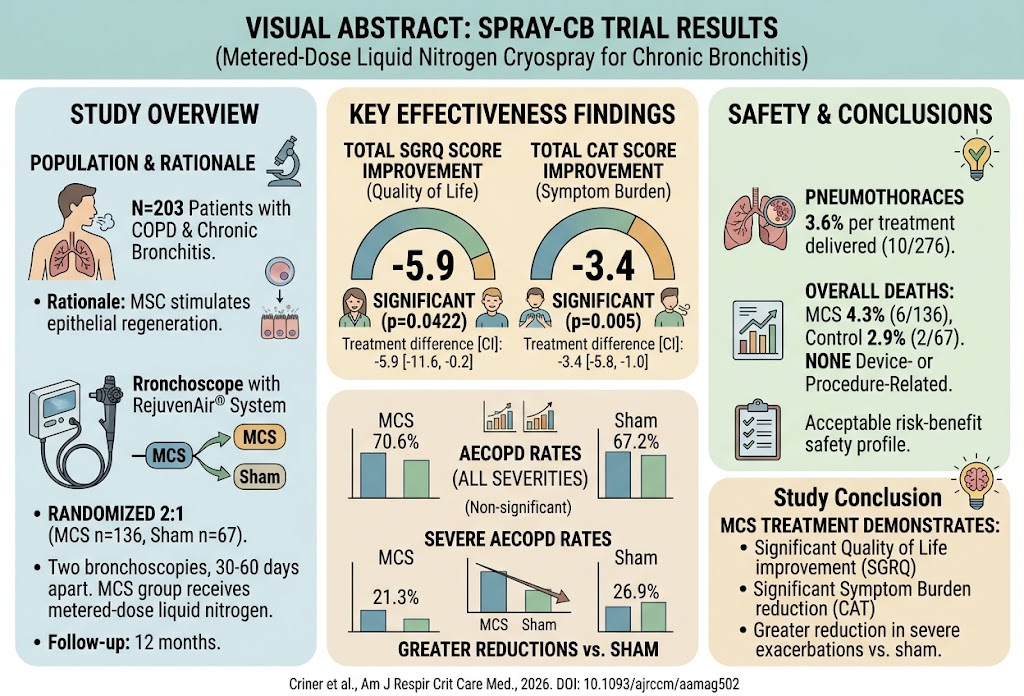
The SPRAY-CB trial was a prospective, randomized, sham-controlled clinical study enrolling 203 patients with COPD and chronic bronchitis phenotype. Subjects were randomized in a 2:1 ratio to either the intervention group receiving two bronchoscopic sessions of mucus clearance plus MCS treatments 30-60 days apart or the control group receiving therapeutic mucus clearance alone (sham procedure). The primary endpoints focused on safety and clinical effectiveness outcomes assessed up to 12 months post-treatment. Effectiveness was measured by changes in total SGRQ and COPD Assessment Test (CAT) scores, while safety assessment included periprocedural adverse events, exacerbation rates, and mortality.
Key Findings
Out of 203 evaluable patients, 136 received MCS treatment and 67 underwent sham control procedures.
Clinical Efficacy
– Patients treated with MCS demonstrated statistically significant improvements in total SGRQ scores compared to controls, with a mean treatment difference of -5.9 points (95% CI -11.6 to -0.2; p=0.0422), indicative of meaningful quality of life enhancement.
– Similarly, the total CAT scores also favored MCS with a treatment difference of -3.4 points (95% CI -5.8 to -1.0; p=0.005), reflecting symptomatic relief.
Exacerbation Rates
– The all-severity acute exacerbation of COPD (AECOPD) rates were comparable between groups: 70.6% in the MCS group versus 67.2% in controls.
– However, severe AECOPD events were lower in the MCS group (21.3%) relative to controls (26.9%), suggesting a clinically relevant reduction in exacerbation severity.
Safety
– The periprocedural pneumothorax incidence was low at 3.6% per MCS treatment delivered (10 pneumothoraces out of 276 treatments).
– Eight deaths occurred during the overall study period – six in the MCS group (4.3%) and two in controls (2.9%); importantly, none were attributed to the device or procedural intervention.
– No unanticipated adverse device effects were reported.
Expert Commentary
The SPRAY-CB trial represents a significant advancement in interventional therapy for chronic bronchitis in COPD, going beyond symptomatic treatment to address airway epithelial pathology. The use of metered-dose liquid nitrogen cryospray allows targeted epithelial ablation with subsequent regeneration, potentially improving mucociliary function. The statistically and clinically meaningful improvements in SGRQ and CAT scores underscore patient-centered benefits in quality of life and symptom burden.
While the reduction in severe exacerbations supports the protective effect of MCS treatment, the overall exacerbation frequency was similar, indicating the need for longer-term studies to confirm durability. The safety profile was acceptable, with low pneumothorax rates and no device-related mortality, which is encouraging for adoption in appropriate settings.
Study limitations include the relatively short-term follow-up of 12 months and lack of detailed mechanistic data such as histologic confirmation of epithelial regeneration or mucociliary function assays. Future studies may also explore optimization of dosing intervals and integration with pharmacotherapies.
Conclusion
Metered-dose liquid nitrogen cryospray therapy delivered via the RejuvenAir® System offers a promising novel treatment for patients with COPD complicated by chronic bronchitis. The SPRAY-CB trial demonstrates significant improvement in respiratory health-related quality of life, symptom burden, and reduction in severe exacerbations with a manageable safety profile. This interventional approach may fill a notable unmet need in COPD management by targeting airway epithelium regeneration, warranting further research to establish long-term efficacy and broaden clinical utility.
Funding and Trial Registration
The study was conducted in compliance with clinical research standards; funding sources and clinical trial registration details were reported in the original publication (PMID: 42768446).
References
Criner GJ, Browning RF, Abu-Hijleh M, et al. Metered-Dose Liquid Nitrogen Cryospray for Chronic Bronchitis: Results From the Prospective, Sham-Controlled Trial (SPRAY-CB). Am J Respir Crit Care Med. 2026 Sep 21. PMID: 42768446.
Global Initiative for Chronic Obstructive Lung Disease (GOLD) 2024 Report. Global Strategy for Prevention, Diagnosis and Management of COPD. Available at: https://goldcopd.org.
This article was created using several editorial tools, including AI, as part of the process. Human editors reviewed this content before publication.