Highlight
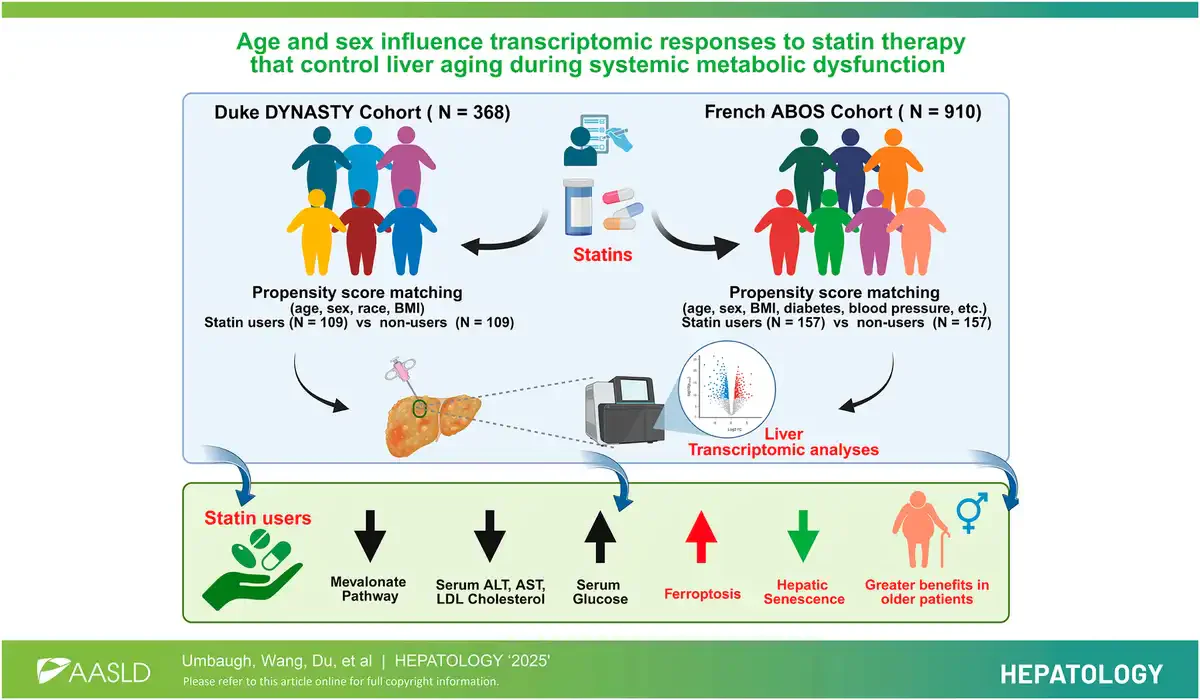
Statin therapy in MASLD patients significantly lowers serum liver enzymes and LDL cholesterol, especially in older adults.
Transcriptomic analyses reveal statin-associated suppression of cellular senescence pathways and activation of ferroptosis-linked pathways in the liver.
Age and sex influence liver transcriptomic responses to statins, suggesting differential regulation of liver aging during systemic metabolic dysfunction.
Statins may act as senolytic agents, offering protection against biological liver aging and highlighting complex roles of senescence in liver remodeling.
Study Background
Metabolic dysfunction-associated steatotic liver disease (MASLD), previously known as nonalcoholic fatty liver disease (NAFLD), is a growing global health burden characterized by excessive fat accumulation in the liver coupled with systemic metabolic dysfunction. Older age markedly increases susceptibility to MASLD and its progression to more severe forms such as nonalcoholic steatohepatitis (NASH) and cirrhosis. Cardiovascular disease remains a major cause of morbidity and mortality in MASLD patients, necessitating widespread use of cholesterol-lowering agents such as statins. Although statins inhibit the mevalonate pathway to reduce cholesterol biosynthesis, their potential impact on liver aging regulators and progression of liver disease remains incompletely understood. This study addresses key knowledge gaps regarding age- and sex-dependent transcriptomic liver responses to statin therapy and their connections to biological aging processes in MASLD.
Study Design
This investigation utilized liver tissue transcriptomes and matched clinical data from 368 adult patients enrolled in the Duke MASLD Biorepository. Patients were stratified by statin use, age, and sex to evaluate differential transcriptomic responses. Key biochemical parameters including serum alanine aminotransferase (ALT), aspartate aminotransferase (AST), and low-density lipoprotein (LDL) cholesterol were measured. RNA sequencing analyses focused on identifying alterations in key pathways related to senescence and ferroptosis, a regulated cell death process associated with iron-dependent lipid peroxidation and constrained by the mevalonate pathway. Propensity score matching was applied to control for confounders. Findings were validated independently in an obese cohort, reinforcing their generalizability beyond the initial study population.
Key Findings
Serum biochemistry revealed that statin users of both sexes exhibited significantly reduced ALT, AST, and LDL cholesterol levels compared to non-users, with the most pronounced reductions observed in older adults. This underscores statins’ biochemical efficacy in improving liver enzymes and lipid profiles in MASLD patients.
Transcriptomic analysis showed striking age-dependent remodeling of liver gene expression associated with statin use. Notably, pathways implicated in cellular senescence—a hallmark of biological aging characterized by irreversible cell-cycle arrest and pro-inflammatory secretions—were robustly suppressed in statin users. This suppression persisted after adjustment for clinical confounders, supporting a direct link between statins and modulation of senescence-related gene networks.
Conversely, pathways related to ferroptosis were activated in the livers of statin users. Ferroptosis is a distinct programmed cell death mechanism involving iron-dependent lipid peroxidation, which contrasts with apoptosis and necrosis. The mevalonate pathway inhibition by statins appears to release constraints on ferroptosis pathways, suggesting an interplay between statins, ferroptosis, and liver cellular turnover.
Sex-specific differences were apparent, with transcriptomic signatures indicating variable sensitivity in senescence and ferroptosis pathways between males and females, particularly influenced by patient age. This highlights the importance of recognizing sex as a biological variable in therapeutic responses.
Validation in an independent obese cohort confirmed the reproducibility of these transcriptomic alterations, strengthening their clinical relevance.
Expert Commentary
This study offers profound mechanistic insights into how statins may influence liver aging beyond their cholesterol-lowering effects. The observed suppression of senescence-associated pathways suggests a senolytic property of statins, which aligns with emerging paradigms on the therapeutic targeting of senescent cells to mitigate aging-related diseases. By promoting ferroptosis, statins might selectively eliminate dysfunctional or damaged liver cells, facilitating tissue remodeling and adaptation during systemic metabolic dysfunction.
However, the dual roles of senescence—as both a detrimental and potentially adaptive process in liver pathophysiology—complicate therapeutic targeting strategies. The authors underscore the context-specificity of senescence in liver remodeling, implying that blanket senolytic therapies require cautious evaluation.
Limitations include the observational study design, which precludes definitive causality attribution; however, robust statistical controls and validation cohorts mitigate this concern. Future randomized controlled trials should evaluate clinical endpoints such as progression to cirrhosis and liver-related morbidity to translate these transcriptomic findings into practice.
Conclusion
This comprehensive transcriptomic study delineates how age and sex modulate liver responses to statin therapy in MASLD patients. By suppressing biological aging markers related to senescence and activating ferroptosis pathways, statins may serve dual roles in improving liver health and slowing disease progression during metabolic dysfunction. These findings warrant further exploration of statins as senolytic agents with potential benefits in liver aging and MASLD management. Clinicians should consider patient age and sex in interpreting statin effects and personalizing MASLD therapies. Continued research is essential to unravel the complex biology of liver aging and optimize interventions in this vulnerable population.
Funding and Registrations
The analysis was conducted under the auspices of the Duke MASLD Biorepository with no explicit statement on funding in the source. Additional validation cohorts included obese patients enrolled from collaborating institutions. No clinical trial registration was reported for this observational transcriptomic study.
References
1. Umbaugh DS, Wang L, Du K, et al. Age and sex influence transcriptomic responses to statin therapy that control liver aging during systemic metabolic dysfunction. Hepatology. 2026;84(5):1451-1468. PMID: 41627886.
2. Friedman SL, Neuschwander-Tetri BA, Rinella M, Sanyal AJ. Mechanisms of NAFLD development and therapeutic strategies. Nat Med. 2018 Jul;24(7):908-922.
3. Kirkland JL, Tchkonia T. Senolytic drugs: from discovery to translation. J Intern Med. 2020 Jan;288(5):518-536.
4. Dixon SJ, Lemberg KM, Lamprecht MR, et al. Ferroptosis: an iron-dependent form of nonapoptotic cell death. Cell. 2012 May 25;149(5):1060-72.
5. Hill M, Tran MT, Smoczyk A, et al. Kidney aging and the regulation of cellular senescence and ferroptosis pathways. Kidney Int. 2020 Dec;98(6):1353-1367.
6. European Association for the Study of the Liver (EASL). EASL Clinical Practice Guidelines on the management of NAFLD. J Hepatol. 2016 Jun;64(6):1388-402.
These references provide supportive context and background on MASLD, senescence, ferroptosis, and statin biology.