Targeting ITK with Soquelitinib: A Promising Phase 1 Trial in Relapsed/Refractory T Cell Lymphomas
Highlight
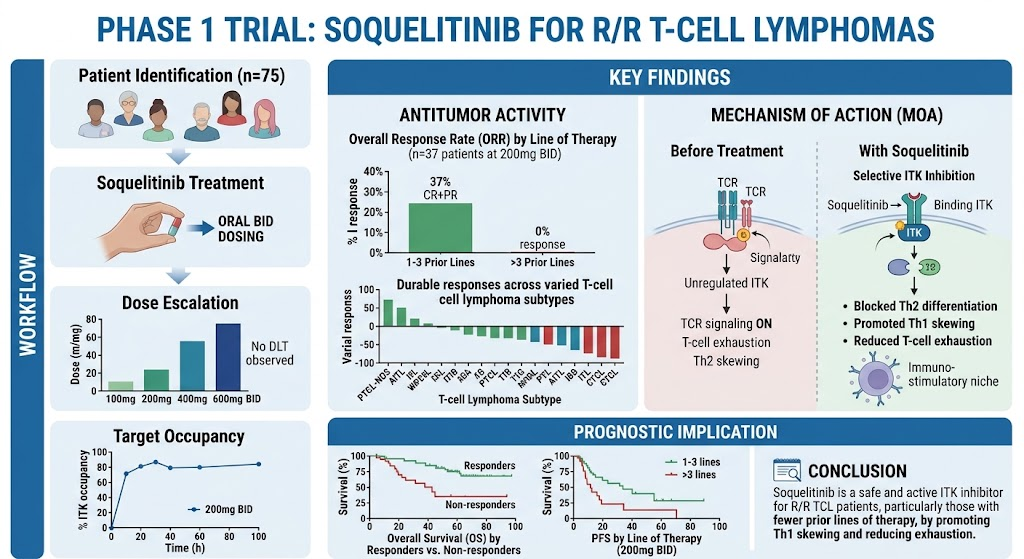
This phase 1 clinical trial demonstrates that soquelitinib, a selective small-molecule covalent inhibitor of interleukin-2 inducible T cell kinase (ITK), is well tolerated up to 600 mg twice daily in patients with relapsed/refractory peripheral T cell lymphomas (PTCL). Target engagement with >80% occupancy at 200 mg BID was achieved, and clinical responses including durable complete and partial remissions were observed, particularly in patients with fewer prior therapies (1-3 lines). Mechanistically, soquelitinib induced Th1 immune skewing, reduced T cell exhaustion, and inhibited Th2 differentiation, suggesting both tumor intrinsic and immunomodulatory effects. These findings support further development of ITK inhibition as a therapeutic strategy in PTCL.
Study Background
Peripheral T cell lymphomas (PTCLs) and other mature T and natural killer (NK) cell neoplasms constitute a heterogeneous group of aggressive lymphoid malignancies with generally poor prognosis, especially in the relapsed or refractory (R/R) setting. Despite advances in molecular profiling that have elucidated recurrent mutations and aberrant T cell receptor (TCR) signaling pathways, durable responses to conventional chemotherapy and salvage regimens remain limited. Aberrant tonic TCR signaling and an immunosuppressive tumor microenvironment favor tumor growth and resistance to immunotherapy. Interleukin-2 inducible T cell kinase (ITK) is a critical mediator of TCR signal transduction and T cell differentiation. Its role in skewing T helper cell subsets, particularly promoting Th2 responses, potentiates oncogenic T cell proliferation and immune evasion. Thus, selective targeting of ITK represents a rational approach to disrupt malignant T cell survival while modulating immune responses favorably.
Study Design
This investigator-initiated, open-label phase 1 trial enrolled 75 patients with relapsed/refractory PTCL and related mature T cell lymphomas. The study employed a standard dose escalation design to evaluate safety, pharmacodynamics, and target occupancy of soquelitinib administered orally twice daily (BID). Dose escalation proceeded up to 600 mg BID, followed by an expansion cohort at the recommended phase 2 dose established based on safety and pharmacodynamic markers (notably >80% ITK target occupancy at 200 mg BID). Primary endpoints included dose-limiting toxicities (DLTs), maximum tolerated dose (MTD), and target engagement. Secondary endpoints encompassed objective response rate (ORR), duration of response, overall survival, and correlative immunophenotyping of peripheral blood and tumor biopsies to assess T cell subset shifts and exhaustion markers.
Key Findings
No dose-limiting toxicities were identified at doses up to 600 mg BID, indicating an excellent safety profile of soquelitinib in a heavily pretreated patient population. Target occupancy assays confirmed robust ITK inhibition at 200 mg BID. Importantly, clinical activity was observed predominantly in patients with 1-3 prior lines of therapy, where objective responses—including complete and partial remissions—were seen in 37% of subjects. Conversely, no responses were noted in patients with more than 3 prior therapies, highlighting the influence of treatment history on efficacy.
Responses were heterogeneous across histologic subtypes, supporting soquelitinib’s broad potential utility. Immunophenotypic analyses revealed that soquelitinib treatment decreased Th2 cell populations while sparing and promoting Th1 cells, effectively shifting the immune milieu toward a Th1-biased profile. This was coupled with a reduction in markers of T cell exhaustion within both malignant clones and tumor-infiltrating lymphocytes, which may enhance antitumor immunity. Together, these data suggest that soquelitinib’s mechanism of action encompasses both direct inhibition of malignant T cells dependent on ITK signaling and restoration of effective T cell effector function through modulation of the tumor microenvironment.
Overall, the safety, pharmacodynamic, and preliminary efficacy data support further clinical development of soquelitinib as a novel agent targeting TCR signaling pathways in relapsed/refractory T cell lymphomas.
Expert Commentary
The selective inhibition of ITK with soquelitinib offers a novel therapeutic angle distinct from conventional cytotoxic chemotherapy or broad kinase inhibitors. By skewing the immune response toward Th1 and reducing exhaustion, it may potentiate endogenous immune control and complement immunotherapies or other targeted approaches. However, the lack of responses in patients with extensive prior treatments underscores the challenges of treating heavily pretreated T cell lymphomas and suggests the importance of earlier intervention or combination strategies.
Limitations of this phase 1 study include its nonrandomized design and relatively small sample size for subgroup analyses. Further randomized studies are warranted to confirm efficacy, optimal dosing, and combination regimens. Biomarker development to predict response, such as assessment of ITK pathway mutations or immune signature profiling, would be valuable.
Conclusion
Soquelitinib, as a selective ITK inhibitor, has demonstrated a manageable safety profile, high target engagement, and encouraging antitumor activity in relapsed/refractory PTCL, particularly in patients with fewer prior therapies. Its immunomodulatory effects, including Th1 skewing and reduced T cell exhaustion, provide mechanistic insights supporting its clinical efficacy. These findings justify further investigation in larger, controlled trials and offer hope for improved outcomes in this difficult-to-treat malignancy.
Funding and Clinical Trials Registration
The trial (NCT03952078) was registered at ClinicalTrials.gov. Funding disclosures were not specified in the abstract but can be referenced from the original publication in Blood (2026; PMID: 42640855).
References
1. Miller RA, Ding N, Reneau JC, et al. Phase 1 Trial with Soquelitinib, a Selective ITK Inhibitor for Treatment of Relapsed/Refractory T Cell Lymphomas. Blood. 2026 Aug 25; PMID: 42640855.
This article was created using several editorial tools, including AI, as part of the process. Human editors reviewed this content before publication.