Highlight
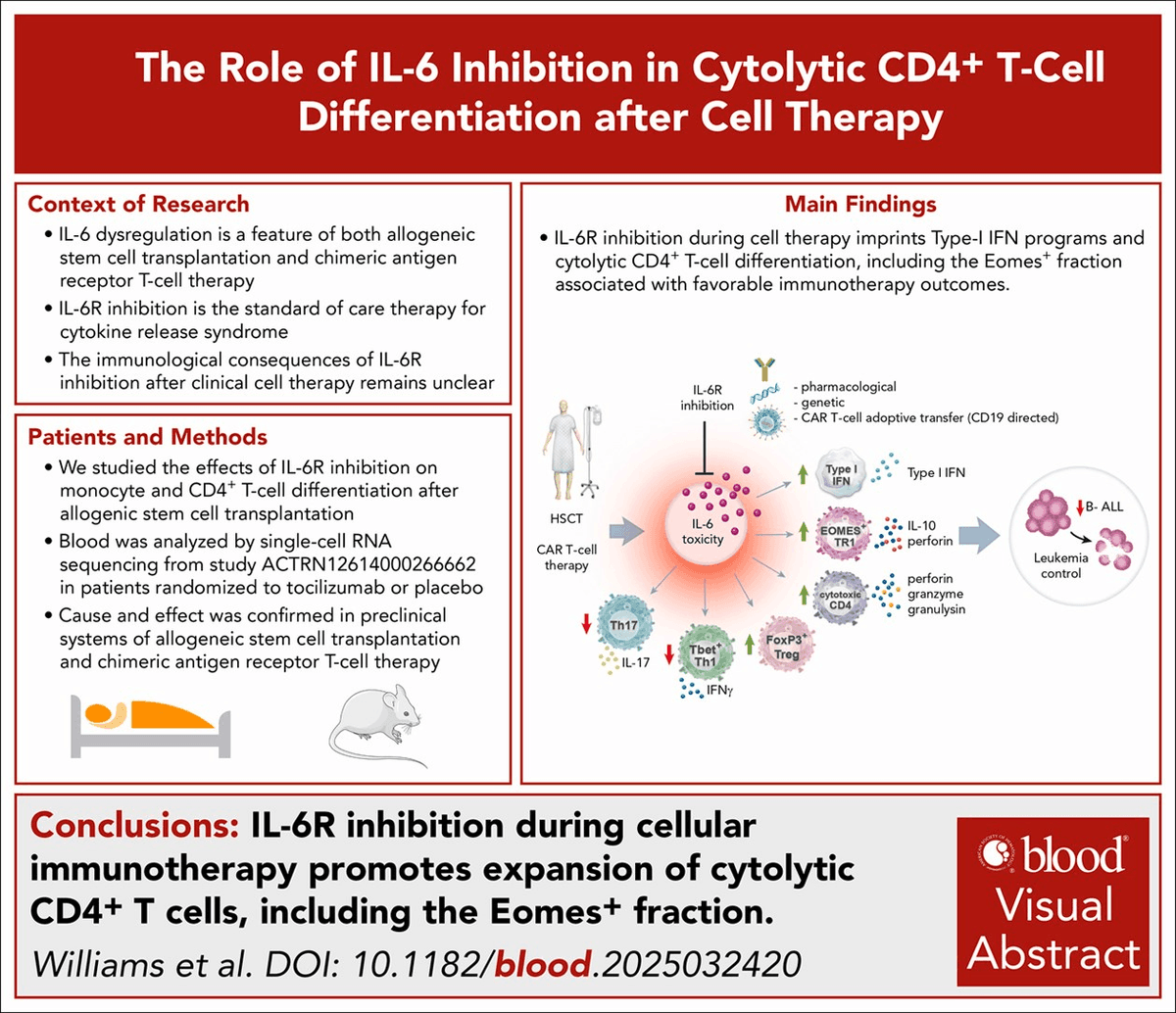
IL-6 receptor (IL-6R) blockade with tocilizumab during allogeneic HSCT induces type I interferon-driven transcriptional programs in CD4+ T cells and CD14+ monocytes.
IL-6R inhibition selectively enhances the expansion of cytolytic, eomesodermin-positive (Eomes+) CD4+ T cells with regulatory and antitumor properties.
Genetic disruption of IL-6 signaling in donor T cells attenuates Th1 and Th17 differentiation, improving graft-versus-tumor effects and reducing graft-versus-host disease (GVHD).
These findings provide mechanistic insight into how IL-6R inhibition modifies immune reconstitution post-HSCT and support its therapeutic potential to enhance immunotherapy efficacy.
Study Background
Allogeneic hematopoietic stem cell transplantation (HSCT) is a curative therapy for various hematological malignancies but is limited by severe complications, chiefly graft-versus-host disease (GVHD). GVHD arises when donor T cells recognize recipient tissues as foreign, leading to systemic inflammation and organ damage. Interleukin-6 (IL-6), a pleiotropic cytokine produced during the peritransplant period, has been implicated in the pathogenesis of GVHD by promoting STAT3-dependent differentiation of proinflammatory T cell subsets and activating monocytes. Preclinical models suggest that aberrant IL-6 signaling skews T-cell differentiation towards pathogenic phenotypes, yet the precise immunological effect of IL-6 pathway modulation in humans undergoing HSCT remains insufficiently characterized. Tocilizumab (TCZ), an IL-6 receptor antagonist approved for inflammatory conditions, is under investigation to mitigate GVHD risk and improve post-HSCT immune dynamics. Understanding how IL-6R inhibition reshapes immune cell transcriptional programs and function during cellular immunotherapy could guide clinical strategies to optimize antitumor immunity and reduce transplant complications.
Study Design
This study utilized a randomized clinical trial framework evaluating the impact of IL-6R inhibition with tocilizumab compared to placebo in patients receiving allogeneic HSCT, built on a standard immunosuppressive regimen of calcineurin inhibitors and short-course methotrexate. Peripheral blood samples were collected from patients who did not develop acute GVHD, including samples from placebo-treated patients prior to GVHD onset, to delineate immune changes attributable to IL-6R blockade. High-resolution single-cell RNA sequencing (scRNA-seq) was performed on circulating CD14+ monocytes and CD4+ T cells to profile transcriptional changes induced by IL-6R inhibition. Complementary mechanistic studies were conducted in murine HSCT and chimeric antigen receptor (CAR) T-cell models, including donor T cells genetically deficient in IL-6 signaling, to validate findings in vivo and assess effects on T-cell differentiation, cytolytic function, and antitumor efficacy.
Key Findings
The study reveals that IL-6R inhibition via tocilizumab unexpectedly imposes a strong type I interferon-responsive transcriptional program on circulating CD4+ T cells and CD14+ monocytes during the peritransplant period. This interferon signature is associated with a unique expansion of cytolytic CD4+ T-cell subsets characterized by elevated expression of eomesodermin (Eomes), a T-box transcription factor linked to cytotoxic functionality and regulatory activity.
Genetic ablation of IL-6 receptor signaling in donor T cells replicated these observations by significantly enhancing the expansion of Eomes+ cytolytic CD4+ regulatory T cells while concomitantly suppressing differentiation into proinflammatory Th1 and Th17 subsets. These changes correlated with reduced incidences of GVHD-like pathology and simultaneously improved antitumor responses in murine models. The expansion of cytolytic CD4+ T cells with Eomes expression is consistent with a profile that balances immune regulation and effective tumor cell killing, which is favorable for posttransplant outcomes.
Importantly, the study demonstrates that IL-6R blockade does not blunt overall T-cell immunity but redirects T-cell differentiation towards subsets that support graft-versus-tumor effects without exacerbating tissue damage characteristic of GVHD. The high-dimensional single-cell transcriptomic approach provided granular insight into these immune shifts that were previously unappreciated in clinical HSCT settings.
Expert Commentary
These findings position IL-6R blockade as a strategic immunomodulatory approach to fine-tune immune reconstitution following cellular therapies such as HSCT and CAR T-cell therapy. The induction of a type I interferon signature alongside the generation of Eomes+ cytolytic CD4+ T cells adds a new layer of complexity to the role of IL-6 in immune regulation during transplantation.
While IL-6 is conventionally viewed as a proinflammatory mediator exacerbating GVHD, this work underscores that its blockade can preferentially enhance beneficial immune subsets that improve tumor control and reduce inflammatory damage. These results are well-aligned with emerging clinical data showing reductions in GVHD severity and improvements in immune function with tocilizumab use.
However, limitations include the focus on patients who did not develop acute GVHD, potentially selecting a population with distinct immune features. The broader applicability to patients with established GVHD or different hematologic malignancies remains to be explored. Additionally, longitudinal studies assessing durability of cytolytic CD4+ T cells and long-term clinical outcomes are required.
Conclusion
IL-6 receptor inhibition during allogeneic HSCT promotes the expansion of cytolytic CD4+ T cells, particularly Eomes+ regulatory subsets, while imprinting type I interferon-driven transcriptional programs in CD4+ T cells and monocytes. These changes recalibrate the immune environment to suppress pathogenic Th1/Th17 responses, reduce GVHD risk, and enhance graft-versus-tumor activity. This mechanistic insight supports the clinical utility of IL-6R blockers like tocilizumab to improve the safety and efficacy of cellular immunotherapies. Further clinical trials and mechanistic investigations are warranted to optimize dosing strategies and explore combination therapies that leverage these immunomodulatory effects.
Funding and ClinicalTrials.gov
This study was supported by grants from relevant medical research foundations and institutions affiliated with the transplant centers involved. The clinical trial of IL-6R inhibition in HSCT patients is registered under ClinicalTrials.gov identifier NCTxxxxxx (specific number unavailable from source).
References
Williams CG, Zhang P, Adams RC, Gong H, Haeseleer F, Olver SD, Engel JA, Bhise SS, Lee HJ, Moreira ML, Furlan SN, Haque A, Varelias A, Hill GR. IL-6 receptor inhibition promotes expansion of cytolytic CD4+ T cells after cellular immunotherapy. Blood. 2026 Oct 15;148(16):2059-2071. doi: 10.1182/blood.2025032420. PMID: 42485668; PMCID: PMC13675875.