Highlight
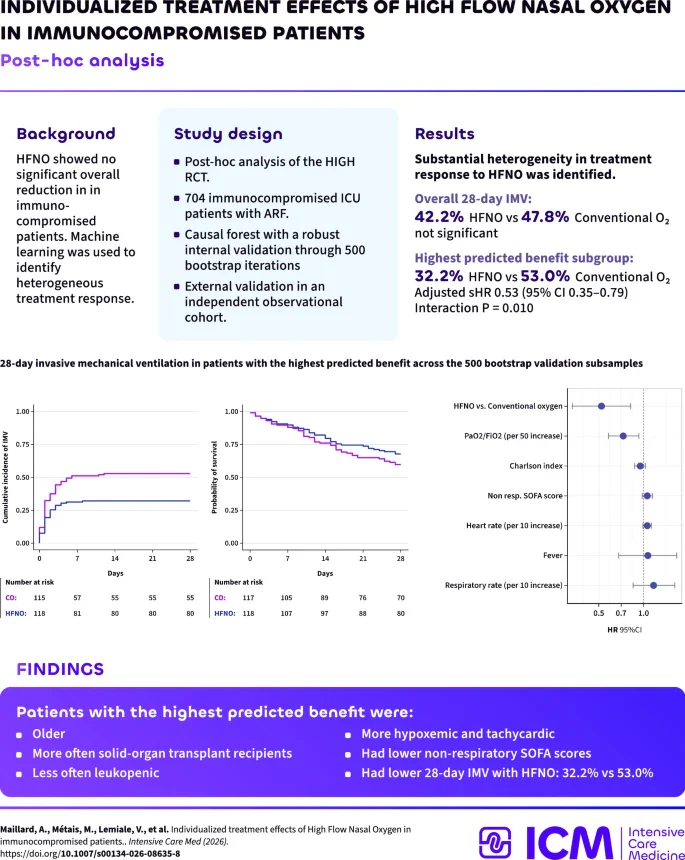
High flow nasal oxygen (HFNO) does not uniformly reduce invasive mechanical ventilation (IMV) rates in immunocompromised patients with acute respiratory failure (ARF).
Machine learning-based causal forest modeling identified significant heterogeneity in treatment responses, highlighting subpopulations that derive substantial benefit from HFNO.
Patients older in age, with solid organ transplants, less neutropenia, and higher respiratory distress but lower non-respiratory organ dysfunction were more likely to benefit from HFNO.
Findings were externally validated in an independent observational cohort, though with calibration differences, underscoring the need for prospective validation.
Study Background
Acute respiratory failure (ARF) is a common and life-threatening complication in immunocompromised patients, representing the leading cause of intensive care unit (ICU) admission in this vulnerable population. Immunocompromise due to malignancy, organ transplantation, or immunosuppressive therapies predisposes patients to infections and inflammatory lung injury, often culminating in hypoxemic ARF. Management strategies to optimize oxygenation and avoid invasive mechanical ventilation (IMV) are critical given the elevated risks of ventilator-associated complications and poor outcomes in this group.
High flow nasal oxygen (HFNO) therapy has gained prominence as a first-line oxygen delivery method for hypoxemic respiratory failure because it improves oxygenation, reduces respiratory effort, and may prevent intubation. However, a recent randomized controlled trial (HIGH trial) surprisingly found no overall advantage of HFNO compared to conventional oxygen therapy in immunocompromised patients, raising questions about its universal applicability. This inconsistency signals that population heterogeneity may obscure benefits limited to specific patient subgroups.
Study Design
This investigation applies a causal forest machine-learning approach to the HIGH trial data to elucidate which baseline characteristics affect HFNO efficacy in preventing IMV at 28 days. The HIGH trial enrolled 776 immunocompromised adults with ARF randomized to HFNO or conventional oxygen therapy. Patients with “do-not-intubate” orders (n=72) were excluded to focus on those eligible for escalation.
Using the causal forest algorithm, the researchers modeled individualized treatment effects (ITEs) of HFNO on the incidence of invasive mechanical ventilation (IMV) by day 28. The model was internally validated via 500 bootstrap iterations to assess robustness. Patients were stratified into terciles according to predicted HFNO benefit. To evaluate the model’s transportability, an independent observational cohort of 818 immunocompromised patients with ARF subjected to oxygen therapy was analyzed.
Key Findings
Average treatment effect analysis demonstrated no statistically significant reduction in IMV incidence at day 28 for HFNO compared to conventional oxygen. However, the causal forest model revealed substantial heterogeneity in treatment effects across individuals, with predicted absolute risk reductions ranging from 7.4% to 20.2% depending on baseline features.
Patients in the highest predicted benefit tercile shared several notable characteristics: they were older, more frequently recipients of solid organ transplants, less often neutropenic, more profoundly hypoxemic and tachycardic, yet with lower non-respiratory Sequential Organ Failure Assessment (SOFA) scores. In this subgroup, HFNO use correlated with a statistically significant reduction in the risk of invasive ventilation, suggesting a targeted clinical benefit.
The model’s performance in the external observational cohort preserved the benefit ranking, indicating good discrimination ability. However, absolute effect estimates showed less calibration, likely reflecting differences in clinical management and patient selection, underscoring the limitations of retrospective application and the necessity for prospective confirmation.
Safety analyses did not reveal excess adverse events linked to HFNO use in any subgroup. The findings collectively indicate that a “one-size-fits-all” approach to oxygen therapy in immunocompromised patients with ARF is suboptimal, and individualized treatment based on baseline risk and physiologic parameters could optimize outcomes.
Expert Commentary
This study exemplifies the progressive application of advanced machine-learning methodologies to unravel treatment heterogeneity, often masked in traditional randomized controlled trials. Immunocompromised patients represent a biologically and clinically diverse population; recognizing subphenotypes that drive differential treatment responsiveness is critical for precision critical care.
Notably, the identified subgroup benefiting from HFNO shares features suggesting a predominant hypoxemic respiratory component with less multisystem failure, where noninvasive respiratory support could forestall intubation effectively. Conversely, patients with higher non-respiratory organ dysfunction or neutropenia may require alternative or more aggressive interventions.
Limitations include the retrospective nature of the secondary analysis, potential confounding in observational validation, and reliance on predefined clinical variables available at baseline. Future research should focus on prospective validation trials integrating machine-learning–guided patient stratification to confirm these findings and inform personalized oxygen therapy protocols.
Conclusion
The evidence from this advanced causal inference analysis challenges existing paradigms by demonstrating that HFNO is not universally beneficial in immunocompromised patients with ARF but may significantly reduce invasive ventilation rates in carefully identified subgroups. Precision medicine approaches incorporating machine learning may enhance decision-making in intensive care, optimizing resource use and outcomes.
Prospective clinical trials implementing individualized treatment effect predictions are warranted to establish causality and direct guideline modifications. Until then, clinicians should cautiously interpret HFNO benefits on a case-by-case basis, considering patient age, immunocompromised status subtype, organ failure burden, and respiratory parameters.
Funding and Trial Registration
The HIGH trial and its secondary analyses were conducted by a collaborative network of French critical care units, supported by institutional and governmental research funding. Specific funding details were not provided in the source abstract.
ClinicalTrials.gov registration and further details can be accessed via the PubMed citation (PMID: 42970133).
References
1. Maillard A, Métais M, Lemiale V, et al. Individualized treatment effects of high flow nasal oxygen in immunocompromised patients. Intensive Care Med. 2026 Nov 2. doi:10.1007/s00134-026-07618-4. PMID: 42970133.
2. Frat JP, Thille AW, Mercat A, et al. High-flow oxygen through nasal cannula in acute hypoxemic respiratory failure. N Engl J Med. 2015;372(23):2185-2196.
3. Azoulay E, Mokart D, Kouatchet A, et al. High-flow nasal oxygen vs. standard oxygen therapy in immunocompromised patients with acute hypoxemic respiratory failure: The HIGH randomized clinical trial. JAMA. 2020;324(13):1331-1339.
4. Van der Veer SN, Kleinberg S. Applications of machine learning and causal forest methods in critical care medicine. Curr Opin Crit Care. 2021;27(1):45-52.