Introduction
Decisions regarding life-sustaining treatment (LST) at the end of life are critical components of intensive care unit (ICU) management. Tools such as Physician Orders for Life-Sustaining Treatment (POLST) and advance directives (AD) are designed to uphold patient autonomy by anticipating patient preferences about terminal care. However, the effect of who signs these documents—the patient themselves or a surrogate decision-maker (usually a family member or legally authorized representative—on the patterns of care and resource utilization in ICU settings remains less well understood.
This nationwide population-based cohort study from South Korea aims to shed light on how the identity of the signatory (patient-determined vs. surrogate-determined) impacts the intensity of terminal care and hospitalization costs among adult ICU patients. Understanding these dynamics is essential in tailoring end-of-life care to respect patient wishes while avoiding overly aggressive and costly interventions that may not benefit the patient.
Background on Life-Sustaining Treatment Decision-Making
Life-sustaining treatments include mechanical ventilation, cardiopulmonary resuscitation (CPR), dialysis, and other interventions that prolong life but may not improve quality of life, particularly in terminal phases. Advance directives and POLST forms serve as legal and clinical tools guiding healthcare providers on patients’ preferences regarding such treatments.
In many cases, patients complete these documents themselves, reflecting their personal wishes. However, when patients become incapacitated or unable to communicate, surrogates often step in to make decisions on their behalf. While surrogates are expected to make choices consistent with known patient preferences, discrepancies can occur, potentially leading to more intensive care than the patient might have desired.
Study Design and Methods
This study analyzed data from the South Korean National Health Insurance Service encompassing 1,189,042 adult ICU admissions between 2020 and 2023 across 417 hospitals nationwide. Researchers used high-dimensional fixed-effects statistical models accounting for institutional variability to assess associations between signatory status on POLST forms and outcomes including terminal care intensity and hospitalization costs.
POLST documentation was categorized into patient-determined POLST (PD-POLST) and surrogate-determined POLST (SD-POLST). Outcomes focused primarily on the intensity of terminal care—measured by invasive interventions during the last days of life—and daily hospitalization costs.
Key Findings
The study found that surrogate-determined POLST (SD-POLST) was more than three times more common than patient-determined POLST (PD-POLST) among ICU patients, indicating that surrogates frequently make end-of-life decisions.
Among patients who died within 90 days, those with PD-POLST had significantly reduced odds of receiving invasive terminal care (Odds Ratio [OR]: 0.43; 95% Confidence Interval [CI]: 0.43–0.54), meaning patient-led decisions were associated with less aggressive interventions at the end of life.
Conversely, SD-POLST was associated with more than double the odds of invasive terminal care (OR: 2.16; 95% CI: 1.98–2.35), highlighting a paradox where surrogate decision-making resulted in more intense treatment, potentially overriding prior patient wishes.
A notably important observation was the phenomenon described as “AD erosion.” Even patients with proactive advance directives experienced increased care intensity if the final order was signed by a surrogate (OR: 1.69; 95% CI: 1.51–1.89). This suggests that initial patient preferences documented in ADs may be undercut once surrogates are involved in decision-making.
Financial analysis showed that SD-POLST was linked to significantly higher daily hospitalization costs (cost ratio: 1.04; 95% CI: 1.02–1.06), suggesting that surrogate-driven decisions may lead to costlier care at the end of life.
Discussion
These findings have important implications for clinical practice and healthcare policy. The effectiveness of POLST in curbing nonbeneficial or overly aggressive care appears fundamentally dependent on the identity of the decision-maker. Patient-led decisions tend to align better with goals of comfort and limiting invasive interventions, whereas surrogate decisions may unintentionally promote more intensive treatment due to emotional factors, uncertainty, or differing perceptions of the patient’s best interest.
“AD erosion” highlights the concerning tendency for advance directives to lose their guiding power when surrogates override documented patient preferences. This phenomenon underscores the need for early and ongoing communication between patients, families, and healthcare providers about end-of-life wishes before critical illness or incapacity occurs.
Clinical and Ethical Considerations
Clinicians should be aware that surrogate decision-makers, while essential, face complex emotional and ethical challenges which may bias decisions toward aggressive care. Therefore, strategies to enhance patient autonomy include:
Encouraging early patient engagement in completing POLST and AD documentation.
Providing support and clear communication to surrogates to understand and respect patient preferences.
Implementing standardized frameworks and training for healthcare teams to guide surrogate decision-making aligned with patient goals.
Healthcare systems should also consider integrating multidisciplinary approaches, including ethics consultations and palliative care involvement, to navigate difficult end-of-life decisions effectively.
Limitations and Future Directions
This study’s strengths include a large national dataset and adjustment for institutional variability. However, limitations include potential unmeasured confounders such as patient cultural background, surrogate understanding, and provider influences on decisions.
Future research should explore interventions that empower patients to complete advance care planning early, enhance surrogate education, and develop supportive policies that align end-of-life care more closely with patient values while considering cultural contexts.
Conclusion
In critically ill adult ICU patients, the identity of the signatory on life-sustaining treatment orders is pivotal. Patient-led decisions are associated with less intensive and costly terminal care, while surrogate-led decisions tend to increase care intensity and costs, sometimes contrary to previously expressed patient wishes. These findings emphasize the urgent need for early, patient-centered discussions and structured support for surrogates to ensure that end-of-life care in the ICU aligns with patients’ goals and values.
Reference
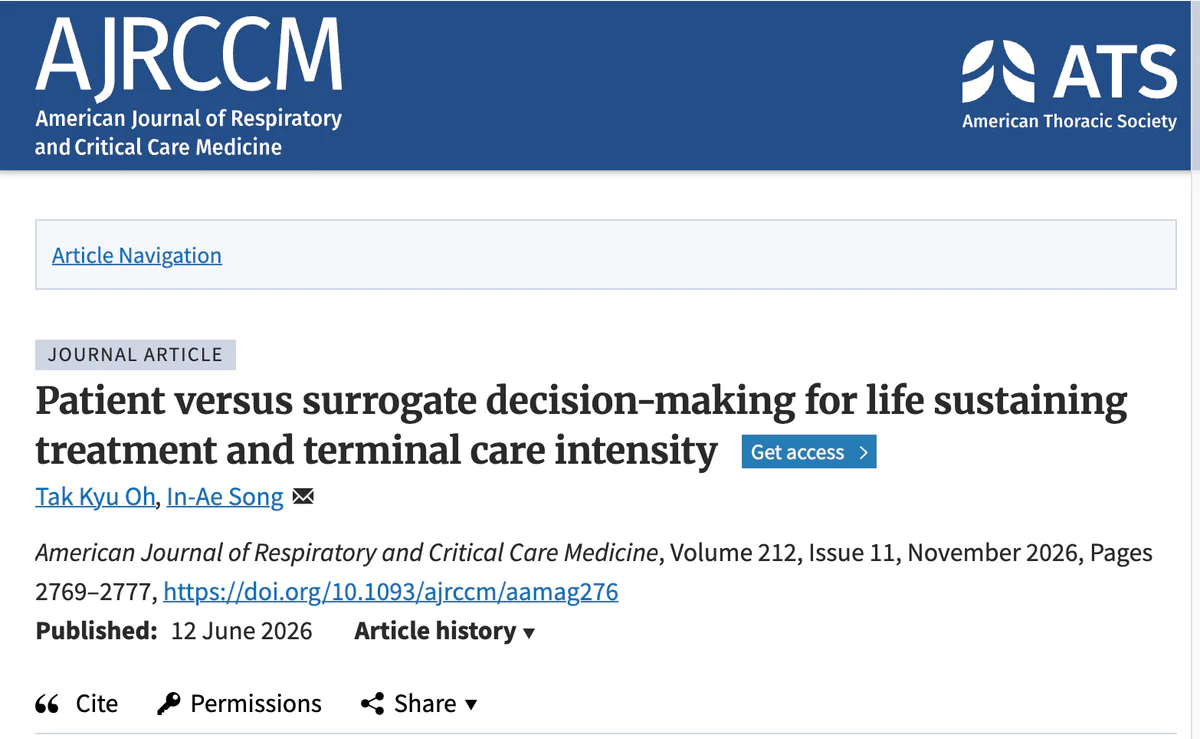
Oh TK, Song IA. Patient versus surrogate decision-making for life sustaining treatment and terminal care intensity. Am J Respir Crit Care Med. 2026 Nov 1;212(11):2769-2777. doi: 10.1093/ajrccm/aamag276. PMID: 42286341.