Switching from Mepolizumab to Benralizumab in EGPA: A Promising Alternative for Persistent Respiratory Symptoms
Highlight
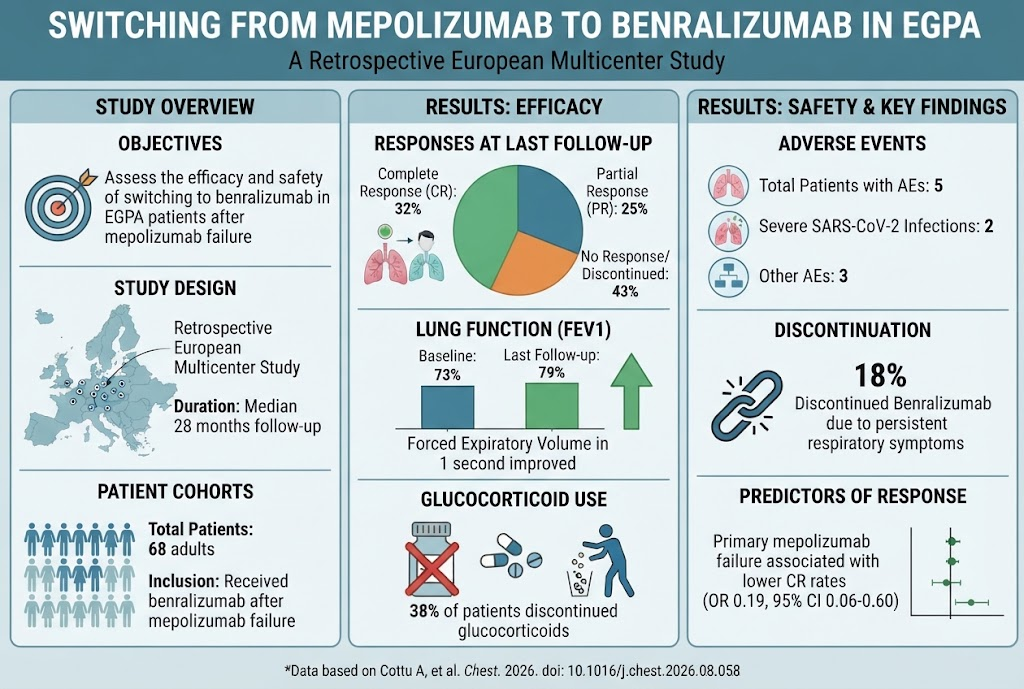
– Switching to benralizumab after mepolizumab failure in EGPA offers a valuable therapeutic option with enhanced eosinophil depletion.
– Approximately 57% of patients achieved complete or partial response, with improvement in lung function and reduced corticosteroid dependency.
– Primary mepolizumab failure predicted lower response rates to benralizumab.
– Benralizumab was generally safe, though some patients discontinued due to persistent respiratory symptoms or adverse events including severe infections.
Study Background
Eosinophilic granulomatosis with polyangiitis (EGPA) is a rare ANCA-associated vasculitis characterized by eosinophilic-rich inflammation affecting small-to-medium vessels. Clinical hallmarks include severe eosinophilic asthma and sinonasal involvement, complicating disease management. Glucocorticoids have been the cornerstone of treatment but are associated with significant toxicity when used long term.
Advancements in targeted biologics that deplete eosinophils have improved outcomes. Mepolizumab, an anti–IL-5 monoclonal antibody, demonstrated efficacy in reducing disease activity and corticosteroid use in EGPA. Benralizumab, an anti–IL-5 receptor alpha antibody, offers a distinct mechanism through antibody-dependent cell-mediated cytotoxicity that results in near-complete depletion of eosinophils, potentially providing superior control in cases refractory to mepolizumab.
Given the variability in response to anti–IL-5 therapies, understanding the clinical benefit and safety of switching from mepolizumab to benralizumab in EGPA is crucial to optimize treatment strategies.
Study Design and Methods
This retrospective European multicenter study included 68 adult patients diagnosed with EGPA who were treated with benralizumab after failure of mepolizumab therapy. Failure criteria included persistent respiratory symptoms and incomplete vasculitis control despite mepolizumab treatment.
Primary endpoints focused on efficacy defined by vasculitis activity score (BVAS) and prednisone dosage: Complete Response (CR) was BVAS=0 with prednisone ≤4 mg/day, while Partial Response (PR) was BVAS=0 with prednisone >4 mg/day. Pulmonary function changes, glucocorticoid tapering success, vasculitis flare rates, and safety profiles were also evaluated.
Follow-up duration on benralizumab had a median of 28 months (interquartile range 20–39 months), allowing for longer-term assessment of outcomes.
Key Findings
The study found that after switching to benralizumab, 32% of patients achieved CR and 25% achieved PR during treatment. Remission was sustained at last follow-up in 19% (CR) and 16% (PR) of patients, indicating maintained disease control for a notable subset.
Median time to achieve CR was 6 months, suggesting a relatively prompt response in many cases. Clinically meaningful improvement was observed with a rise in Forced Expiratory Volume in one second (FEV1) from 73% to 79% predicted, reflecting better pulmonary function.
Significantly, 38% of patients discontinued glucocorticoids, highlighting benralizumab’s corticosteroid-sparing potential — a critical consideration given the side effects of prolonged steroid use.
Vasculitis flares were infrequent, with only six patients experiencing flares during follow-up, supporting the sustained efficacy of benralizumab in controlling systemic inflammation.
Patients who exhibited primary failure on mepolizumab had significantly lower odds of achieving CR with benralizumab (OR 0.19), suggesting that initial resistance to anti–IL-5 strategies predicts a more challenging therapeutic course.
Benralizumab was discontinued in 18% of patients due to persistent respiratory symptoms, indicating that not all refractory patients benefit fully. Overall, adverse events were infrequent; five patients reported events including two severe SARS-CoV-2 infections, which necessitates cautious monitoring but does not contraindicate use.
Expert Commentary
This study addresses an important clinical dilemma in EGPA management: what to do when mepolizumab fails. The data support benralizumab as a viable alternative due to its potent eosinophil depletion mechanism, which likely underpins the improved clinical outcomes observed.
However, the retrospective nature and lack of randomized comparison limit definitive conclusions. The findings emphasize the importance of patient selection, as mepolizumab nonresponders were less likely to achieve complete remission with benralizumab, highlighting potential intrinsic disease heterogeneity.
Future prospective trials are needed to delineate optimal sequencing of anti–IL-5 therapies, identify biomarkers predicting response, and confirm long-term safety, especially amidst viral pandemics that may increase infection risk with immunomodulatory treatments.
Conclusion
For patients with EGPA who exhibit persistent respiratory symptoms and inadequate disease control despite mepolizumab, switching to benralizumab offers a promising therapeutic option. It improves lung function, facilitates glucocorticoid tapering, and maintains disease remission in a substantial proportion.
Clinicians should remain vigilant for persistent symptoms and adverse events necessitating discontinuation. Individualized treatment planning and further research will be critical to optimizing biologic sequencing and improving outcomes in this challenging patient population.
Funding and Clinical Trials
No specific funding disclosures were reported for this retrospective analysis. Further prospective studies assessing benralizumab in EGPA are ongoing and will provide additional insights into safety and efficacy.
References
Cottu A, Mattioli I, Groh M, Puéchal X, Egan A, Padoan R, Brussino L, Schroeder J, Taillé C, Samson M, Cathébras P, Cinetto F, Yildiz H, Pugnet G, Chauvin P, Jouneau S, Diot E, Nicolas S, Lifermann F, Martellosio JP, Guilleminault L, Nguyen Y, De Moreuil C, Guilpain P, Cottin V, Moroni L, Delvino P, Franceschini F, Conticini E, Crimi C, Moroncini G, Bond M, Moi L, Jayne D, Vaglio A, Tcherakian C, Emmi G, Terrier B; European EGPA study group (EESG) and the French Vasculitis Study Group (FVSG). Switching from mepolizumab to benralizumab in eosinophilic granulomatosis with polyangiitis (EGPA). Chest. 2026 Oct 9:S0012-3692(26)06799-1. doi: 10.1016/j.chest.2026.08.058. Epub ahead of print. PMID: 42855125.
This article was created using several editorial tools, including AI, as part of the process. Human editors reviewed this content before publication.