Highlight
The SINGLE-CLOSURE trial is the first randomized study comparing single vs double ProGlide vascular closure devices after transfemoral aortic valve replacement (TAVR). The trial found the single-ProGlide approach to be noninferior regarding access-site vascular complications, with a similar safety profile and no increase in major adverse events. This simplified closure strategy may reduce procedural complexity and potentially mitigate risks related to vascular stenosis associated with multiple device deployment.
Study Background
Transcatheter aortic valve replacement (TAVR) has revolutionized treatment for aortic stenosis, especially in elderly or high-risk patients. The transfemoral approach is the standard access route due to simplicity and feasibility but carries risks of access-site vascular complications including bleeding, hematoma, stenosis, and limb ischemia. Such complications can prolong hospitalization and increase morbidity and mortality.
Vascular closure devices, particularly suture-mediated devices like ProGlide, are routinely used to achieve hemostasis post-TAVR. The conventional strategy employs two ProGlide devices deployed at the access site to ensure robust closure. However, this double-ProGlide method may increase the risk of vessel injury or stenosis, especially in patients with challenging iliofemoral anatomy, small vessel size, or peripheral artery disease.
Retrospective and observational studies suggested that a single-ProGlide strategy might reduce vascular trauma and procedural time while maintaining closure efficacy, but prospective randomized data were lacking before the SINGLE-CLOSURE trial.
Study Design
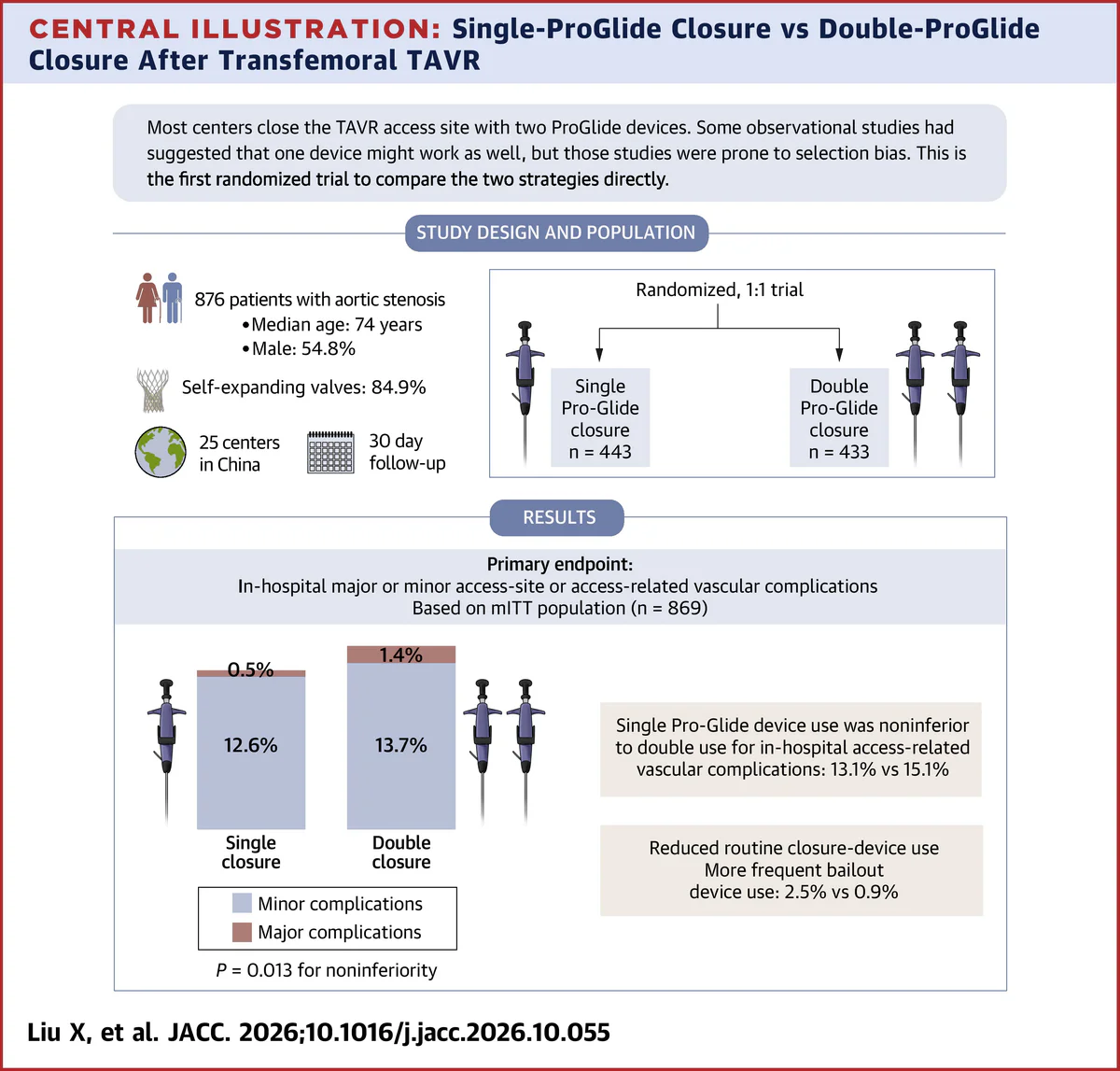
The SINGLE-CLOSURE trial was a prospective, open-label, multicenter randomized controlled trial conducted at 25 centers across China. It enrolled 876 patients aged 65 years or older who were scheduled for transfemoral TAVR for severe aortic stenosis. Patients were randomized in a 1:1 ratio to undergo main access site closure with either a single ProGlide device or the conventional double ProGlide strategy.
The primary endpoint was a composite of access-site and access-related major and minor vascular complications during hospitalization, defined according to Valve Academic Research Consortium (VARC)-3 criteria. Secondary endpoints included individual components of the composite endpoint, access-related bleeding, time to hemostasis, incidence of access-site stenosis, need for additional closure devices, and all-cause mortality.
Key Findings
Among the 876 randomized patients, 436 in the single-ProGlide group and 430 in the double-ProGlide group constituted the modified intention-to-treat population. The primary endpoint occurred in 13.1% of patients in the single-ProGlide group versus 15.1% in the double-ProGlide group. The risk difference was -2.2% (95% confidence interval –7.0% to 2.6%) favoring noninferiority with a prespecified margin of 3.19% (P=0.013 for noninferiority).
Access-related major vascular complications were low in both groups (0.5% with single-ProGlide vs 1.4% with double-ProGlide). Minor vascular complications constituted most primary endpoint events. Bleeding complications, time to achieve hemostasis, and all-cause mortality were comparable between groups, with no statistically significant differences.
Access-site stenosis was observed numerically less frequently in the single-ProGlide group (5.0%) compared to the double-ProGlide group (7.9%), consistent with the hypothesis that reducing device number may lessen vessel narrowing risks. However, the single-ProGlide strategy necessitated additional closure devices more often (2.5% vs 0.9%), suggesting occasional need for adjunctive hemostatic support.
Overall, the data support that single-ProGlide closure is a safer and simpler alternative without compromising clinical outcomes.
Expert Commentary
The SINGLE-CLOSURE trial fills an important knowledge gap by providing randomized evidence for a simplified closure approach after transfemoral TAVR. Vascular complications remain a modifiable contributor to early morbidity, and minimizing device-related vessel trauma is a priority.
Experts advocate carefully selecting closure strategies tailored to patient anatomy and operator experience. The reduced access-site stenosis observed with single-ProGlide aligns with plausible biological reasoning that multiple suture points may cause localized vessel narrowing or damage.
Despite encouraging findings, the trial’s open-label design and predominance of minor complications as endpoint events should be considered when interpreting results. The need for additional devices in some single-ProGlide cases underscores that patient-specific factors remain critical in closure strategy decisions.
Future studies may explore outcomes beyond hospitalization, cost-effectiveness, and refined patient selection criteria to optimize closure device utilization.
Conclusion
The SINGLE-CLOSURE trial demonstrated that a single-ProGlide device is noninferior to the conventional double-ProGlide strategy regarding access-site vascular complications after transfemoral TAVR. With comparable safety and efficacy profiles, the single-ProGlide strategy offers a simpler alternative that may reduce procedural complexity and potentially decrease risk of access-site stenosis. These findings could influence clinical guidelines and practice patterns, improving patient outcomes and procedural efficiency in TAVR care.
Funding and Registration
The SINGLE-CLOSURE trial was multicenter and prospectively conducted. Specific funding sources were not detailed in the abstract. The trial was registered under ClinicalTrials.gov identification not specified in the abstract.
References
1. Liu X, Guo Y, Song G, et al. Single vs Double ProGlide Devices for Access Site Closure after Transfemoral Aortic Valve Replacement: The SINGLE-CLOSURE Trial. J Am Coll Cardiol. 2026 Nov 3; PMID: 42980634.
2. Généreux P, Kodali SK, Green P, et al. Vascular complications after transcatheter aortic valve replacement: insights from the STS/ACC TVT Registry. J Am Coll Cardiol. 2016;67(14):1752-1762.
3. Valgimigli M, et al. Access-site management and closure devices in TAVR: current best practices and future directions. Circulation. 2020;141(14):1219-1232.
4. VARC-3 Consensus Document: Standardized endpoint definitions for TAVR trials. Eur Heart J, 2021; 42(42): 3937–3948.