Highlight
Sibeprenlimab, a humanized monoclonal antibody targeting APRIL, significantly stabilizes kidney function in IgA nephropathy patients over 24 months compared to placebo in a large phase 3 randomized trial. The treatment notably reduced the annualized decline of eGFR and kidney-function deterioration events, with a comparable safety profile to placebo.
Study Background
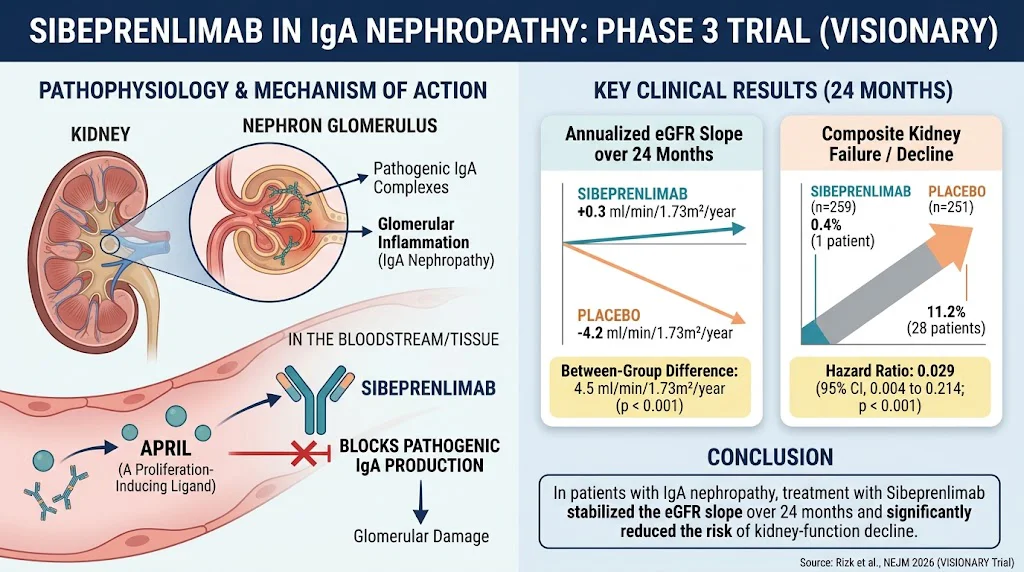
IgA nephropathy is the most common primary glomerulonephritis worldwide and a leading cause of chronic kidney disease progressing to kidney failure. Its pathogenesis involves immune complex deposition of aberrantly glycosylated IgA1, promoting mesangial proliferation and inflammation. Proliferation-inducing ligand (APRIL), a cytokine involved in B-cell survival and immunoglobulin production, has been identified as a pivotal driver of aberrant IgA1 regulation and kidney damage. Despite available supportive care and immunosuppressants, progression to end-stage kidney disease remains a significant clinical challenge, highlighting an unmet need for targeted therapies that can modify disease progression and preserve renal function.
Study Design
The multinational, double-blind, placebo-controlled VISIONARY phase 3 trial enrolled 510 adults with biopsy-confirmed IgA nephropathy. Participants were randomized in a 1:1 ratio to receive subcutaneous sibeprenlimab at 400 mg or placebo every 4 weeks. The primary endpoint, previously reported, was reduction in 24-hour urinary protein-to-creatinine ratio at 9 months. This final analysis focused on key secondary endpoints, including the annualized slope of estimated glomerular filtration rate (eGFR) over 24 months, absolute change in eGFR from baseline to 24 months, and a composite kidney endpoint encompassing significant kidney-function decline or kidney failure. Safety and pharmacodynamics were assessed throughout the study.
Key Findings
Among the 510 randomized patients (259 sibeprenlimab, 251 placebo), the trial achieved a highly significant improvement in preservation of kidney function. The annualized eGFR slope was effectively stabilized in the sibeprenlimab group with a mean change of +0.3 ml/min/1.73 m2 per year (95% CI, -0.4 to 0.9), contrasting with a decline of -4.2 ml/min/1.73 m2 per year (95% CI, -4.9 to -3.6) in placebo (difference of 4.5 ml/min/1.73 m2/year; 95% CI, 3.6 to 5.4; P<0.001). This suggests sibeprenlimab not only halts eGFR loss but may stabilize or improve function in some patients.
The least-squares mean difference in eGFR from baseline to 24 months favored sibeprenlimab by 9.2 ml/min/1.73 m2 (95% CI, 7.1 to 11.4; P<0.001), a clinically meaningful preservation compared to progressive decline on placebo.
Regarding the composite kidney endpoint, only 0.4% of patients receiving sibeprenlimab experienced kidney-function deterioration or failure events compared to 11.2% in placebo (adjusted difference -10.8 percentage points; hazard ratio 0.029, 95% CI 0.004 to 0.214; P<0.001), corroborating a substantial risk reduction.
Safety analyses revealed adverse events were frequent but balanced between groups (90.7% sibeprenlimab vs. 90.0% placebo). Serious adverse events occurred less often in the sibeprenlimab group (8.1% vs. 12.7%), including fewer serious infections (1.9% vs. 4.0%), and no deaths were reported, supporting an acceptable safety profile.
Expert Commentary
The VISIONARY trial provides compelling evidence for the efficacy of sibeprenlimab in altering the natural trajectory of IgA nephropathy by targeting APRIL. Unlike nonspecific immunosuppressants, sibeprenlimab’s mechanism offers specificity for a key pathogenic axis, potentially reducing off-target immunosuppression.
The striking stabilization and even slight improvement in eGFR slope over two years signify a breakthrough, given that IgA nephropathy typically demonstrates relentless kidney function decline. Moreover, the trial’s robust design, large sample size, and clinically relevant endpoints enhance confidence in these findings.
Limitations include the relatively short follow-up for chronic kidney disease progression and the need to confirm long-term safety and efficacy in broader populations, including those with more advanced disease or concomitant immunosuppressive therapies. Further research should explore biomarker-driven patient selection and combination approaches.
Conclusion
Sibeprenlimab represents a promising targeted biologic intervention for IgA nephropathy, achieving significant preservation of kidney function and reduction in clinically meaningful kidney outcomes over 24 months. These findings may shift clinical practice toward precision therapies addressing disease mechanisms and herald improved prognosis for patients with IgA nephropathy.
Funding and ClinicalTrials.gov
This study was funded by Otsuka Pharmaceutical Development and Commercialization. The clinical trial registration number is NCT05248646.
References
Rizk DV, Barratt J, Suzuki Y, et al. Sibeprenlimab in IgA Nephropathy – Final Phase 3 Trial Analysis. N Engl J Med. 2026 Oct 22. PMID: 42911185. Available from: https://pubmed.ncbi.nlm.nih.gov/42911185/