Highlights
Ravulizumab, a long-acting terminal complement C5 inhibitor, significantly reduces proteinuria in IgA nephropathy patients compared to placebo.
Phase 3 interim analysis showed a 43.4% adjusted reduction in 24-hour urinary protein-to-creatinine ratio at 34 weeks.
Complement activation and renal inflammation biomarkers markedly decreased with ravulizumab treatment, supporting mechanism of action.
Ravulizumab demonstrated a favorable safety profile with fewer serious adverse events than placebo and no meningococcal infections.
Background
IgA nephropathy (IgAN) is the most common primary glomerulonephritis worldwide, characterized by mesangial IgA deposition, leading to complement activation. This drives glomerular inflammation, manifesting clinically as hematuria, proteinuria, and progressive nephron loss culminating in chronic kidney disease (CKD) or end-stage kidney disease (ESKD). Despite optimized supportive care including renin-angiotensin system blockade, many patients experience persistent proteinuria and progressive decline in glomerular filtration rate (GFR), underscoring an unmet medical need for effective disease-modifying therapies.
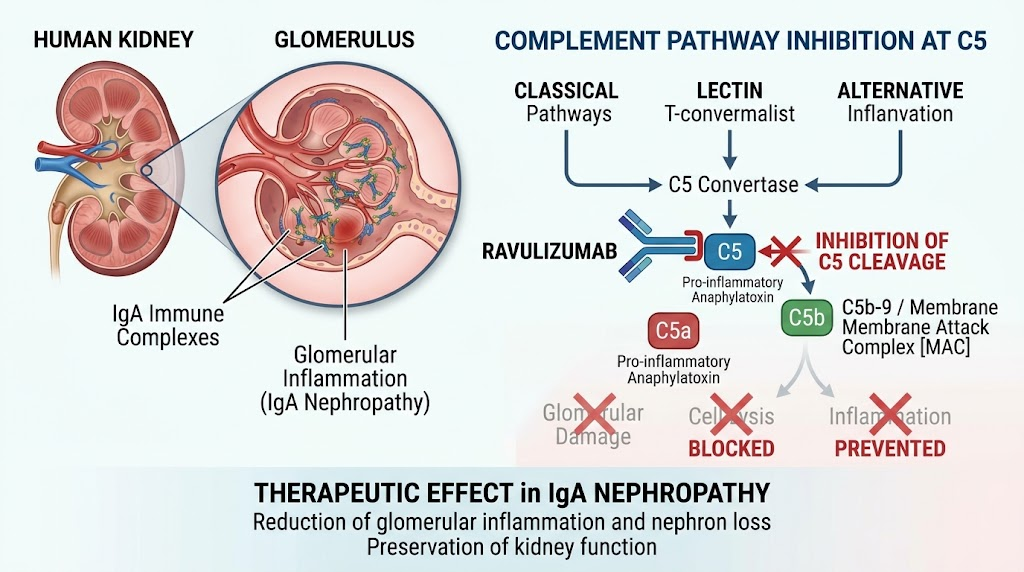
Preclinical and clinical evidence implicate complement activation, especially via the alternative and lectin pathways, as a pivotal driver of inflammatory injury in IgAN. Terminal complement components such as C5a and the membrane attack complex (C5b-9) exacerbate glomerular damage. Targeting these effectors offers a rational therapeutic strategy.
Ravulizumab is a humanized monoclonal antibody targeting complement component C5, preventing its cleavage into proinflammatory C5a and C5b-9 formation. It has an extended half-life, allowing infusions every 8 weeks, providing convenience over earlier inhibitors like eculizumab. Prior phase 2 data showed promising antiproteinuric effects and safety.
Key Content
Chronological Development of Clinical Evidence
Phase 2 Trial Insights
The pivotal 2025 phase 2 RCT (NCT04564339) evaluated ravulizumab plus standard care versus placebo in adults with IgAN having proteinuria ≥1 g/day and eGFR ≥30 ml/min/1.73 m2. Over 26 weeks, ravulizumab induced a 30.1% relative reduction in proteinuria compared to placebo (P=0.005). At 50 weeks, continued proteinuria reduction and stabilization of eGFR trends were noted. Safety was comparable to placebo, with no significant adverse events. This trial established proof-of-concept for complement C5 blockade in IgAN.
Biomarker and Mechanistic Correlations
The complementary SANCTUARY phase 2 trial (NCT04564339) analyzed urinary biomarkers to elucidate ravulizumab’s mechanistic impact. Significantly elevated baseline urinary complement activation markers (soluble C5b-9 and factor Ba), renal inflammation marker (CD163), and tubular injury markers (KIM-1, NGAL) distinguished IgAN patients from healthy controls.
Ravulizumab treatment produced early, sustained reductions in urinary sC5b-9/Cr and Ba/Cr, consistent with inhibition of terminal complement activation. Parallel decreases in CD163/Cr and KIM-1/Cr suggested amelioration of renal inflammation and proximal tubular injury. These biomarker improvements correlated temporally with proteinuria reductions, reinforcing the centrality of complement in IgAN pathophysiology.
Interim Phase 3 Trial Analysis
The recent phase 3 I CAN randomized, double-blind, placebo-controlled trial (NCT06291376) enrolled 485 adults with biopsy-proven IgAN, eGFR ≥30 ml/min/1.73 m2, and persistent proteinuria despite standard therapy (protein-to-creatinine ratio ≥0.75 or total urinary protein ≥1 g/day). Participants were randomized 1:1 to ravulizumab or placebo administered intravenously every 8 weeks.
The prespecified interim analysis at week 34 included 352 participants (176 per group). Baseline geometric mean protein-to-creatinine ratios were comparable (ravulizumab 1.56; placebo 1.60). At week 34, ravulizumab recipients showed a substantial 46.6% reduction versus 5.6% in placebo, an adjusted between-group difference of 43.4% (99% CI, 30.1 to 54.2; P<0.001). Proteinuria reduction was consistent across subgroups defined by baseline proteinuria and eGFR.
Safety evaluation revealed adverse events in 69.5% of ravulizumab-treated versus 75.8% receiving placebo; serious adverse events were fewer with ravulizumab (4.6% vs. 9.0%). Notably, no meningococcal infections or deaths occurred during follow-up, affirming a favorable safety profile.
Comparative Efficacy and Safety Summary
Trial | Phase | Population | Duration | Proteinuria Reduction | eGFR Change | Adverse Events |
|---|---|---|---|---|---|---|
S ANCTUARY (2025) | Phase 2 | Adults IgAN; proteinuria≥1 g/d, eGFR≥30 | 26-50 weeks | ~30% relative reduction vs placebo at 26 weeks | Trend toward stabilization at 26 and 50 weeks | Similar to placebo; well tolerated |
I CAN (2026 Interim) | Phase 3 | Adults IgAN; proteinuria≥0.75 g/g, eGFR≥30 | 34 weeks | 43.4% adjusted reduction vs placebo (P<0.001) | Data pending; early results suggest stable function | Adverse events 69.5% vs 75.8%; serious events less |
Expert Commentary
The accumulating data from phase 2 and interim phase 3 studies firmly position ravulizumab as a promising disease-modifying agent targeting complement activation in IgAN. The robust magnitude of proteinuria reduction, considered a validated surrogate for renal outcomes, portends potential long-term kidney protection.
The mechanistic biomarker analyses substantiate ravulizumab’s biological effect on key pathogenic pathways, particularly dampening terminal complement-mediated glomerular and tubular injury. These insights align with mounting evidence supporting complement inhibition as a pivotal therapeutic axis.
Safety signals are reassuring, with no excess serious infections or unexpected toxicities, though vigilance for meningococcal infection remains paramount given C5 inhibitor class effects.
Uncertainties remain concerning the durability of clinical benefit beyond midterm follow-up and effects on hard renal endpoints such as ESKD. Longer-term data from the ongoing phase 3 trial and subsequent extension studies are eagerly awaited.
Guideline incorporation of ravulizumab will depend on confirmatory phase 3 data and cost-effectiveness considerations given its biologic nature. Moreover, patient selection markers—potentially including urinary complement biomarkers—could optimize therapeutic responsiveness.
Conclusion
Ravulizumab demonstrates significant antiproteinuric efficacy and biomarker modulation in IgAN, evidencing a tangible clinical and mechanistic advance. The phase 3 interim results underscore its potential to transform the treatment paradigm for IgAN, a disease currently managed inadequately with supportive therapies alone.
Continued investigation is warranted to delineate long-term renal outcomes, safety, and integration with existing immunomodulatory and supportive treatments. Personalized complement-targeted approaches embody a promising frontier in glomerulonephritis management.
References
Barratt J et al. Ravulizumab in IgA Nephropathy – Interim Analysis of a Phase 3 Trial. N Engl J Med. 2026 Oct 23; PMID: 42912700. doi:10.1056/NEJMoa2607544.
Heerspink HJL et al. Efficacy and Safety of Ravulizumab in IgA Nephropathy: A Phase 2 Randomized Controlled Trial. J Am Soc Nephrol. 2025 Apr 1;36(4):645-656. PMID: 39455063. doi:10.1681/ASN.0000000534.
Rice K et al. Urinary Biomarker Analysis of the SANCTUARY Trial: Insights into IgA Nephropathy Pathophysiology and Ravulizumab Mechanism of Action. Clin J Am Soc Nephrol. 2026 Oct 22. PMID: 42912895. doi:10.2215/CJN.0000001243.