Short-Term Kanzaki Mulberry Leaf and Water Chestnut Tea Intake Effectively Suppresses Postprandial Blood Glucose Variability: A Randomized Crossover Trial
Postprandial hyperglycemia, characterized by elevated blood glucose levels following meals, is increasingly recognized as an independent risk factor for the development of type 2 diabetes mellitus and cardiovascular disease. Even in healthy individuals, transient spikes in glucose can impair vascular endothelial function, promoting long-term morbidity. Therefore, strategies to mitigate postprandial glucose excursions are critical for diabetes prevention and metabolic health.
Dietary approaches incorporating natural anti-hyperglycemic agents have gained momentum, as they provide a safe and accessible means to blunt glucose spikes. Particularly, plant-derived polyphenols and 1-deoxynojirimycin (DNJ), an $ extalpha$-glucosidase inhibitor from mulberry leaves (Morus alba), exhibit promising carbohydrate digestion modulation properties. Water chestnut (Trapa japonica) husks similarly contribute hydrolyzable polyphenols that impede carbohydrate-degrading enzymes, potentially complementing DNJ activity.
The Kanzaki mulberry leaf and water chestnut tea (MW tea) combines these botanicals, but evidence on its short-term daily intake efficacy and safety remains limited. This study addresses this gap by evaluating the effects of two-week MW tea consumption on postprandial glycemic variability using continuous glucose monitoring (CGM), a tool enabling high-resolution glucose dynamics assessment in real-world conditions.
Study Design and Methods
This was a randomized, double-blind, placebo-controlled, two-period crossover trial involving 31 adult participants without diabetes, recruited in Japan. Each intervention period lasted two weeks, with a one-week washout interval between periods. Participants were randomly assigned to consume either MW tea, comprising a standardized dose of 2.85 g mulberry leaf powder and 0.15 g water chestnut husk containing 5.10 mg DNJ and 87.3 mg polyphenols, or a visually indistinguishable placebo before meals.
Interstitial glucose measurements were continuously recorded every 15 minutes over each period using the FreeStyle Libre system. The primary outcome was the coefficient of variation (CV) of glucose, calculated from the 10 central days of each intervention phase to exclude adaptation effects. Secondary outcomes included postprandial glucose incremental area under the curve (AUC) following a standardized meal, hypoglycemia incidence, and comprehensive safety assessments via blood biochemical panels, physical activity, sleep monitoring, and participant-reported symptoms.
Key Findings
The primary endpoint analysis revealed a statistically significant reduction in glucose CV during the MW tea period compared with placebo (mean difference: -0.0203; 95% CI: -0.031 to -0.010; p=0.0006), indicating decreased glycemic variability. This finding persisted after controlling for sequence and period effects in the crossover design.
Postprandial glucose AUC at 1 hour was significantly lower with MW tea intake versus placebo (p=0.020), demonstrating suppression of early postprandial glucose spikes. Reductions at 2 and 3 hours were not significant, suggesting that MW tea predominantly affects initial carbohydrate absorption.
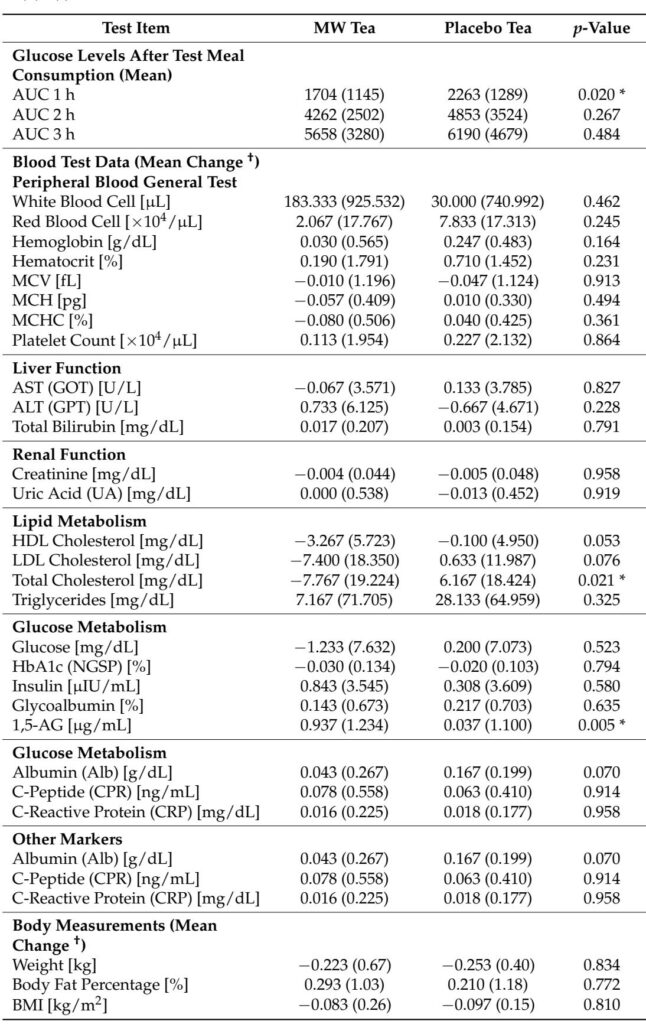
1,5-Anhydroglucitol (1,5-AG), a marker inversely related to glucose excursions, significantly increased during MW tea consumption (p=0.005), further supporting improved glycemic control. Total cholesterol levels decreased (p=0.021), with a trend towards reduced LDL cholesterol, hinting at lipid metabolism benefits linked to the polyphenolic content.
Importantly, no significant differences emerged in hypoglycemia episodes, duration, or severity, nor in hepatic, renal, or inflammatory markers, underscoring the safety of MW tea during short-term use. Self-reported adverse symptoms, including gastrointestinal disturbances, also did not differ significantly.
Physical activity and sleep metrics remained comparable between periods, minimizing confounding. Dietary intake analysis showed minor decreases in total energy and food weight during the study but stable macronutrient composition, unlikely to account for glycemic changes.
Expert Commentary
This well-designed crossover study leverages CGM technology, allowing precise insight into fluctuating glucose dynamics beyond conventional fasting glucose or sporadic postprandial measures. The robust finding of reduced glycemic variability through short-term MW tea consumption aligns with prior mechanistic studies of DNJ and water chestnut polyphenols inhibiting $ extalpha$-glucosidase and $ extalpha$-amylase enzyme activity.
The lack of hypoglycemic events suggests that the inhibitory effect is moderate and meal-specific, favoring safety. The observed improvement in lipid profiles warrants further mechanistic exploration, as polyphenols may modulate cholesterol absorption and metabolism.
Study limitations include the short duration and modest sample size, limiting extrapolation to longterm clinical endpoints or populations with established diabetes. Also, dietary intake was self-reported, which might introduce reporting bias. Future studies with larger cohorts, longer follow-up, and diverse populations—including those with insulin resistance or diabetes—are necessary to confirm efficacy and safety.
Conclusion
Short-term daily intake of Kanzaki mulberry leaf and water chestnut tea significantly diminishes postprandial glucose variability and early glucose spikes in healthy adults without compromising safety. These findings support MW tea as a promising natural adjunct for glycemic management and diabetes prevention strategies. Broader clinical trials are warranted to validate these effects in at-risk populations and to evaluate sustained consumption outcomes.
References
1.Shinkawa Y, Yasuda M, Nishida Y, Tokiya M, Takagi Y, Matsumoto A, Kawaguchi A, Hara M. Evaluation of the Postprandial-Hyperglycemia-Suppressing Effects and Safety of Short-Term Intake of Mulberry Leaf and Water Chestnut Tea: A Randomized Double-Blind Placebo-Controlled Crossover Trial. Nutrients. 2025 Jul 13;17(14):2308. doi: 10.3390/nu17142308. PMID: 40732933; PMCID: PMC12300009.
2. Yasuda M, Yasutake K, Yoshinaga I, et al. Mulberry leaves and water chestnut tea reduces postprandial blood glucose in borderline diabetic Japanese: A randomized, double-blind, placebo-controlled crossover study. Asia Pac J Clin Nutr. 2025;34:174-182.
3. Nakano T, Kondo H, Ken’o I, et al. Effects of dietary intake of mulberry leaves on postprandial blood glucose in humans—a randomized, placebo controlled, double-blind, crossover study. J Glob. 2016;44:391-397.
4. Yasuda M, Yasutake K, Hino M, et al. Inhibitory effects of polyphenols from water chestnut (Trapa japonica) husk on glycolytic enzymes and postprandial blood glucose elevation in mice. Food Chem. 2014;165:42-49.
5. Bailey T, Bode BW, Christiansen MP, et al. The performance and usability of a factory-calibrated flash glucose monitoring system. Diabetes Technol Ther. 2015;17:787-794.
6. Buse JB, Freeman JLR, Edelman SV, et al. Serum 1,5-anhydroglucitol (GlycoMark): A short-term glycemic marker. Diabetes Technol Ther. 2003;5:355-363.
This article was created using several editorial tools, including AI, as part of the process. Human editors reviewed this content before publication.