Severe Hypertriglyceridemia: New Therapies and Evolving Understanding
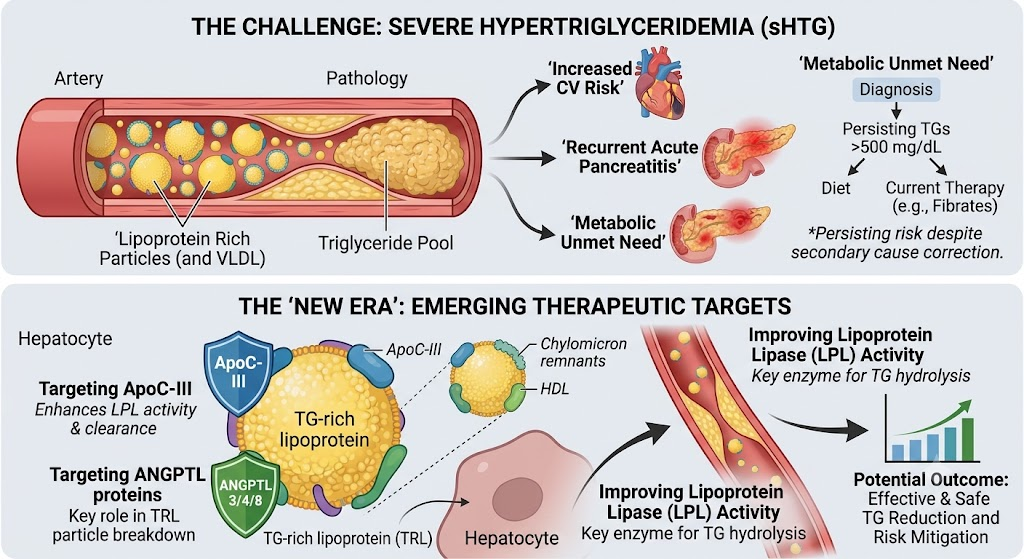
Severe hypertriglyceridemia (sHTG, TG >500 mg/dL) affects approximately 1 in 88 adults in pooled global estimates and is linked to elevated risks of acute pancreatitis and atherosclerotic cardiovascular disease.
Current pharmacologic options often fail to achieve sustained triglyceride control. The siRNA therapy plozasiran, which targets apoC-III, has shown robust TG reductions and reduced pancreatitis risk in the Phase III PALISADE trial.
Pediatric sHTG management, particularly for hospitalized children, lacks dedicated guidelines; genetic causes are common in this population.
Prevalence estimates vary widely by region and definition, underscoring the need for standardized thresholds and longitudinal incidence studies.
Background
Hypertriglyceridemia (HTG) is an established independent risk factor for cardiovascular disease. Severe HTG (sHTG), defined by most current guidelines as fasting triglycerides (TG) >500 mg/dL, and extreme HTG (>1,000 mg/dL) are associated with a markedly increased risk of recurrent acute pancreatitis and represent a substantial unmet medical need. Despite the availability of lifestyle interventions, fibrates, omega‑3 fatty acids, and statins, many patients fail to achieve adequate TG lowering, particularly those with monogenic disorders such as familial chylomicronemia syndrome (FCS) or polygenic forms compounded by secondary factors such as obesity, insulin resistance, and poorly controlled diabetes. In 2025–2026, a wave of novel therapies has begun to reshape the treatment landscape. This article synthesizes recent evidence on emerging pharmacologic strategies, epidemiology, and pediatric management of sHTG, drawing from a contemporary review, a Phase III trial on apoC‑III inhibition, a pediatric management chapter, and a comprehensive prevalence study.
Key Advances
Targeting apoC‑III: Plozasiran and beyond
Apolipoprotein C‑III (apoC‑III) is a key inhibitor of lipoprotein lipase (LPL) activity and promotes the accumulation of triglyceride‑rich lipoproteins. Naturally occurring loss‑of‑function variants in the APOC3 gene are associated with favorable lipid profiles and reduced cardiovascular risk, making apoC‑III an attractive therapeutic target. Plozasiran is an investigational small interfering RNA (siRNA) that selectively degrades hepatic APOC3 mRNA, thereby reducing apoC‑III production. Clinical trials, including the pivotal Phase III PALISADE study in patients with FCS, have demonstrated that plozasiran produces robust and durable reductions in TG levels, often normalizing them, and is associated with reductions in non‑HDL cholesterol and apolipoprotein B. Importantly, PALISADE showed a significant reduction in acute pancreatitis events, a critical endpoint for this high‑risk population. The safety profile has been favorable, with the most common adverse events being mild injection‑site reactions. The prolonged dosing interval (every three months) offers a practical advantage over daily or weekly regimens. While long‑term cardiovascular outcome data are still pending, the mechanism‑based action of plozasiran positions it as a potentially transformative therapy for patients with sHTG refractory to conventional treatments.
Evolving understanding of prevalence and definition
A comprehensive review and weighted meta‑analysis of 18 clinical guidelines identified TG >500 mg/dL as the most commonly used threshold for sHTG. Pooled prevalence estimates for unspecified (primary or secondary) sHTG varied by cutpoint: 1.14 % (1 in 88) for TG >500 mg/dL, 0.19 % for TG >886 mg/dL, and 0.18 % for TG >1,000 mg/dL. Substantial regional differences exist; the United States and China report higher prevalence than Europe. Incidence data are sparse: Canada reported a cumulative incidence of 1 in 400 for TG 886–1,771 mg/dL and 1 in 2,500 for TG >1,771 mg/dL; Denmark reported 39 per 100,000 person‑years for TG >886 mg/dL. These data highlight the need for standardized nomenclature and thresholds to improve comparability across studies and to identify patients with persistent elevations who may benefit from emerging therapies.
Pediatric severe hypertriglyceridemia
sHTG in children is uncommon but carries its own set of challenges. When TG levels exceed 1,000 mg/dL, a monogenic disorder or a combination of polygenic variants is likely, often exacerbated by obesity, insulin resistance, or medications. The 2011 NHLBI Expert Panel provided outpatient recommendations, but no guidelines exist for the inpatient management of critically ill children with sHTG, with or without pancreatitis. Management in the hospital setting typically involves aggressive hydration, insulin infusion, and sometimes plasmapheresis, but evidence is limited. The Endotext chapter reviewed here underscores the need for pediatric‑specific protocols and highlights that long‑term risk of atherosclerotic cardiovascular disease may begin early.
Expert Commentary
The emergence of therapies such as plozasiran represents a paradigm shift in the management of sHTG. The ability to durably suppress apoC‑III production with an every‑three‑month injection addresses both adherence and efficacy gaps that have long plagued fibrates and other agents. However, several important questions remain. First, long‑term cardiovascular outcome trials are needed to confirm that TG reduction with apoC‑III inhibition translates to reduced myocardial infarction, stroke, and cardiovascular death. Second, the cost and access to these novel agents could limit their use to specialized lipid clinics and patients with confirmed FCS, leaving a large population of polygenic sHTG undertreated. Pediatric management remains a particular challenge; the absence of inpatient guidelines and the lack of pediatric safety data for plozasiran and similar agents mean that current care is largely empirical. Finally, the variability in prevalence estimates underscores the importance of consistent screening and case‑finding, especially in populations with high rates of obesity and diabetes.
Clinical and Translational Implications
For clinicians, the key takeaway is that sHTG is not a monolithic condition. Patients with TG >500 mg/dL should undergo evaluation for secondary causes and, if levels persist, consideration of genetic testing and referral to a lipid specialist. The availability of plozasiran and other emerging therapies (such as ANGPTL3 inhibitors, which are also in development) will likely expand the therapeutic arsenal, but cost and access will determine their real‑world impact. In the interim, optimizing lifestyle, managing diabetes, and using maximally tolerated statins and fibrates remain the backbone of care. The pediatric community must urgently develop evidence‑based protocols for hospitalized children with sHTG, as current reliance on adult‑derived data carries considerable uncertainty.
Conclusion
Severe hypertriglyceridemia remains a serious condition with elevated risks of pancreatitis and cardiovascular disease. The treatment landscape is entering a new era, led by apoC‑III inhibition with plozasiran, which has demonstrated remarkable efficacy in reducing TG and pancreatitis events. At the same time, work remains to standardize definitions, improve incidence estimates, and develop pediatric guidelines. As research progresses and broader patient populations are studied, these therapies have the potential to fundamentally alter the natural history of sHTG and its complications.
References
Larouche M, Gaudet D. Treatment of severe hypertriglyceridemia: a new era dawns. J Clin Endocrinol Metab. 2026. PMID: 42497031.
Kassem B, Shaik FA, Sorour O, et al. Silencing Triglycerides: The Clinical Impact of Plozasiran and apoC‑III Inhibition in Severe Hypertriglyceridemia. J Cardiovasc Pharmacol. 2026. PMID: 42359618.
De La Torre A, Hamilton L, Wilson DP. Management of Hospitalized Children with Severe Hypertriglyceridemia. In: Feingold KR, et al., editors. Endotext. 2026. PMID: 32049473.
Baass A, Paquette M, Lam O, et al. Prevalence, incidence, and definition of severe hypertriglyceridemia: A comprehensive review and weighted summary. J Clin Lipidol. 2025;19(6):1550-1563. PMID: 41073238.
This article was created using several editorial tools, including AI, as part of the process. Human editors reviewed this content before publication.