Reversing Epigenetic Aging in Psoriasis: The Impact of Tildrakizumab over 52 Weeks
Highlight
• Psoriasis patients exhibit accelerated epigenetic aging linked to increased mortality risk.
• Tildrakizumab treatment significantly reduces epigenetic age deviation measured by mortality-predictive DNA methylation clocks.
• Partial reversal of biological aging markers was observed as early as 28 weeks, sustained at 52 weeks.
• The study provides novel insights into the systemic effects of IL-23 inhibition beyond cutaneous symptom control.
Study Background
Psoriasis is a chronic immune-mediated inflammatory skin disorder affecting approximately 2–3% of the global population. Besides its cutaneous manifestations, psoriasis is associated with increased systemic comorbidities, including cardiovascular disease and metabolic syndrome, conditions often linked with accelerated aging processes. Recent advances in molecular biology have introduced epigenetic aging clocks—biomarkers based on DNA methylation patterns—that predict biological age and mortality risk beyond chronological age. While biologics targeting interleukin-23 (IL-23) have revolutionized psoriasis treatment by effectively controlling skin inflammation, their impact on systemic aging biomarkers has not been established. Understanding whether IL-23 blockade modulates epigenetic aging has important implications, as it suggests potential disease-modifying effects beyond symptom control.
Study Design
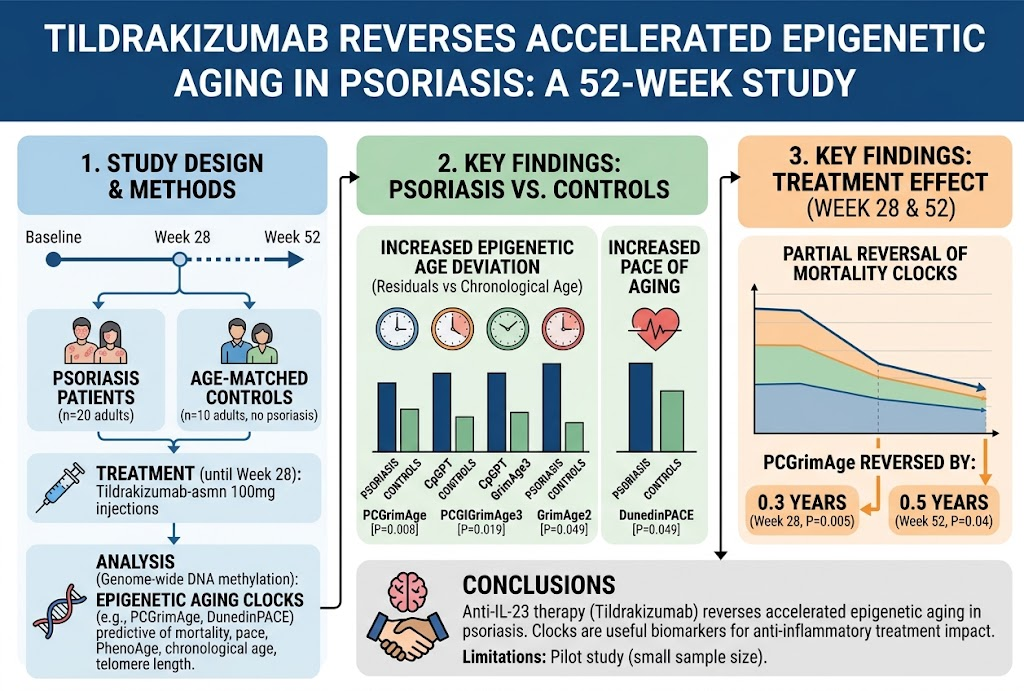
This investigation was a 52-week open-label clinical trial enrolling 20 adult patients with moderate-to-severe psoriasis. Participants received tildrakizumab-asmn 100 mg subcutaneous injections until week 28, per approved dosing regimens. Ten age-matched healthy controls without psoriasis served as comparative baselines. Peripheral blood leukocyte DNA from all participants was analyzed using the Illumina MethylationEPIC v2.0 array to profile genome-wide DNA methylation patterns. Several epigenetic aging clocks were calculated to assess different aspects of biological aging: clocks predictive of all-cause mortality (PCGrimAge, CpGPTPCGrimAge3, CpGPTGrimAge3, GrimAge2), phenotypic age, chronological age, pace of aging (DunedinPACE), and telomere length proxies. Epigenetic age deviation was derived as residual values after adjusting for chronological age, thus reflecting accelerated or decelerated biological aging relative to calendar age.
Key Findings
At baseline, psoriasis patients demonstrated significantly increased epigenetic age acceleration compared to controls, particularly in clocks predicting mortality risk. Specifically, PCGrimAge showed increased deviation with statistical significance (P=0.008), as did CpGPTPCGrimAge3 and CpGPTGrimAge3 (both P=0.019), and GrimAge2 (P=0.049). These findings align with the recognized heightened mortality risk in psoriasis beyond the burden of skin symptoms.
Tildrakizumab treatment produced a significant reversal of epigenetic age acceleration. PCGrimAge deviation decreased by approximately 0.3 years at week 28 (P=0.005) and maintained a 0.5-year reduction at week 52 (P=0.04). This partial normalization suggests biological aging processes can be modulated within a year of effective IL-23 inhibition in psoriasis. The DunedinPACE clock, which measures the pace of aging, indicated an increased rate in psoriasis patients at baseline (P=0.049), though data on post-treatment changes were not reported in detail.
Additional findings regarding phenotypic age, telomere length proxies, and chronological age clocks were not highlighted, emphasizing the greater sensitivity of mortality-focused methylation clocks to disease-related epigenetic aging deviations.
Importantly, the study was limited by a small sample size, precluding extensive subgroup or mechanistic analysis. The open-label design also limits interpretation regarding placebo effects or comparative efficacy. No safety signals or adverse event data were detailed in the abstract, though tildrakizumab’s safety profile is well established in prior psoriasis trials.
Expert Commentary
This pilot study illuminates a novel dimension of psoriasis pathophysiology and treatment response—epigenetic aging modulation. The acceleration of methylation-based aging clocks in psoriasis complements emerging evidence that chronic systemic inflammation drives premature biological aging and increased mortality risk. The partial reversal with tildrakizumab suggests that IL-23 blockade may mitigate systemic pro-aging signals, potentially contributing to improved long-term outcomes beyond skin clearance.
The choice of epigenetic clocks predictive of mortality risk as primary endpoints is scientifically sound, given their relevance to clinical outcomes. Nevertheless, mechanistic connections linking IL-23 inhibition to DNA methylation alterations warrant further exploration, possibly involving modulation of inflammatory cytokines, cellular senescence, and oxidative stress pathways.
Future larger, placebo-controlled studies could clarify durability and clinical implications of epigenetic age reversal. Longitudinal evaluations correlating epigenetic changes with cardiovascular and metabolic comorbidity development would further enhance translational relevance. Integration of epigenetic biomarkers into clinical decision-making might eventually personalize biologic therapy by identifying patients at greatest systemic risk.
Conclusion
The study provides compelling preliminary evidence that moderate-to-severe psoriasis is associated with accelerated epigenetic aging, specifically in methylation clocks linked to mortality risk. Treatment with tildrakizumab-asmn over 28 to 52 weeks partially reverses this acceleration, indicating IL-23 inhibition may beneficially influence systemic biological aging processes. These findings highlight the expanded therapeutic potential of biologics in psoriasis, addressing not only skin pathology but also broader systemic aging-related morbidity. Larger confirmatory trials are needed to validate and extend these observations and to elucidate mechanistic underpinnings.
Funding and ClinicalTrials.gov Registration
This study was funded by Sun Pharmaceutical Industries, Inc. It was registered on ClinicalTrials.gov under the identifier NCT05110313.
References
1. Macit B, Benca-Bachman CE, Qureshi A, et al. The Effects of Tildrakizumab in the Epigenetic Aging Deviation of Psoriasis: A 52-Week Open-Label Study. J Am Acad Dermatol. 2026 Aug 19. PMID: 42617697.
2. Horvath S. DNA methylation age of human tissues and cell types. Genome Biol. 2013;14(10):R115.
3. FitzGerald O, et al. Biology of IL-23 and IL-17 in psoriasis and psoriatic arthritis pathogenesis. Nat Rev Rheumatol. 2021;17(9):567-579.
4. Levine ME. Modeling the Rate of Senescence: Can We Predict Health Outcomes Using Epigenetic Biomarkers? Methods Mol Biol. 2020;2090:47-57.
5. Rachakonda TD, et al. Psoriasis and risk of cardiovascular disease: Insights into protective mechanisms and treatment implications. J Am Acad Dermatol. 2020;83(4):934-942.
This article was created using several editorial tools, including AI, as part of the process. Human editors reviewed this content before publication.