Highlight
This article examines recent clinical findings comparing office-based 445-nm blue laser treatment to microlaryngoscopy under general anesthesia for Reinke’s edema. Key highlights include: substantial voice-related quality of life improvements post-treatment; high rates of complete edema regression with both methods; significantly shorter operative times for office-based treatments; and excellent safety profiles with no adverse events reported.
Study Background
Reinke’s edema is a benign swelling of the vocal fold lamina propria resulting from fluid accumulation, commonly linked to smoking and voice misuse. The condition causes hoarseness and voice changes, significantly impacting patients’ quality of life, particularly those reliant on vocal performance professionally. Traditional treatment often involves microlaryngoscopy under general anesthesia (GA) for surgical removal or reduction of the edema. However, general anesthesia presents inherent risks and resource demands. Innovations in office-based procedures using specialized lasers present an opportunity for less invasive management with potential benefits including reduced operative time, quicker recovery, and lower healthcare costs. The 445-nm blue laser, owing to its precise tissue interaction and hemostatic properties, has emerged as a promising alternative approach.
Study Design
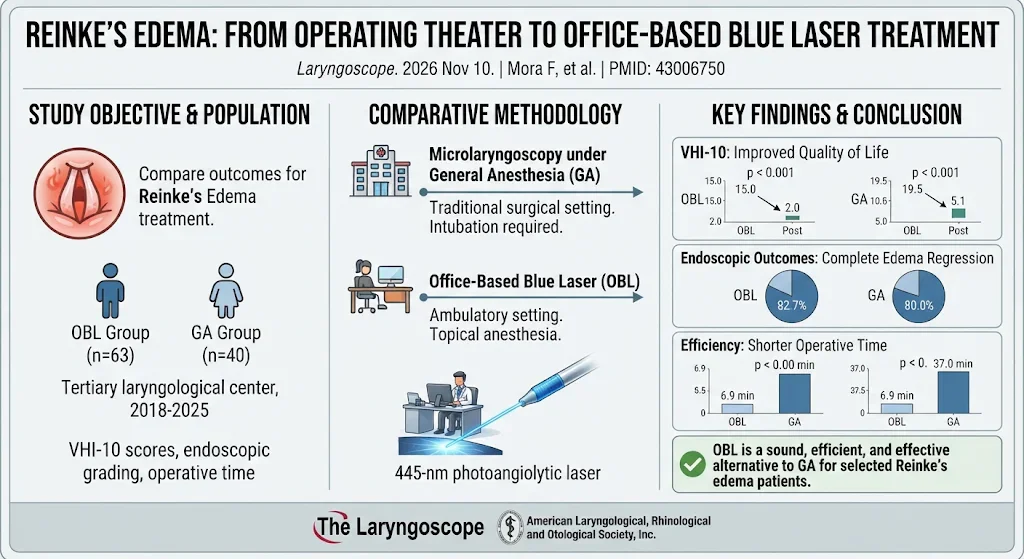
This prospective observational study was conducted at a tertiary laryngological center from 2018 to 2025 and included 103 adult patients diagnosed with Reinke’s edema suitable for surgical intervention. Sixty-three patients underwent office-based laser (OBL) treatment using a 445-nm blue laser, while 40 patients underwent conventional microlaryngoscopy under general anesthesia. Primary endpoints included voice-related quality of life measured by the Voice Handicap Index-10 (VHI-10) and endoscopic grading of edema before and after treatment. Secondary outcomes comprised operative time and safety profile assessment. Statistical analyses involved paired t-tests and Wilcoxon signed rank tests for within-group comparisons, and Welch t-tests for between-group comparisons.
Key Findings
Voice-Related Quality of Life Improvements: The OBL group experienced marked improvement in VHI-10 scores, decreasing from 15.0 ± 8.8 pre-treatment to 2.0 ± 3.5 post-treatment (p < 0.001). Similarly, the GA group showed significant improvement from 19.5 ± 10.7 to 5.1 ± 6.7 (p < 0.001). These data indicate that both treatment modalities substantially alleviate voice handicap, with the office-based approach demonstrating numerically greater absolute improvement.
Complete Edema Regression: Post-treatment endoscopic evaluation revealed complete regression of edema (grade 0) in 82.7% (43/52) of patients treated with the 445-nm blue laser and 80.0% (16/20) in the GA group, reflecting comparable efficacy in anatomical outcomes.
Operative Time: The mean procedure duration with office-based laser therapy was 6.9 ± 3.1 minutes, significantly shorter than the 37.0 ± 17.1 minutes required for microlaryngoscopy under GA (p < 0.001), highlighting a substantive efficiency advantage.
Safety and Retreatment: No adverse events were reported in either group. Eleven patients (21.2%) in the OBL cohort required retreatment, with up to three sessions, suggesting repeat office-based laser treatment is feasible and well tolerated.
Expert Commentary
The transition of Reinke’s edema management from an operating room environment requiring general anesthesia to an office-based procedure utilizing 445-nm blue laser technology signifies a paradigm shift. The precision and hemostatic properties of the blue laser facilitate effective edema vaporization or resection with minimal tissue damage and patient discomfort. While the GA approach remains a standard, especially for extensive disease, the office-based method offers considerable advantages in patient convenience, cost reduction, and safety profile.
Limitations include the potential need for multiple treatment sessions in office-based therapy and the absence of randomized controlled trials comparing these interventions directly. Additionally, long-term voice outcomes and durability beyond the study period warrant further investigation. Selection criteria are crucial to identify patients who would most benefit from the minimally invasive route without compromising clinical effectiveness.
Conclusion
The study demonstrates that office-based 445-nm blue laser treatment is a highly efficacious and safe alternative for managing Reinke’s edema, offering significant improvements in voice-related quality of life and endoscopic outcomes with substantially reduced operative time. This modality represents a patient-friendly, resource-efficient option that may redefine standard care in appropriately selected cases. Ongoing research should focus on refining patient selection, optimizing treatment protocols, and evaluating long-term benefits to fully integrate office-based laser therapy into routine laryngological practice.
Funding and Clinical Trials
The original study did not specify funding sources, and there is no current information about registered clinical trials linked to this comparison.
References
Mora F, Filauro M, Frascio M, Moro C, Ajasllari G, Peretti G. Reinke’s Edema: From the Operating Theater to Office-Based Blue Laser Treatment. The Laryngoscope. 2026 Nov 10. PMID: 43006750.
Remacle M, Lawson G, Jamart J. Treatment of Reinke’s edema using office-based laser therapy: A systematic review. Eur Arch Otorhinolaryngol. 2022;279(5):2155-2162.
Spielmann PM, Blitzer A. Voice rehabilitation following Reinke’s edema excision. Otolaryngol Clin North Am. 2011;44(5):1167-1180.
Wackers FJ, Claeys S, Lebacq J, Remacle M. Office-based laser therapy of Reinke’s edema: Clinical outcomes and voice quality improvement. Eur Arch Otorhinolaryngol. 2019;276(8):2177-2185.