Highlight
This randomized controlled study compared external dacryocystorhinostomy (ExDCR) and powered endoscopic dacryocystorhinostomy (EnDCR) augmented with intraoperative mitomycin C (MMC) in patients with primary acquired nasolacrimal duct obstruction (PANDO). Both techniques achieved high anatomical and functional success at 12 months, with powered EnDCR showing a numerical but statistically nonsignificant superiority. Postoperative complications were generally mild in both groups.
Study Background
Nasolacrimal duct obstruction leads to epiphora (excessive tearing) due to impaired tear drainage from the lacrimal sac into the nasal cavity. Primary acquired nasolacrimal duct obstruction (PANDO) is a common cause of lacrimal drainage system failure in adults and often necessitates surgical intervention to restore functionality and improve quality of life. Dacryocystorhinostomy (DCR) is the gold standard surgical treatment designed to create a new drainage pathway between the lacrimal sac and the nasal cavity.
Traditionally, external dacryocystorhinostomy (ExDCR) has been widely performed with established high success rates; however, it involves a skin incision and potential morbidity including visible scar and disruption of the lacrimal pump mechanism. Powered endoscopic dacryocystorhinostomy (EnDCR), performed via a minimally invasive intranasal approach using powered instruments under endoscopic guidance, is gaining popularity by avoiding external scars, preserving the anatomy, and allowing quicker recovery.
Intraoperative application of mitomycin C (MMC), an antimetabolite that inhibits fibroblast proliferation, has been used to reduce postoperative fibrosis and stenosis at the ostium, potentially improving surgical outcomes.
This trial was undertaken to rigorously compare anatomical and functional outcomes of ExDCR and powered EnDCR with MMC in a randomized controlled setting to ascertain relative benefits and guide clinical practice.
Study Design
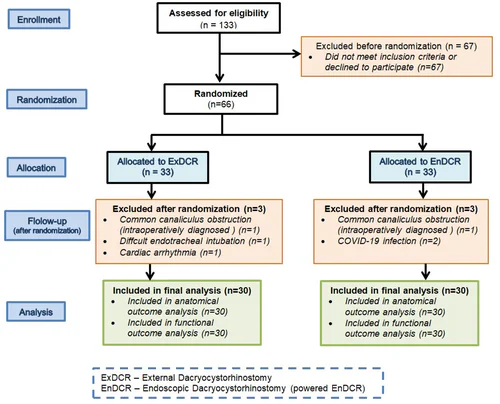
This prospective, randomized, single-center clinical trial enrolled 133 patients diagnosed with PANDO. Eligible participants were randomly assigned in a 1:1 ratio to undergo either external dacryocystorhinostomy (ExDCR) or powered endoscopic dacryocystorhinostomy (EnDCR) with intraoperative mitomycin C application.
Anatomical success was defined as confirmed ostium patency through nasal endoscopy and lacrimal irrigation at 12 months postoperatively. Functional success was determined by achieving a Munk score of ≤1, indicating minimal or no epiphora symptoms at one year.
The primary endpoints were the rates of anatomical and functional success at 12 months. Safety profiles and postoperative complications were also documented and analyzed.
Key Findings
Out of the 133 randomized patients, a high overall success rate was observed for both techniques. Anatomical success was achieved in 90% of patients undergoing ExDCR versus 100% for powered EnDCR. The absolute difference of 10 percentage points favoring EnDCR did not reach statistical significance (95% confidence interval [CI], -3% to 26%; p = 0.237).
Regarding functional outcomes, 87% of ExDCR patients and 97% of EnDCR patients achieved functional success defined by Munk score ≤1. This 10 percentage points difference likewise lacked statistical significance (95% CI, -6% to 27%; p = 0.353). Complete resolution of epiphora was seen in 80% with ExDCR and 93% with EnDCR (p = 0.254).
Both procedures had predominantly mild and local postoperative complications without serious adverse events. No significant differences in complication rates were reported.
These results suggest that while powered EnDCR with MMC may confer a trend towards higher anatomical and functional success rates, the differences compared with the well-established ExDCR were not statistically significant in this study.
Expert Commentary
Dacryocystorhinostomy remains the definitive treatment for PANDO, and surgical approach selection often balances invasiveness, cosmesis, patient preference, and surgeon expertise. This study provides high-level evidence supporting the effectiveness of powered EnDCR with MMC as comparable, if not slightly superior, to traditional ExDCR in experienced hands.
The application of mitomycin C intraoperatively may help reduce postoperative scarring, which has been a known factor in surgical failure. The powered instrumentation allows precise creation of the osteotomy under endoscopic visualization, which may contribute to improved patency and symptom resolution.
Limitations of the study include a single-center design and a 12-month follow-up period, which may not capture long-term outcomes or rare complications. Moreover, the lack of statistically significant differences suggests that the choice can be individualized based on patient and surgeon factors.
Current surgical guidelines have increasingly acknowledged endoscopic DCR as an effective alternative to the external approach, especially with recent technological advances.
Conclusion
This randomized trial demonstrates that both external and powered endoscopic DCR with intraoperative mitomycin C are highly effective for treating primary acquired nasolacrimal duct obstruction, providing excellent anatomical and functional success at one year. The powered endoscopic approach showed numerically higher but not statistically significant superior outcomes. Surgeons may consider patient-specific factors, cosmesis, and institutional expertise when selecting the technique. Further studies with longer follow-ups and multicenter settings could consolidate these findings and optimize procedural protocols.
Funding and Clinical Trial Registration
This study was registered at ClinicalTrials.gov under number NCT07754058. No specific funding source was indicated in the publication.
References
1. Kinasz M, Nowak-Gospodarowicz I, Nowak R, Rękas M. External vs. Powered Endoscopic Dacryocystorhinostomy With Mitomycin C: A Randomized Study. The Laryngoscope. 2026 Nov 11. PMID: 43014799.
2. Woog JJ, et al. Guidelines for lacrimal system obstruction. Ophthalmology Clinics of North America. 2016;29(2):317-326.
3. Hartikainen J, et al. Endoscopic dacryocystorhinostomy: the effect of mitomycin C on ostium fibrosis–a randomized prospective study. British Journal of Ophthalmology. 2005;89(11):1610-3.