Highlight
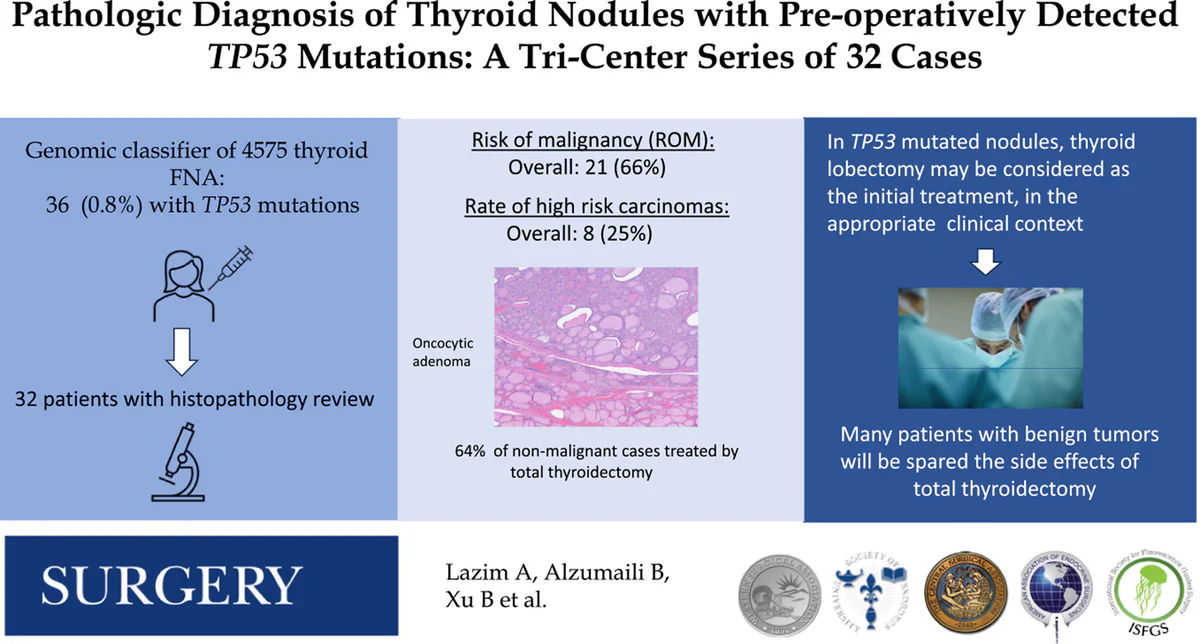
This study significantly challenges the notion that TP53 mutations detected preoperatively in thyroid nodules uniformly indicate high malignancy risk. Importantly, 34% of nodules with TP53 mutations were benign or low-risk neoplasms. The risk surged to 100% when TP53 mutations coexisted with other mutations and copy number alterations. These findings support more nuanced surgical decision-making, potentially favoring thyroid lobectomy over total thyroidectomy in selected cases.
Study Background
Mutation of the tumor protein 53 gene (TP53) has traditionally been considered a marker for aggressive, often high-grade malignancies across diverse cancers, including thyroid carcinomas. Molecular testing such as the ThyroSeq v3 genomic classifier increasingly guides preoperative evaluation of thyroid nodules, aiding in malignancy risk stratification. Previous reports cite an approximately 80% probability of malignancy when TP53 mutations arise with other molecular abnormalities. However, isolated or certain combinations of TP53 mutations might be present in benign or indolent thyroid neoplasms, leading to diagnostic uncertainty and therapeutic dilemmas in clinical practice.
Accurate risk assessment is critical given the morbidity associated with total thyroidectomy and the potential overtreatment of low-risk nodules. This study investigates the pathology of thyroid nodules with preoperatively detected TP53 mutations from three centers, aiming to clarify the correlation between molecular profiles and histopathological outcomes, and thus refine clinical management.
Study Design
This retrospective multicenter analysis examined 4,575 fine-needle aspiration (FNA) samples profiled molecularly prior to surgery. Among these, 36 (0.8%) harbored TP53 mutations; pathology diagnoses were available for 32 nodules, composed the primary cohort. These cases underwent comprehensive pathological review on surgical specimens, with further stratification based on additional molecular alterations identified through extended genomic profiling.
Risk categorization used the American Thyroid Association (ATA) risk of recurrence stratification framework and Bethesda cytologic classification, focusing particularly on the indeterminate Bethesda III-IV category where malignancy risk is often unclear.
Key Findings
The cohort’s histopathologic diagnoses comprised benign or low-risk neoplasms in 11 cases (34%), ATA low-risk carcinomas in 7 (22%), low-intermediate risk in 6 (19%), and high-risk carcinomas in 8 (25%). Thus, the overall risk of malignancy was 66%, and specifically 56% within Bethesda III-IV category nodules.
Whole tumor capsule submission and rigorous pathological evaluation characterized the benign/low-risk cases, underpinning diagnostic confidence. A majority (64%) of this subgroup underwent total thyroidectomy, indicating a potential overtreatment trend given favorable pathology.
Molecularly, cases were stratified into four groups: TP53 mutation alone (5 cases, 17%), TP53 plus copy number alterations (9 cases, 30%), TP53 with other mutations excluding copy number changes (9 cases, 30%), and TP53 combined with other mutations plus copy number alterations (7 cases, 23%). Malignancy risk correlated directly with molecular complexity: 40% for TP53 alone, 44% for TP53 with copy number changes, 67% for TP53 and other mutations, and 100% for TP53 with both additional mutations and copy number alterations.
The incidence of ATA high-risk carcinomas was significantly associated with complex molecular alterations (rising from 11-22% in simpler molecular profiles to 43% in the most altered group). Statistical analysis showed malignancy risk was significantly higher in cases with concurrent mutations and copy number alterations versus those with TP53 exclusive or simple alterations (P = 0.018).
Expert Commentary
These findings highlight the heterogeneity of thyroid nodules harboring TP53 mutations. The conventional assumption that TP53 mutations portend uniformly high risk is nuanced by molecular context. This aligns with emerging concepts of clonal evolution and tumor biology in thyroid cancer, where secondary hits and genomic instability drive progression aggressiveness.
Current ATA guidelines recommend surgical extent based on risk stratification, with total thyroidectomy favored for high-risk cancers. This study suggests that for many TP53-mutated nodules, especially with less complex molecular backgrounds, lobectomy could suffice, minimizing surgical morbidity without compromising oncologic safety.
Limitations include retrospective design, the small sample size of TP53-mutated nodules, and potential selection bias inherent in molecularly profiled institutional cohorts. Prospective validation and integration with clinical features will be essential to operationalize these molecular risk stratifications in routine practice.
Conclusion
TP53 mutations in thyroid nodules, though historically viewed as a marker of high malignancy risk, exhibit considerable heterogeneity influenced by accompanying molecular alterations. A significant fraction (34%) represent benign or low-risk pathological entities. The absolute malignancy risk escalates to 100% when TP53 mutations coexist with other genomic abnormalities including copy number changes.
This nuanced understanding challenges the prevailing approach of defaulting to total thyroidectomy, advocating for initial thyroid lobectomy consideration in the appropriate clinical context. Personalized surgical planning, guided by detailed molecular diagnostics, holds promise for optimizing care by balancing oncologic control with quality of life in patients with TP53-mutated thyroid nodules.
Future studies should focus on larger cohorts and integration of molecular data with imaging, cytology, and clinical parameters to refine risk-adaptive management algorithms.
Funding and Clinical Trial Registration
The original study did not provide detailed funding statements or clinical trial registration information.
References
Lazim A, Alzumaili B, Xu B, Instrum R, Hintze J, Ganly C, Sadow PM, Morris LG, Viswanathan K, Ghossein R. Pathologic diagnosis of thyroid nodules with preoperatively detected tumor protein 53 mutations: A tricenter series of 32 cases. Surgery. 2026 Aug 17;199:110536. PMID: 42743661.
American Thyroid Association Guidelines Task Force et al. 2015 American Thyroid Association Management Guidelines for Adult Patients with Thyroid Nodules and Differentiated Thyroid Cancer. Thyroid. 2016 Jan;26(1):1-133.
Yoo SK, Kim TY, Kim WG, et al. The clinical utility of molecular testing panels in thyroid nodules: a meta-analysis. J Clin Endocrinol Metab. 2021;106(2):e587-e597.