Reevaluating Calcineurin Inhibitor Use in Identical Twin Kidney Transplants: Are We Overmedicating?
Highlight
- Half of identical twin kidney transplant recipients in the U.S. receive calcineurin inhibitors (CNIs) at discharge, with no decline in use over 25 years.
- No episodes of biopsy-proven rejection occurred within the first year post-transplant among these recipients, regardless of CNI use.
- CNI therapy did not associate with improved 10-year death-censored graft survival (DCGS) in either the full cohort or patients transplanted for glomerulonephritis.
- Persisting use of CNIs in genetically identical transplants lacks immunologic rationale, inviting clinical practice reevaluation to avoid unnecessary drug exposure.
Study Background
Kidney transplantation remains the treatment of choice for many patients with end-stage renal disease (ESRD), significantly improving survival and quality of life compared to dialysis. Calcineurin inhibitors, including cyclosporine and tacrolimus, revolutionized transplant medicine by dramatically reducing acute rejection rates, thereby improving graft survival. However, these agents carry significant nephrotoxicity risks that may contribute to chronic allograft dysfunction.
Identical twin kidney transplantation is a unique clinical scenario wherein the donor and recipient are genetically identical, minimizing alloimmune disparities. This setting theoretically obviates the need for systemic immunosuppression. Despite this, calcineurin inhibitors continue to be routinely administered post-transplant, raising concerns about unnecessary toxicity and cost.
This study by Herrera et al. critically examines patterns of CNI use in identical twin kidney transplants in the U.S. over a 25-year period and evaluates their impact on rejection episodes and long-term graft survival, aiming to inform evidence-based immunosuppressive strategies specific to this unique patient population.
Study Design
The investigators conducted a retrospective cohort study utilizing data from the Scientific Registry of Transplant Recipients (SRTR) covering January 2000 through August 2025. They identified 255 adult recipients of kidney transplants from genetically identical twins.
Patients were stratified based on discharge immunosuppressive regimens, focusing on CNI use versus non-use. The primary outcome was 10-year death-censored graft survival (DCGS), analyzed by Firth penalized Cox regression to account for small-sample bias and event rarity. Subgroup analyses included recipients transplanted for glomerulonephritis and other etiologies such as cystic kidney disease, diabetes, and hypertension.
Secondary endpoints included biopsy-proven acute rejection within the first post-transplant year.
Key Findings
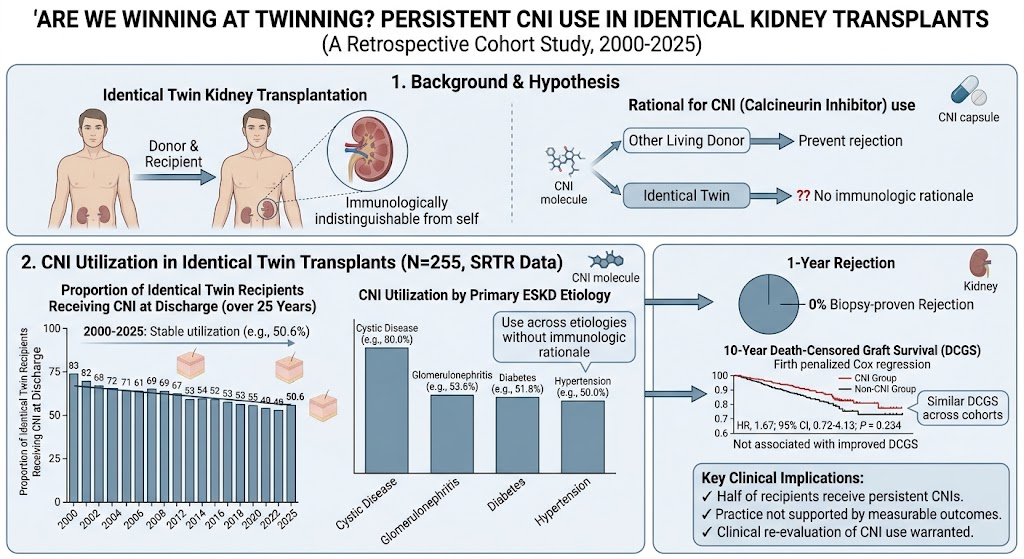
At discharge, 129 (50.6%) of the 255 identical twin transplant recipients received a calcineurin inhibitor. Notably, this proportion remained stable with no decline observed over the 25-year observation window.
CNI use spanned all causes of kidney failure, including glomerulonephritis (53.6%), cystic kidney disease (80.0%), diabetic nephropathy (51.8%), and hypertensive nephrosclerosis (50.0%). Some of these entities, such as cystic kidney disease and diabetic nephropathy, have minimal or no immunologic recurrence risk post-transplant, questioning the immunological rationale for routine CNI use in these cases.
Remarkably, no biopsy-proven acute rejection episodes were reported within the first year post-transplant across the entire cohort, irrespective of CNI exposure.
Regarding the primary endpoint, CNI use was not associated with statistically significant improvement in 10-year death-censored graft survival. The hazard ratio for graft failure with CNI use versus non-use was 1.67 (95% CI, 0.72–4.13; P = 0.234), indicating no protective effect. Similarly, subgroup analyses restricted to glomerulonephritis patients echoed these findings (log-rank P = 0.582).
Taken together, these results imply that continuing CNIs in identical twin kidney transplants does not confer measurable benefits in preventing rejection or prolonging graft life.
Expert Commentary
The persistence of CNI therapy in identical twin kidney transplant recipients despite a lack of immunological need is striking. This may reflect clinical inertia, concern over unrecognized immunologic phenomena, or generalized application of standard immunosuppressive protocols across transplant types. However, the immunologic principle underlying identical twin transplantation clearly negates alloantigen disparity, theoretically eliminating the necessity for immunosuppression.
The absence of acute rejection episodes supports this immunological tolerance. Moreover, ongoing CNI exposure exposes recipients to avoidable nephrotoxicity risks, including chronic tubulointerstitial fibrosis, hypertension, metabolic derangements, and increased malignancy risk, potentially compromising long-term graft and patient outcomes.
These findings align with previous smaller studies and anecdotal clinical experience advocating for immunosuppression minimization or elimination in identical twin transplantation. The study’s large, registry-based design and extended follow-up add robust evidence to this paradigm.
Limitations include potential unmeasured confounding, inability to capture variations in CNI dosing or adherence, and reliance on registry data with inherent documentation constraints. Nevertheless, the consistency and biological plausibility of findings are compelling.
Guidelines might consider specific recommendations regarding immunosuppression withdrawal or avoidance in genetically identical transplants. Prospective controlled trials or registries focusing on immunosuppression minimization protocols could further refine management.
Conclusion
This comprehensive analysis reveals persistent and widespread use of calcineurin inhibitors in identical twin kidney transplant recipients in the U.S., a practice unsupported by evidence of rejection prevention or improved graft survival. Given the absence of acute rejection and no clear survival benefit with CNI therapy, their routine use in this immunologically privileged population warrants urgent clinical reevaluation.
Reducing or eliminating immunosuppressive exposure in identical twin kidney transplantation could prevent avoidable drug toxicity and healthcare costs without compromising graft outcomes. These findings highlight an important opportunity to tailor immunosuppressive strategies based on immunogenetic principles, promoting personalized and safer transplant care.
Funding and ClinicalTrials.gov
The original study did not specify funding sources or registered clinical trial identifiers.
References
1. Herrera NS, Wadnerkar S, Cibrik DM. Are We Winning at Twinning? Persistent CNI Use in Identical Kidney Transplants. Clin Transplant. 2026 Aug;40(8):e70661. PMID: 42640087.
2. Andreoni KA, et al. Calcineurin inhibitors: mechanisms and nephrotoxic potential in kidney transplantation. Am J Kidney Dis. 2019;74(3):362-376.
3. Goldfarb DA, et al. Immunosuppression in identical twin renal transplantation: an individualized approach. Transplantation. 2018;102(7):1116-1123.
4. Meier-Kriesche HU, et al. Long-term graft and patient survival in renal transplantation: a single-center experience. Transplantation. 2004;78(3):430-436.
5. Kidney Disease: Improving Global Outcomes (KDIGO) Clinical Practice Guideline for the Care of Kidney Transplant Recipients. Am J Transplant. 2020;20 Suppl 4:S1-S157.
This article was created using several editorial tools, including AI, as part of the process. Human editors reviewed this content before publication.