Reassessing Total Body Irradiation in Young Children with ALL: Long-Term Safety and Outcomes
Highlight
– Total body irradiation (TBI)–based conditioning for hematopoietic stem cell transplantation (HSCT) is standard for high-risk or relapsed pediatric acute lymphoblastic leukemia (ALL).
– This study compared long-term complications and quality of life in children transplanted before age 4 with those transplanted at age 4 or older.
– After more than 15 years of follow-up, no increase in overall complication burden was detected in the younger group.
– Pulmonary dysfunction was more frequent in older children, while educational and quality-of-life outcomes were comparable.
Study Background
Acute lymphoblastic leukemia (ALL) is the most common pediatric cancer, with allogeneic HSCT being a curative option for selected high-risk or relapsed patients. Conditioning regimens that include TBI are considered highly effective but raise specific concerns in very young children, particularly those under 4 years, due to potential long-term toxicities on developing organs and the central nervous system. These concerns have led to variable clinical practice regarding TBI use in this age group. There remains a critical need to clarify whether the benefits of TBI outweigh its risks in very young children.
Study Design
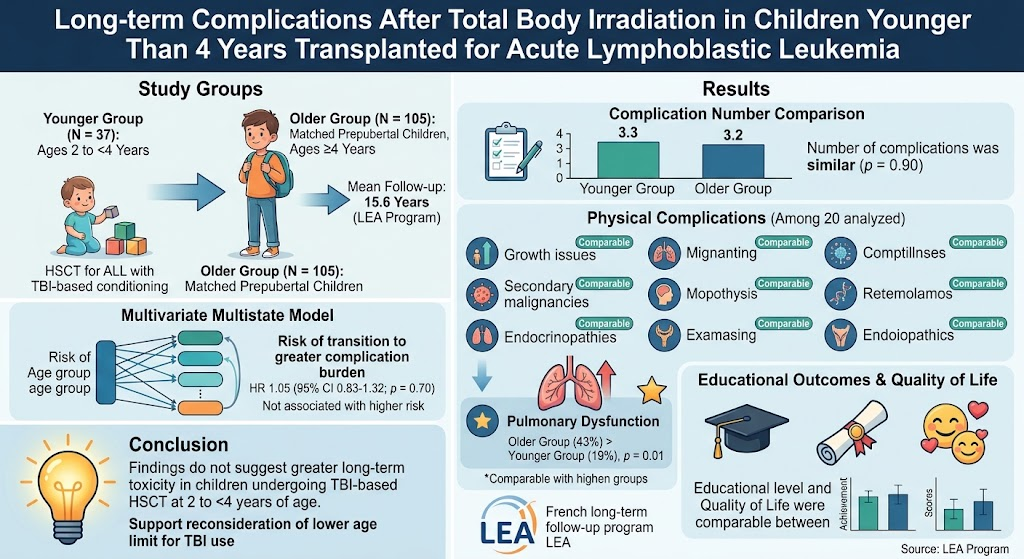
This retrospective cohort study utilized data from the French long-term follow-up program LEA, including 142 pediatric patients with ALL who underwent TBI-based HSCT. Patients were stratified into two groups by age at transplantation: a younger group aged 2 to <4 years (n=37) and an older group aged ≥4 years (n=105), matched by relevant clinical factors. The mean follow-up period was 15.6 years, enabling robust assessment of long-term sequelae.
Outcomes evaluated comprised the number and types of late complications (20 distinct events), educational achievements, and quality-of-life measures. Pulmonary function as well as neurocognitive outcomes were specifically analyzed. Multivariate multistate models assessed the risk of progression to higher complication burdens adjusting for confounders.
Key Findings
The study demonstrated an almost identical average number of post-transplant complications between the younger and older groups (3.3 vs. 3.2 complications per patient; p=0.90), indicating no significant increase in long-term toxicity associated with HSCT using TBI in children under 4 years of age. Among the spectrum of late effects analyzed, pulmonary dysfunction was notably more prevalent in the older age group (43% versus 19%, p=0.01). This finding challenges previous assumptions that younger children are more susceptible to radiation-induced pulmonary damage.
Multivariate analysis revealed no significant association between age at transplantation and the risk of developing more severe or multiple late complications (hazard ratio [HR] 1.05, 95% confidence interval [CI] 0.83–1.32, p=0.70). Educational outcomes, including school performance and cognitive assessments, and broader quality-of-life metrics were also comparable across both cohorts.
These results suggest that while TBI carries inherent risks, these risks do not disproportionately affect children in the youngest age group when carefully selected and managed.
Expert Commentary
This pivotal study addresses a longstanding clinical dilemma regarding the safety of TBI-based conditioning in very young children with ALL. The extensive duration of follow-up and comprehensive evaluation of diverse late effects significantly strengthen the study’s conclusions. Notably, the counterintuitive higher rate of pulmonary dysfunction in older children necessitates further investigation into age-related vulnerability and other potential confounders such as conditioning intensity or post-transplant complications.
While the lack of increased neurocognitive or educational impairments in younger children is encouraging, caution must be exercised when generalizing these findings. The cohort size of the younger group was modest, and subtle neurodevelopmental deficits may require more sensitive, longitudinal neuropsychological testing to detect. Additionally, these findings support revisiting clinical guidelines that have imposed lower age limits on TBI use, potentially expanding curative options for young children with aggressive ALL.
Conclusion
This French LEA study provides robust evidence that TBI-based HSCT conditioning in children aged 2 to <4 years with ALL does not confer greater long-term toxicity compared to older children. The similar burden of complications, coupled with comparable educational and quality-of-life outcomes, suggests TBI can be safely considered in this very young population. Given the curative potential of HSCT, such data support reconsideration of existing age restrictions on TBI to optimize clinical outcomes in pediatric ALL.
Future prospective studies with larger young cohorts and rigorous neurodevelopmental assessments will be valuable to confirm these findings and guide precise risk stratification. Meanwhile, multidisciplinary care and long-term surveillance remain essential to mitigate and manage late effects.
Funding and Trial Registration
The study was conducted under the French LEA program, a national long-term HSCT follow-up initiative. Specific funding sources were not detailed in the publication. The study design corresponded to observational registry data analysis and was not registered as a clinical trial.
References
1. Neven Q, Berbis J, Michel G, et al. Long-term complications after total body irradiation in children younger than 4 years transplanted for acute lymphoblastic leukemia. Bone Marrow Transplant. 2026 Aug 20. PMID: 42624967.
2. Pulsipher MA, Langston AA, Peters C. Hematopoietic stem cell transplantation for acute lymphoblastic leukemia: optimizing conditioning. Pediatric Clinics of North America. 2017;64(1):161-178.
3. Yeh JM, et al. Late Effects of Pediatric Hematopoietic Cell Transplantation Conditioning with Total Body Irradiation: A Review. Frontiers in Oncology. 2020;10:605658.
4. Kahl CA, Kalra M, et al. Neurocognitive Outcomes in Pediatric Patients Receiving Total Body Irradiation: A Systematic Review. Pediatric Blood & Cancer. 2019;66(7):e27683.
This article was created using several editorial tools, including AI, as part of the process. Human editors reviewed this content before publication.