Although immune checkpoint inhibitors (ICIs) have achieved clinical breakthroughs across multiple malignancies, most patients with metastatic colorectal cancer (mCRC)—particularly those with microsatellite-stable (MSS) tumors—still fail to benefit. Currently, ICI efficacy remains largely confined to patients with microsatellite instability-high or mismatch repair-deficient (MSI-H/dMMR) tumors, who account for only about 5% of all mCRC cases. Consequently, the vast majority of mCRC patients see no benefit from existing ICI monotherapies.
To overcome this, combination strategies pairing ICIs with other therapeutic modalities have emerged, with anti-angiogenic agents (such as VEGF inhibitors) attracting considerable attention. However, real-world clinical outcomes from these combinations remain suboptimal: emerging evidence shows that even when initial responses are acceptable, median progression-free survival (PFS) frequently falls short of four months, highlighting the major challenge of converting short-term sensitivity into durable clinical benefit. Given the limited response rates to immunotherapy in MSS colorectal cancer, identifying novel predictive biomarkers and translating them into clinical practice has become an urgent priority.
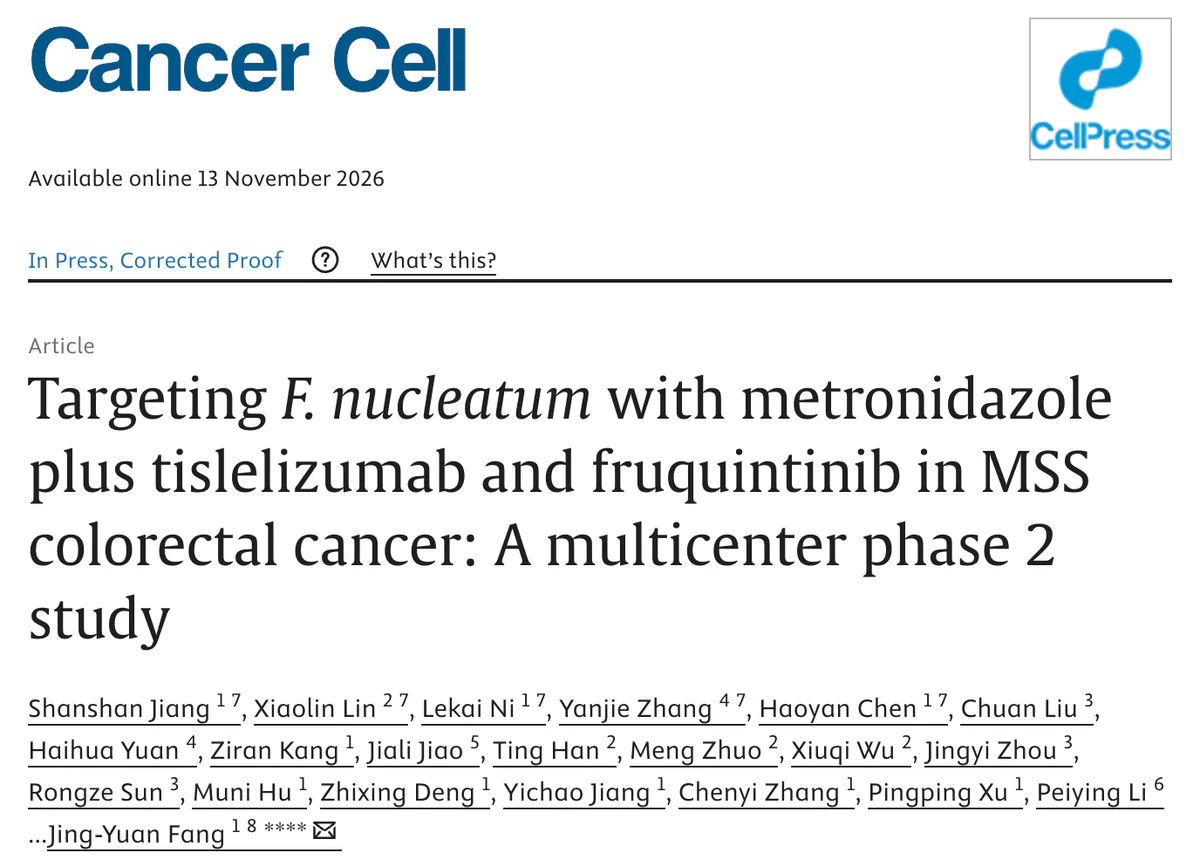
On November 13, 2026, a research team published a study in the Cell sister journal Cancer Cell titled: "Targeting F. nucleatum with metronidazole plus tislelizumab and fruquintinib in MSS colorectal cancer: A multicenter phase 2 study."
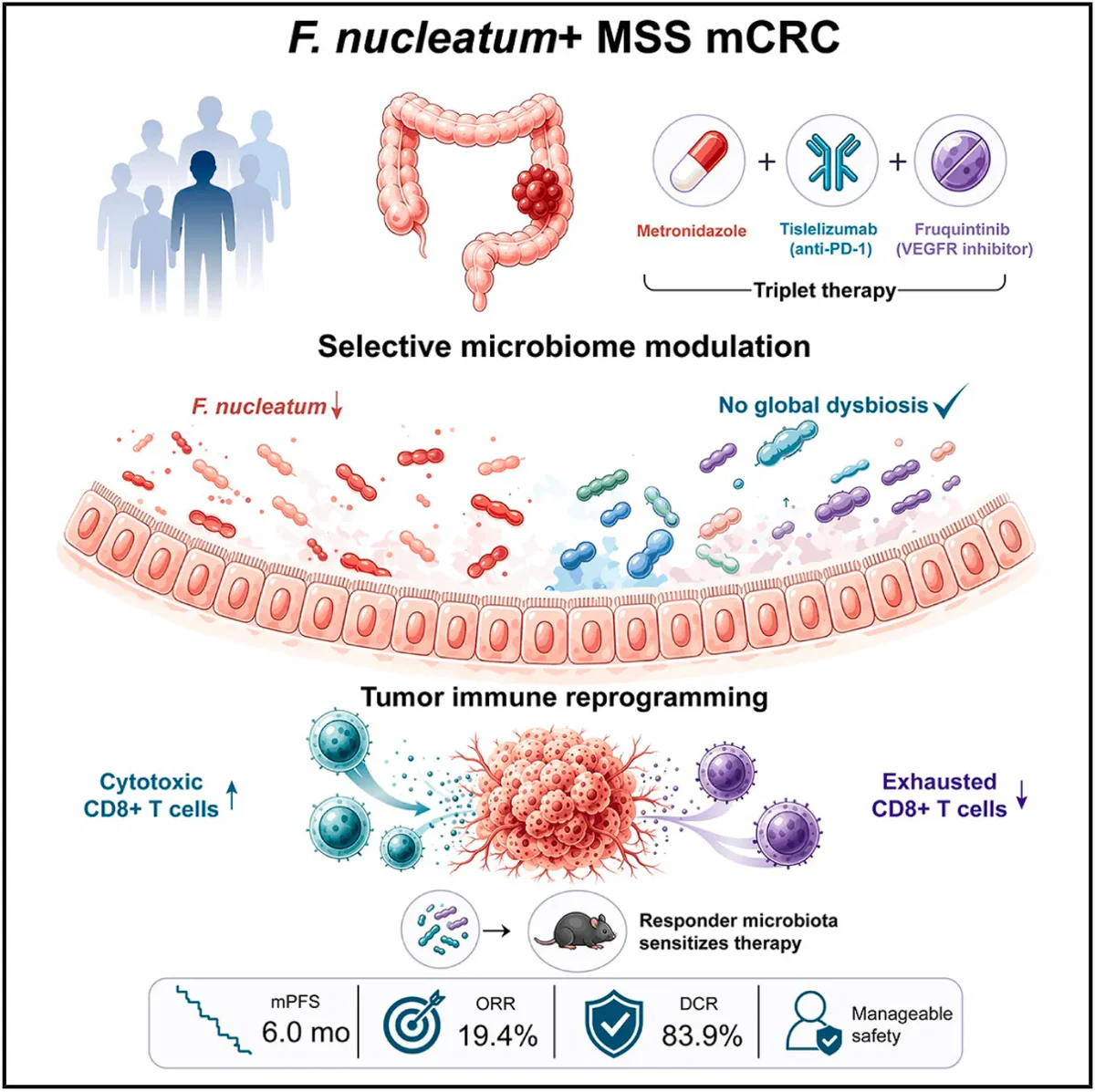
In this multicenter Phase II clinical trial, an innovative triplet regimen combining metronidazole (an antibiotic), tislelizumab (an anti-PD-1 monoclonal antibody), and fruquintinib (an anti-angiogenic agent) demonstrated encouraging clinical activity with manageable toxicity in patients with Fusobacterium nucleatum-positive, microsatellite-stable metastatic colorectal cancer (MSS mCRC). Notably, adding metronidazole reduced F. nucleatum levels without inducing broad gut microbiome dysbiosis, while the combination therapy enhanced CD8⁺ T-cell responses.
The gut bacterium Fusobacterium nucleatum is closely linked to chemoresistance and immune evasion in colorectal cancer, yet targeted therapeutic strategies against it have remained limited. In this multicenter, single-arm Phase II trial (NCT06356597), 33 patients with F. nucleatum-positive MSS mCRC received the combination of tislelizumab (a humanized anti-PD-1 antibody), fruquintinib (an oral, highly selective small-molecule VEGFR1/2/3 inhibitor), and metronidazole (a nitroimidazole antimicrobial agent with potent bactericidal activity against anaerobic bacteria).
The trial met its primary endpoint, achieving a median progression-free survival of 6.0 months, an objective response rate (ORR) of 19.4%, and a disease control rate (DCR) of 83.9%. Grade 3 treatment-related adverse events occurred in 30.3% of patients, with no Grade 4 or Grade 5 events reported.
Metagenomic analysis confirmed that metronidazole effectively reduced F. nucleatum abundance. Exploratory analyses further revealed that clinical benefit was associated with the enrichment of Lactobacillus species, whereas non-response correlated with Enterococcus. Furthermore, fecal microbiota transplantation (FMT) from treatment responders sensitized germ-free mice to the regimen, promoting cytotoxic CD8⁺ T-cell differentiation and reducing terminal T-cell exhaustion. These findings support further clinical evaluation of this combination strategy in F. nucleatum-positive metastatic colorectal cancer.
Key Findings of the Study:
The innovative triplet regimen of metronidazole, tislelizumab, and fruquintinib met its primary endpoint in F. nucleatum-positive MSS mCRC;
Patients achieved a median progression-free survival of 6.0 months, an objective response rate of 19.4%, and a one-year overall survival rate of 75.0%, with a manageable safety profile;
Metronidazole selectively reduced F. nucleatum without triggering widespread gut dysbiosis;
The combination promoted cytotoxic CD8⁺ T-cell differentiation and prevented terminal exhaustion.
While broad-spectrum antibiotics are traditionally thought to impair the efficacy of immune checkpoint inhibitors, this study demonstrates that intermittently incorporating the anaerobe-targeting antibiotic metronidazole alongside anti-PD-1 and VEGFR inhibition selectively disrupts pathogenic microbial networks without causing systemic microbiome disruption—yielding promising progression-free survival in F. nucleatum-positive MSS mCRC.
Looking ahead, this precision microbiome-modulation approach opens new avenues in oncology: more strategies that selectively remodel the gut microbiota are likely to emerge for cancer treatment, particularly to sensitize immunologically "cold" tumors that traditionally fail to respond to immunotherapy.
Reference
Jiang S, Lin X, Ni L, Zhang Y, Chen H, Liu C, Yuan H, Kang Z, Jiao J, Han T, Zhuo M, Wu X, Zhou J, Sun R, Hu M, Deng Z, Jiang Y, Zhang C, Xu P, Li P, Li Q, Chen YX, Xiao XY, Fang JY. Targeting F.nucleatum with metronidazole plus tislelizumab and fruquintinib in MSS colorectal cancer: A multicenter phase 2 study. Cancer Cell. 2026 Nov 13:S1535-6108(26)00478-2. doi: 10.1016/j.ccell.2026.10.012. Epub ahead of print. PMID: 43025422.