Highlight
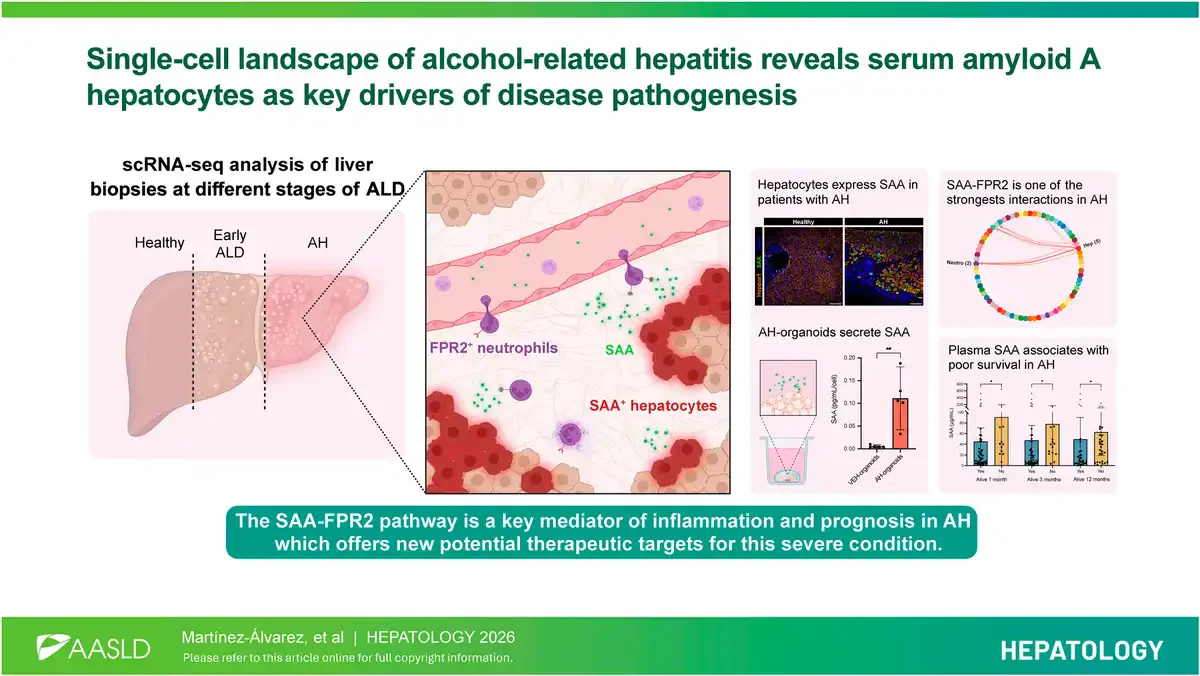
• Single-cell RNA sequencing of liver biopsies from patients with alcohol-related hepatitis (AH) uncovers heterogeneous cell subpopulations driving disease.
• Hepatocytes expressing serum amyloid A (SAA) are identified as principal inflammatory mediators in AH.
• The SAA-FPR2 interaction between hepatocytes and hyperactivated neutrophils promotes liver inflammation and correlates with prognosis.
• Elevated circulating SAA levels associate with disease severity and reduced survival, suggesting diagnostic and therapeutic potential.
Study Background
Alcohol-related liver disease (ALD) encompasses a spectrum from steatosis to cirrhosis, with alcohol-related hepatitis (AH) representing an acute and severe inflammatory variant characterized by high morbidity and mortality. Despite its clinical importance, the cellular and molecular drivers underlying AH pathogenesis remain incompletely understood. Traditional bulk analyses obscure the complexity of liver cell heterogeneity and fail to delineate distinct cellular subpopulations and their interactions during disease progression. Thus, elucidating the liver’s cellular landscape at a single-cell resolution in AH could uncover novel pathogenic mechanisms and therapeutic targets.
Study Design
This study employed single-cell RNA sequencing (scRNA-seq) on liver biopsy samples obtained from patients with AH, early-stage ALD, and healthy controls to profile liver cellular heterogeneity and identify key cellular contributors to AH pathogenesis. Complementary immunofluorescence staining validated protein expression of selected cell markers. In vitro liver biopsy-derived organoids were generated and stimulated with conditioned media mimicking AH environment (AH-medium) to evaluate serum amyloid A (SAA) secretion by enzyme-linked immunosorbent assay (ELISA). Plasma samples from ALD patients at different stages were analyzed for circulating SAA levels, correlating biochemical findings with clinical outcomes. Cell-cell communication analyses were conducted computationally to predict ligand-receptor interactions amongst hepatic cell subpopulations.
Key Findings
The scRNA-seq revealed multiple distinct liver cell subsets in AH, including:
• Hepatocytes expressing serum amyloid A (SAA), identified as a central hepatocyte subpopulation uniquely upregulated in AH.
• Scar-associated (SA) endothelial cells and Fibulin-3+ mesenchymal cells implicated in fibrosis.
• SA-macrophages enriched in matrix metalloproteinase 19 (MMP19) expression, indicating a role in remodeling.
• Activated CD4+ T cells and stressed/effector CD8+ T cell subsets, reflecting adaptive immune activation.
• Hyperactivated neutrophils expressing formyl peptide receptor 2 (FPR2), critical for inflammatory recruitment.
Cell-cell communication modeling highlighted a strong signaling axis between SAA-expressing hepatocytes and FPR2-positive neutrophils in AH, suggesting a feedforward inflammatory loop mediated via the SAA-FPR2 pathway.
Functional assays in liver organoids confirmed that hepatocytes secrete SAA upon exposure to AH-conditioned media, corroborating in vivo findings.
Clinically, plasma SAA levels were significantly elevated in AH patients and correlated negatively with survival, identifying SAA as a potential biomarker for disease severity and prognosis.
Expert Commentary
These findings integrate single-cell transcriptomics with functional validation to elucidate key cellular players in AH. The discovery of SAA-expressing hepatocytes as inflammatory initiators and the critical interaction with neutrophils via the FPR2 receptor expands our understanding of intrahepatic inflammatory circuits driving AH progression. The study has notable strengths, including direct human liver tissue analysis and verification in organoid systems, which add translational relevance.
Limitations include relatively small sample sizes common to human biopsy-dependent single-cell studies and the complexity of replicating the full AH microenvironment ex vivo. Furthermore, while the SAA-FPR2 axis is implicated in inflammation, its precise molecular mechanisms warrant further investigation.
These insights align with emerging perspectives recognizing hepatocytes not only as metabolic but also immunologically active cells in liver disease, underscoring potential therapeutic avenues targeting the SAA-FPR2 interaction to ameliorate AH-associated inflammation.
Conclusion
This study defines a detailed single-cell landscape of alcohol-related hepatitis, identifying serum amyloid A–expressing hepatocytes as key drivers of inflammatory pathogenesis. The established SAA-FPR2 hepatocyte-neutrophil axis offers compelling evidence for targeted interventions that could modulate inflammation and improve outcomes in this devastating condition. Future research should explore therapeutic blockade of SAA signaling and validate circulating SAA as a prognostic biomarker to advance personalized care for patients with AH.
Funding and Clinical Trials
The study was supported by multiple grants and institutional funding detailed in the primary publication. There was no specific clinical trial registration mentioned for this exploratory mechanistic study.
References
1. Martínez-Álvarez A, et al. Single-cell landscape of alcohol-related hepatitis reveals serum amyloid a hepatocytes as key drivers of disease pathogenesis. Hepatology. 2026;doi:10.1002/hep.31520.
2. Gao B, Bataller R. Alcoholic Liver Disease: Pathogenesis and New Therapeutic Targets. Gastroenterology. 2011;141(5):1572–85.
3. Ramachandran P, et al. Resolving the fibrotic niche of human liver cirrhosis at single-cell level. Nature. 2019;575(7783):512-518.
4. Kolodziejczyk AA, et al. Single Cell RNA Sequencing of Liver Cell Types. Trends Mol Med. 2015;21(9):563-574.
5. Verbeek J, et al. The role of neutrophils in alcoholic hepatitis. Semin Liver Dis. 2022;42(3):338-350.