Predicting Anal Incontinence One Year After Severe Perineal Tears in Primiparous Women: Development and Validation of a Practical Risk Model
Highlight
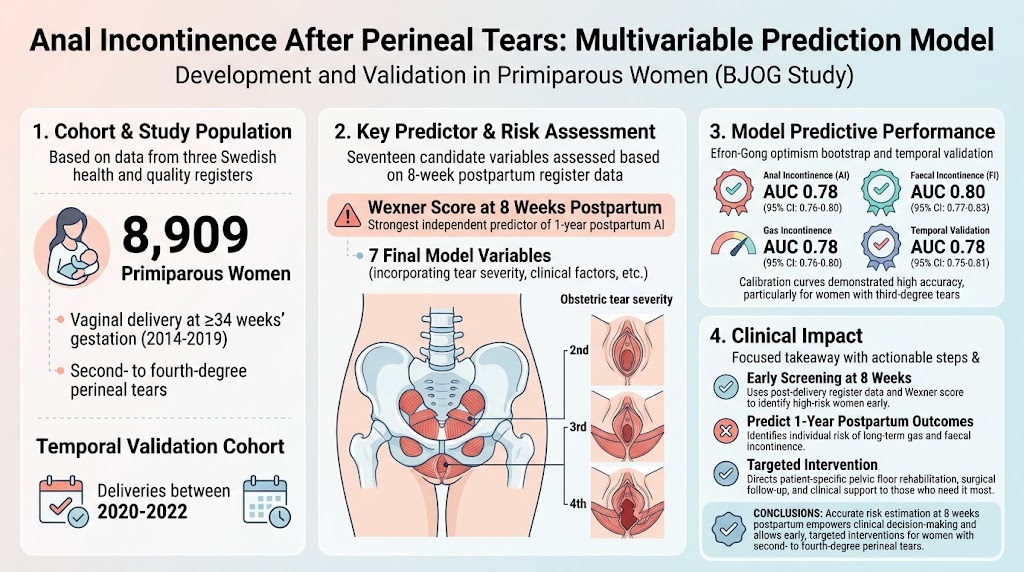
1. A multivariable model was developed and validated to predict anal incontinence (gas and/or fecal) at 1 year postpartum in primiparous women with second- to fourth-degree perineal tears after vaginal delivery.
2. Seven key predictors, including a high Wexner score at 8 weeks postpartum, strongly forecast the risk of anal incontinence.
3. The model demonstrates good accuracy and calibration (AUC ~0.78), with temporal validation confirming its reliability.
4. This model, derived from large Swedish register data, offers clinicians a tool for risk stratification and individualized postpartum care planning.
Background
Perineal tears during vaginal delivery are a significant obstetrical complication with implications on pelvic floor function. Second-degree tears involve the perineal muscles, while third- and fourth-degree tears extend through the anal sphincter complex and rectal mucosa, respectively. These severe lacerations can lead to anal incontinence, causing major physical, psychological, and social morbidity for affected women.
Anal incontinence postpartum remains under-recognized despite its impact on quality of life. Primiparous women with severe perineal tears are at increased risk, but predicting which women will develop persistent symptoms beyond the immediate postpartum period has been challenging. Early identification can guide targeted interventions and counseling.
Study Design
This prognostic study retrospectively analyzed data from three Swedish health and quality registers, encompassing 8,909 primiparous women with second- through fourth-degree perineal tears following vaginal delivery at or beyond 34 weeks gestation, recorded between 2014 and 2019.
Seventeen candidate predictors were initially evaluated—comprising demographic, obstetrical, and clinical variables including early postpartum Wexner scores (a validated scale measuring anal incontinence severity).
Logistic regression was employed to construct multivariable prediction models for three outcomes at 1 year postpartum: any anal incontinence (gas and/or fecal), fecal incontinence alone, and gas incontinence alone.
Model performance metrics included the area under the receiver operator characteristic curve (AUC) for discrimination, calibration plots for predictive accuracy, and internal validation via Efron-Gong optimism bootstrapping. Temporal external validation was conducted on a separate cohort delivered between 2020 and 2022.
Key Findings
From the candidate variables, seven predictors remained in the final model for anal incontinence. The single strongest predictor was a high Wexner score measured at 8 weeks postpartum, indicating early symptoms correlate with chronic risk.
The prediction models demonstrated good discrimination:
– Anal Incontinence model: AUC 0.78 (95% CI: 0.76–0.80)
– Fecal Incontinence model: AUC 0.80 (95% CI: 0.77–0.83)
– Gas Incontinence model: AUC 0.78 (95% CI: 0.76–0.80)
Calibration curves showed that the models accurately estimated risk particularly for women with third-degree perineal tears, suggesting the model performs well in the subgroup with the greatest clinical concern.
Temporal validation involving women delivering between 2020–2022 affirmed the model’s consistent accuracy (AUC 0.78; 95% CI: 0.75–0.81), indicating robustness over time and different practice settings.
The study did not explicitly report safety endpoints, as it was an observational prognostic model development study. However, by enabling early identification of high-risk women, the model may facilitate timely interventions and improved outcomes.
Expert Commentary
The study presents a valuable, data-driven tool for predicting persistent anal incontinence risk after severe perineal trauma in primiparous women. The integration of early postpartum Wexner scoring as the strongest predictor aligns well with clinical experience that early symptomatology reflects underlying sphincter damage or dysfunction.
Limitations include reliance on register data, which may have missing or misclassified variables, and the focus on a Swedish population which might limit immediate generalizability globally without external validation. Also, the predictive factors beyond the Wexner score were not detailed here, which would provide further mechanistic insights.
Future research should explore the model’s utility in guiding clinical decision-making, tailored rehabilitative strategies such as pelvic floor physical therapy, and potentially surgical repair timing. Additionally, integrating imaging or physiological assessment data could further refine risk stratification.
Conclusion
This study successfully developed and validated a reliable multivariable prediction model for anal incontinence at one year in primiparous women who sustained second- to fourth-degree perineal tears during vaginal delivery. The model, anchored chiefly by early postpartum symptoms measured via Wexner score, offers clinicians a powerful means to prognosticate and personalize postpartum pelvic floor care. Continued refinement and external validation in diverse populations will enhance the model’s applicability and foster improved outcomes for affected women.
Funding and Clinical Trial Registry
The original article did not specify funding sources or clinical trial registration numbers, likely reflecting its observational registry-based nature.
References
Josefsson ML, Lampa E, Uustal E, Sohlberg S, Ekéus C, Jonsson M. Anal Incontinence in Primiparous Women With Second- to Fourth-Degree Perineal Tears One Year After Vaginal Delivery: Development and Validation of a Multivariable Prediction Model. BJOG. 2026 Oct 12. PMID: 42865117.
Additionally pertinent literature for context:
1. Sultan AH et al. Obstetric anal sphincter injury: risk factors and management. BMJ. 2017;357:j3047.
2. Wexner SD et al. A scoring system for fecal incontinence. Dis Colon Rectum. 1993;36(1):77-81.
3. Roos AM et al. The effect of pelvic floor muscle training or surgery on anal incontinence after obstetric injury: systematic review. Int Urogynecol J. 2021;32(12):3119-3133.
This article was created using several editorial tools, including AI, as part of the process. Human editors reviewed this content before publication.