Machine-learning model incorporating perioperative hemodynamics predicts moderate-to-severe AKI after heart transplantation
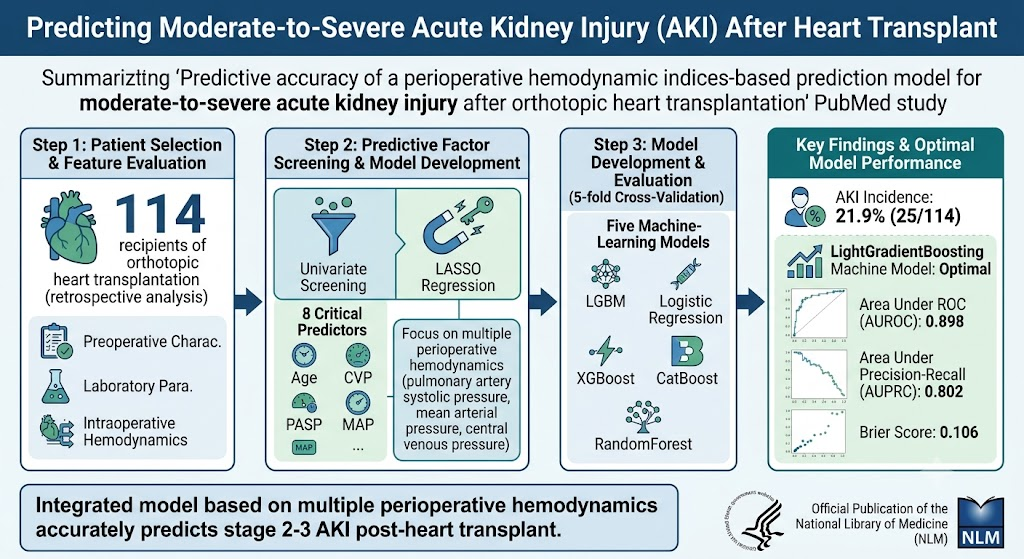
Key result: A machine-learning model incorporating perioperative hemodynamic indices (pulmonary artery systolic pressure, mean arterial pressure, central venous pressure) predicted postoperative stage 2-3 AKI after heart transplant with an AUC of 0.898.
Incidence: 21.9% (25/114) of recipients developed moderate-to-severe AKI.
Best model: Light gradient boosting machine outperformed other algorithms in discrimination and calibration.
Clinical implication: The model may guide early hemodynamic optimization to reduce AKI risk, but requires external validation.
Design | Retrospective cohort study |
|---|---|
Setting | Single center in China |
Population | 114 orthotopic heart transplant recipients |
Outcome | Postoperative stage 2-3 acute kidney injury (KDIGO criteria) within 7 days |
Predictors | 8 factors including pulmonary artery systolic pressure, mean arterial pressure, central venous pressure, and preoperative creatinine |
Model performance | LightGBM: AUC 0.898, AUPRC 0.802, Brier score 0.106 |
Funding | Not reported in source |
Why This Study Matters
Acute kidney injury after orthotopic heart transplantation (OHT) is common, affecting up to 20-50% of recipients depending on definition, and is strongly associated with increased morbidity and mortality. Existing prediction models for post-OHT AKI have focused on preoperative characteristics and static intraoperative factors, often overlooking the dynamic influence of multiple hemodynamic parameters. Given that intraoperative hypotension and venous congestion are modifiable risk factors, a model that integrates real-time hemodynamic data could enable earlier intervention. This study aimed to develop and compare machine-learning (ML) models that incorporate perioperative hemodynamic indices to predict stage 2-3 AKI after OHT.
How the Study Was Conducted
The investigators retrospectively analyzed 114 adult OHT recipients at a single center. Baseline demographic, clinical, and laboratory data were collected, along with intraoperative hemodynamic parameters including mean arterial pressure (MAP), central venous pressure (CVP), and pulmonary artery systolic pressure (PASP). The primary outcome was stage 2-3 AKI per KDIGO creatinine criteria within 7 days post-transplant. Predictor selection proceeded through univariable analysis followed by LASSO regression to minimize overfitting. Five ML algorithms were trained: logistic regression, random forest, support vector machine, extreme gradient boosting (XGBoost), and light gradient boosting machine (LightGBM). Model performance was assessed by area under the receiver operating characteristic curve (AUC), area under the precision-recall curve (AUPRC), and Brier score using 5-fold cross-validation.
What the Researchers Found
Of the 114 patients, 25 (21.9%) developed stage 2-3 AKI. Among the candidate predictors, lower MAP, higher CVP, higher PASP, higher preoperative creatinine, lower preoperative hemoglobin, longer cardiopulmonary bypass time, higher vasoactive-inotropic score, and higher red blood cell transfusion volume were retained for the final models. The LightGBM model demonstrated the best overall performance (AUC 0.898, AUPRC 0.802, Brier score 0.106). The authors noted that intraoperative hypotension (low MAP) and venous congestion (elevated CVP and PASP) were strongly associated with AKI risk, consistent with established pathophysiological mechanisms of hypoperfusion and renal congestion.
Strengths and Limitations
Strengths include the use of multiple ML algorithms and comprehensive hemodynamic data. However, the study has important limitations. It is retrospective and single-center, with a modest sample size (n=114) and only 25 events, which increases the risk of model overfitting despite LASSO and cross-validation. No external validation cohort was used, limiting generalizability. The model was built solely on perioperative data; post-transplant confounders such as immunosuppression, fluid balance, and vasopressor use were not included. Additionally, the outcome definition relied only on creatinine criteria without urine output, which may under- or overestimate AKI. The authors did not report calibration curves or decision-curve analysis, which are essential for assessing clinical utility.
Implications for Practice and Research
This proof-of-concept study suggests that ML models integrating hemodynamic parameters may enhance early risk stratification for post-OHT AKI. If externally validated, the model could help guide goal-directed hemodynamic therapy, such as maintaining MAP above a threshold or managing preload to reduce venous congestion. However, before clinical adoption, the model requires prospective, multicenter validation, inclusion of postoperative variables, and assessment of whether its use improves patient outcomes. Researchers should also explore dynamic updating of predictions using intraoperative and postoperative monitoring data. The association between hemodynamics and AKI reinforces the need for careful perioperative perfusion management in heart transplant recipients.