Study Background
The auditory experience of music is complex and multifaceted, relying heavily on accurate perception of frequency components, particularly in the low-frequency range. For individuals with hearing impairment, assistive devices such as hearing aids (HAs) and cochlear implants (CIs) are essential for restoring sound perception. However, the quality of music as perceived through these devices often remains unsatisfactory, especially due to limitations in low-frequency sound processing. Understanding how different hearing-assistive devices impact the perception of musical sound quality, specifically regarding low-frequency degradation, is vital for optimizing rehabilitation strategies and managing patient expectations preoperatively.
Study Design
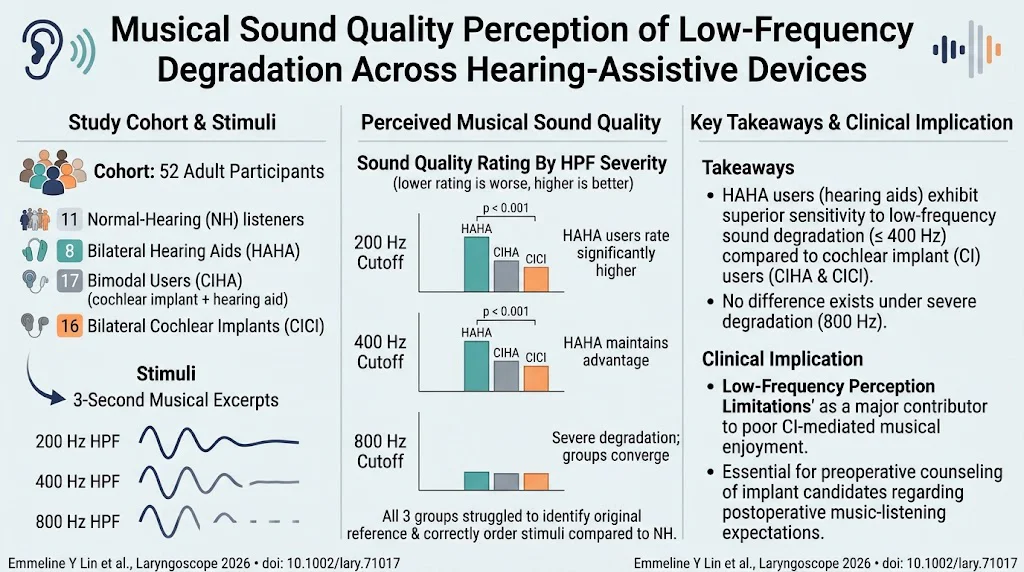
This cross-sectional observational study recruited 52 adult participants divided into four cohorts: 11 normal-hearing (NH) listeners, eight bilateral hearing aid users (HAHA), 17 bimodal users with one cochlear implant and one hearing aid (CIHA), and 16 bilateral cochlear implant users (CICI). The study focused on evaluating the perception of musical sound quality with varying degrees of low-frequency degradation.
Participants listened to 3-second musical segments processed into 15 sets with differing sound quality conditions. These included a hidden Reference (best quality), three high-pass filtered (HPF) versions with cutoff frequencies at 200 Hz, 400 Hz, and 800 Hz (representing increasing degrees of low-frequency degradation), and an anchor stimulus representing the most degraded condition. Sound quality was evaluated using the CI-Multiple Stimulus with Hidden Reference and Anchor test, where subjects rated and ranked the stimuli. Analysis employed ART ANOVA with post hoc comparisons to discern between-group differences in sound quality ratings for each stimulus.
Key Findings
The results demonstrated that both the participant group and the extent of low-frequency degradation significantly influenced musical sound quality perception (p < 0.001). Notably, HAHA users rated sound quality significantly higher than CIHA and CICI users for the 200 Hz and 400 Hz HPF conditions (p < 0.001), indicating superior sensitivity to subtle low-frequency changes.
HA and CI users were similar in their responses at these lower cutoff frequencies, but all three hearing-impaired groups showed comparable sound quality ratings at the 800 Hz HPF condition, suggesting a threshold beyond which low-frequency degradation equally impairs perception regardless of device type.
Importantly, compared to normal-hearing listeners, all hearing-impaired groups—including HAHA, CIHA, and CICI—had difficulty correctly identifying the Reference stimuli and ordering the degraded sounds accurately, reflecting persistent challenges in musical sound discrimination.
Expert Commentary
The study illustrates a clear advantage of bilateral hearing aids in preserving low-frequency sound perception, which is crucial for music sound quality. Cochlear implant users, whether bimodal or bilateral, appear limited in their ability to perceive fine changes in low-frequency content, which is consistent with known constraints of electrical stimulation and electrode insertion depth in CIs.
These findings highlight the biological plausibility underlying the perceptual differences, such as the preservation of hair cell function in residual hearing with HAs that facilitates better low-frequency processing. Conversely, CI users rely on electrical stimulation that tends to have less fidelity in low-frequency transmission.
Limitations of the study include the relatively small sample size for each subgroup and the short duration of musical samples used, which may not fully capture real-world music listening complexity. Nonetheless, the findings are generalizable and valuable for clinical counseling and device programming strategies.
Conclusion
This investigation underscores the superior ability of bilateral hearing aid users to perceive low-frequency sound degradation up to 400 Hz compared to cochlear implant users, who experience marked deficits regardless of unilateral or bilateral CI configuration. Clinicians should integrate these insights into preoperative counseling to set realistic expectations for music listening post-implantation.
Optimizing low-frequency sound processing remains a critical challenge for cochlear implant technology, emphasizing the need for ongoing research into signal processing strategies and hybrid device models. Future studies should expand on these findings with larger cohorts and varied musical genres to further elucidate device-specific limitations and guide rehabilitation approaches.
Funding and Clinical Trials
The study as reported does not mention specific funding sources or clinical trial registration.
References
Lin EY, Barry B, Jiradejvong P, Limb CJ, Barrett KC, Jiam NT. Musical Sound Quality Perception of Low-Frequency Degradation Across Hearing-Assistive Devices. The Laryngoscope. 2026 Oct 26. PMID: 42929452.
Additional references on hearing aid and cochlear implant sound quality perception:
1. Gfeller K, Christ A, Knutson JF, Stordahl J. Musical backgrounds, listening habits, and aesthetic enjoyment of adult cochlear implant recipients. J Am Acad Audiol. 2000;11(10):390-406.
2. Looi V, McDermott HJ, McKay CM, Hickson L. Music perception of cochlear implant users compared with that of hearing aid users. Ear Hear. 2004;25(3):195-204.
3. Drennan WR, Rubinstein JT. Music perception in cochlear implant users and its relationship with early deafness. Hear Res. 2008;242(1-2):53-61.