Highlight
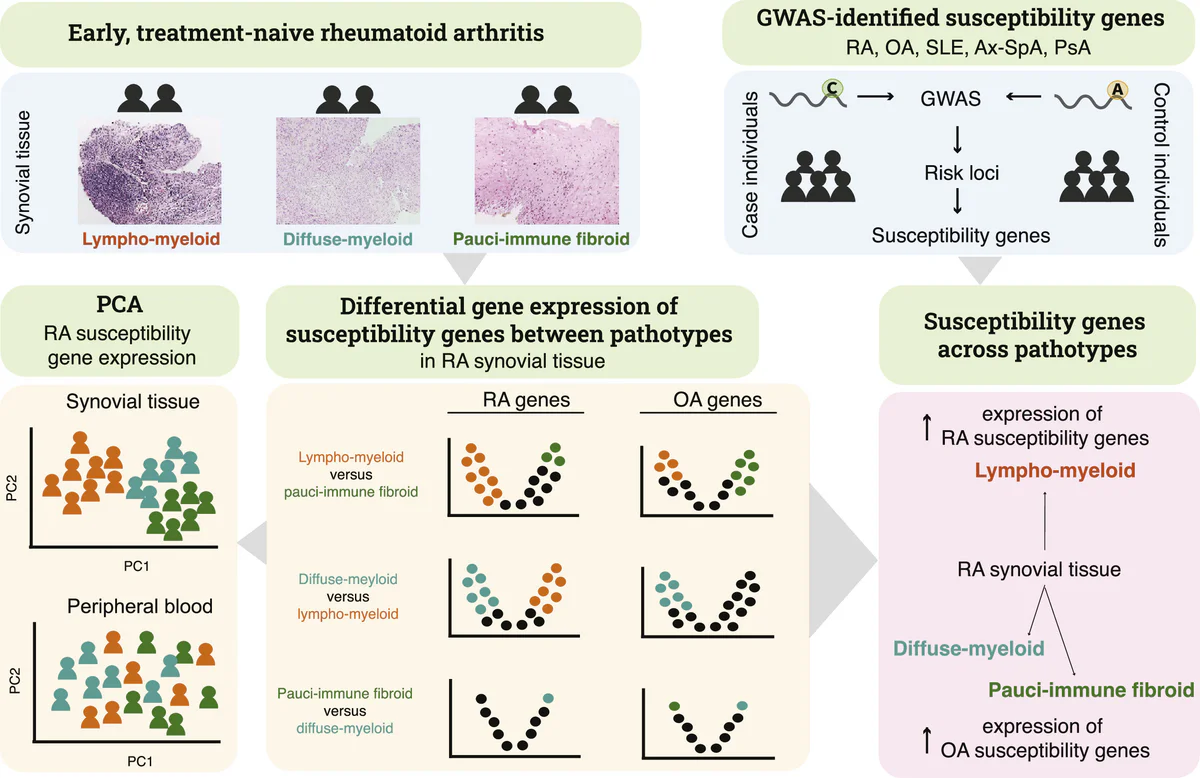
This study demonstrates that expression of rheumatoid arthritis (RA) susceptibility genes varies significantly across synovial histopathological subtypes, or pathotypes, in early, untreated RA patients. RA risk genes are predominantly upregulated in the lympho-myeloid pathotype, consistent with immune-driven inflammation, while osteoarthritis (OA) risk genes are enriched in diffuse-myeloid and pauci-immune fibroid pathotypes. These findings suggest distinct molecular and immunopathogenic mechanisms underpinning synovial heterogeneity in RA, with implications for personalized diagnosis and treatment strategies.
Study Background
Rheumatoid arthritis (RA) is a chronic autoimmune disease characterized by inflammation and progressive destruction of synovial joints. Despite advances in therapy, RA remains clinically and biologically heterogeneous, complicating prognostication and personalized treatment. Histological examination of synovial tissue from RA patients has identified distinct pathotypes—lympho-myeloid, diffuse-myeloid, and pauci-immune fibroid—that correlate with immunopathology and clinical features. Concurrently, genome-wide association studies (GWAS) have identified numerous susceptibility loci associated with RA and other rheumatic diseases, yet the relationship between genetic risk variants and synovial immunopathology remains poorly understood. Understanding this connection may elucidate the mechanisms driving disease heterogeneity and inform more precise therapeutic targeting, especially in early, treatment-naïve RA where intervention might have the greatest impact.
Study Design
The study utilized synovial RNA sequencing data from two early RA cohorts: the Pathobiology of Early Arthritis Cohort (PEAC, n=87) and the Flinders cohort (n=18), focusing on treatment-naïve patients to avoid confounding effects of immunomodulatory therapy. Patients were stratified based on synovial histopathology into three pathotypes: lympho-myeloid, diffuse-myeloid, and pauci-immune fibroid. Differential gene expression analyses were conducted across these pathotypes. The expression profiles of RA susceptibility genes identified by GWAS, as well as genes associated with osteoarthritis (OA), ankylosing spondylitis, psoriatic arthritis, and systemic lupus erythematosus (SLE), were specifically analysed for enrichment patterns and biological pathway associations. Associations with anticitrullinated protein antibody (ACPA) status and disease activity markers were also evaluated to assess clinical relevance.
Key Findings
1. Pathotype-Specific Expression of RA Susceptibility Genes: RA GWAS-identified susceptibility genes exhibited clear differential expression patterns across synovial pathotypes. The lympho-myeloid pathotype showed significant upregulation of RA susceptibility genes compared to diffuse-myeloid and fibroid synovium. This pattern was robust across both cohorts and was significantly correlated with markers of disease activity (e.g., inflammatory parameters).
2. Enrichment of Immune Activation Pathways: Genes upregulated in the lympho-myeloid pathotype were enriched for pathways involved in lymphocyte activation and differentiation, consistent with the known immune-driven pathogenesis of RA in this subtype. This includes upregulation of genes related to T and B cell functions, signaling, and adaptive immunity.
3. OA Susceptibility Genes in Non-Lympho-Myeloid Pathotypes: By contrast, OA susceptibility genes were preferentially upregulated in diffuse-myeloid and pauci-immune fibroid pathotypes, which are characterized by less prominent lymphocyte infiltration and differ in immunopathogenic signatures. This suggests that some RA synovial subtypes share molecular features more typical of degenerative, non-inflammatory joint diseases.
4. Consistency Across ACPA Status: The expression trends of susceptibility genes were most pronounced in ACPA-positive patients but were directionally consistent in ACPA-negative individuals, indicating that genetic risk impacts synovial biology across serological subgroups.
5. Broader Rheumatic Disease Gene Expression: Though explored, genes associated with ankylosing spondylitis, psoriatic arthritis, and systemic lupus erythematosus showed less pathotype-specific enrichment, suggesting more disease-specific synovial genetic expression signatures in early RA.
Expert Commentary
This study reinforces the concept that RA is not a singular disease entity but a spectrum marked by distinct synovial immunopathological states. The preferential expression of RA susceptibility genes in lympho-myeloid synovium supports current understanding of adaptive immune involvement in RA pathogenesis. The unexpected enrichment of OA susceptibility genes in diffuse-myeloid and fibroid pathotypes intriguingly points to overlapping degenerative mechanisms in subsets of RA patients, which may challenge the binary classification of autoimmune versus degenerative arthritis. This finding may have implications for therapeutic decisions and highlights the need for pathotype-guided interventions.
Limitations include the observational design and reliance on RNA expression without functional validation. Also, the sample size, while appropriate for transcriptomic analyses, warrants further validation in larger, diverse cohorts. Moreover, synovial biopsy is invasive and not routinely performed, limiting immediate clinical application. However, the molecular insights provide a compelling rationale for developing less invasive biomarkers correlating with synovial pathotypes.
Conclusion
This study elucidates the pathotype-specific expression of RA susceptibility genes in early, treatment-naïve synovial tissue, highlighting immune-driven mechanisms in lympho-myeloid RA and a distinct, OA-like gene expression signature in other synovial pathotypes. These findings underscore the heterogeneity of RA and the critical importance of synovial stratification for interpreting genetic risk and tailoring therapeutic approaches. Future research should focus on translating these molecular insights into clinical practice, potentially via biomarker development for precision medicine in RA.
Funding and ClinicalTrials.gov
The study was conducted under the auspices of the Pathobiology of Early Arthritis Cohort (PEAC) and Flinders University collaborative projects. Funding sources and relevant clinical trial registrations were detailed in the original publication.
References
1. den Hond IC, Reinders MJT, Lewis MJ, et al. Rheumatoid arthritis susceptibility genes show pathotype-specific expression in synovial tissue of patients with early treatment-naïve RA. Ann Rheum Dis. 2026;85(11):2136-2150. PMID: 42498579.
2. Smolen JS, Aletaha D, McInnes IB. Rheumatoid arthritis. Lancet. 2016;388(10055):2023-2038.
3. Dennis G Jr, Holweg CTJ, Kummerfeld SK, et al. Synovial phenotypes in rheumatoid arthritis correlate with response to biologic therapeutics. Arthritis Res Ther. 2014;16(2):R90.
4. Liu Y, Frisell T, Askling J, et al. Genetic risk and pathogenesis of rheumatoid arthritis. Nat Rev Rheumatol. 2021;17(7):421-433.