Introduction
Staphylococcus aureus bloodstream infections (BSIs) represent a significant infectious complication in pediatric oncology patients, who often require central venous catheters (CVCs) for chemotherapy and supportive care. Despite existing guidelines recommending removal of the catheter during S aureus BSI due to risk of severe complications, the necessity of catheter removal remains debated because of the clinical challenges posed by line replacement in these vulnerable children. The study by Slatnick et al. provides critical insights into risk factors for complications following S aureus BSIs in pediatric cancer patients, focusing on the impact of CVC management strategies—removal versus salvage.
Clinical Context and Disease Burden
Children with cancer are at heightened risk for BSIs due to immunosuppression and frequent invasive device use. Staphylococcus aureus, particularly methicillin-resistant (MRSA) strains, can cause serious infections including recurrent bacteremia, deep tissue abscesses, endocarditis, meningitis, osteomyelitis, and even death. Management strategies must balance infection control with preservation of central access. The disease burden is considerable: BSIs can interrupt cancer therapy and increase hospital stay, healthcare costs, and mortality. Careful evaluation of catheter management paradigms is thus crucial to improving outcomes.
Study Design
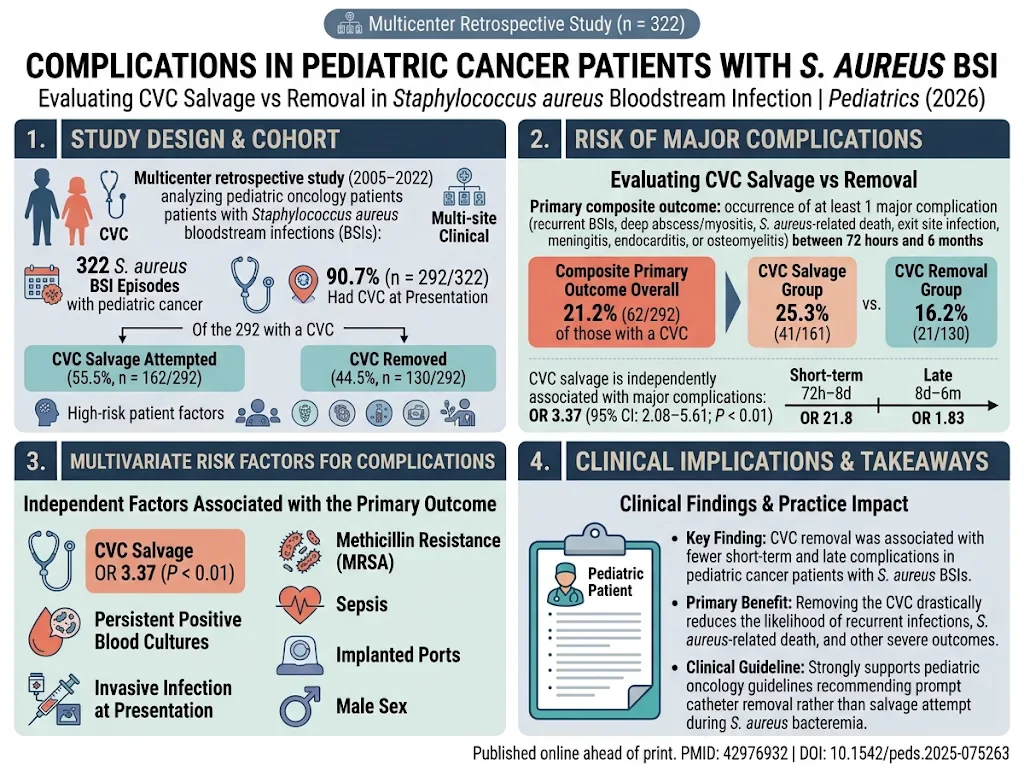
This multicenter, retrospective cohort study analyzed 322 pediatric oncology-associated S aureus bloodstream infection episodes from January 2005 to 2022. The cohort was predominantly composed of patients with CVCs in place at infection onset (90.7%, n=292). Among these, catheter salvage was attempted in 55.5%. The study defined a composite primary outcome of major complications occurring from 72 hours up to 6 months after initial positive culture, dividing this timeframe into short-term (72 hours to 8 days) and late (8 days to 6 months) periods. Major complications included recurrent BSIs, deep abscess/myositis, S aureus-related mortality, exit site infection, meningitis, endocarditis, and osteomyelitis. Multivariable logistic regression with propensity score weighting assessed independent associations between CVC management approaches and complications while controlling for confounders such as methicillin resistance, sex, severity of infection at presentation, and persistence of bacteremia.
Key Findings
Of the episodes with CVCs, 21.2% developed at least one major complication. Patients undergoing catheter salvage experienced a significantly higher complication rate (25.3%) compared to those whose CVCs were removed (16.2%). Importantly, CVC salvage markedly increased the odds of complications in both the short-term period (OR 21.8, 95% CI 7.09–95.4) and late period (OR 1.83, 95% CI 1.06–3.18), underscoring the persistent risk associated with retaining infected lines.
Several additional independent risk factors for complications were identified, including methicillin resistance—a known marker of more severe and harder-to-treat infections—male sex, invasive infection at presentation (indicating systemic severity), use of implanted ports (as opposed to other catheter types), clinical sepsis, and persistent blood culture positivity, reflecting ongoing bacteremia despite treatment.
This study confirms that CVC removal is associated with a clear reduction in risk for both early and late infectious complications in pediatric cancer patients with S aureus BSI. Notably, the high odds ratio for short-term complications with salvage highlights the immediate danger of retaining potentially colonized catheters.
Expert Commentary
The findings provide robust evidence supporting current clinical guidelines recommending CVC removal in pediatric oncology patients with S aureus BSIs. The propensity score adjustment strengthens confidence that the associations observed are not merely due to confounding by indication (such as severity of illness influencing catheter management decisions).
However, practical challenges remain. Catheter removal can be complex in children with limited venous access, and line replacement is not without risk. These data emphasize the need for early identification of risk factors predictive of poor outcomes and may inform more nuanced clinical decision-making, possibly including stratification for aggressive catheter management or adjunctive therapies.
Moreover, understanding the biological basis for higher complication rates with implanted ports versus other catheter types warrants further investigation into colonization dynamics and hardware-related biofilm formation.
Study limitations include its retrospective design and potential variability in practice patterns across centers. Prospective interventional studies could further clarify optimal timing of catheter removal and duration of antibiotic therapy.
Conclusions
In pediatric cancer patients with Staphylococcus aureus bloodstream infections, central venous catheter removal is strongly associated with reduced risk of both early and late major infectious complications. Methicillin resistance, septic presentation, and persistent bacteremia further compound risk. These findings reinforce clinical guidelines advocating for prompt catheter removal to improve outcomes and highlight the delicate balance clinicians face in managing complex infectious and oncologic care needs. Future research should explore strategies to improve vascular access preservation without compromising infection control.
Funding and Trial Information
No specific funding information was provided in the data extract. The study is a retrospective review and not a clinical trial; no clinicaltrials.gov identification was referenced.
References
1. Slatnick LR, Giles J, Miller TP, et al. Complications in Pediatric Cancer Patients With Staphylococcus aureus Bloodstream Infection. Pediatrics. 2026 Nov 4; PMID: 42976932.
2. Infectious Diseases Society of America. Clinical Practice Guidelines for the Diagnosis and Management of Intravascular Catheter-Related Infection. Clin Infect Dis. 2011;52(9):e162-e193.
3. Kang CI, Song JH. Staphylococcus aureus bloodstream infection in cancer patients: risk factors and clinical implications. Infect Chemother. 2014;46(3):145-8.
4. Uchil D, Pai S, Thomas V. Central venous catheter-related bloodstream infections: a review. Indian Pediatr. 2017;54(9):779-783.
These references provide context and support for catheter management decision-making in pediatric oncology patients with S aureus BSIs. The study by Slatnick et al. advances this knowledge by quantifying complication risks related to catheter management in a large multicenter cohort.