Highlight
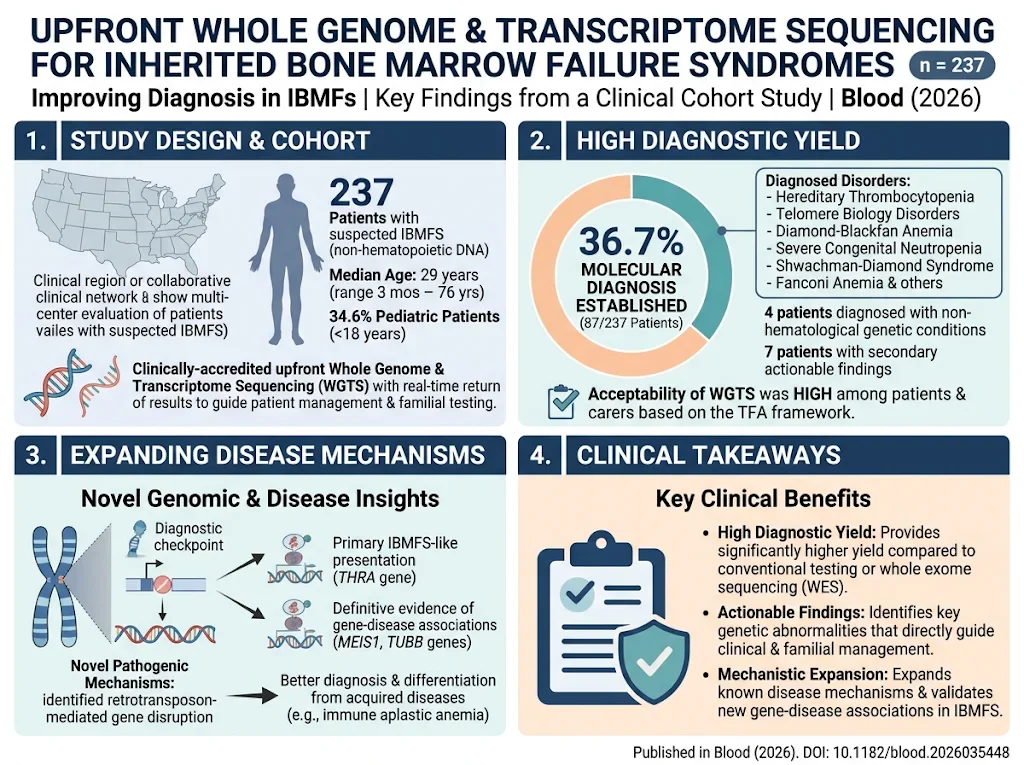
Inherited bone marrow failure syndromes (IBMFS) are challenging to diagnose due to overlapping clinical features and complex genetics. This study demonstrates that upfront whole genome and transcriptome sequencing (WGTS) in a large patient cohort substantially improves diagnostic yield over conventional genetic testing. It reveals novel pathogenic variants, mechanisms such as retrotransposon disruptions, and new gene-disease associations, while providing clinically actionable findings and high patient acceptability.
Study Background
Inherited bone marrow failure syndromes (IBMFS) are rare monogenic disorders characterized by defective hematopoiesis leading to cytopenias affecting one or more blood lineages. Patients often present with bone marrow hypoplasia causing anemia, thrombocytopenia, neutropenia, or a combination thereof. The clinical spectrum is broad and overlaps significantly with acquired bone marrow failure conditions such as immune aplastic anemia, complicating diagnosis.
Traditional diagnostic genetic approaches include targeted gene panels or whole exome sequencing (WES), which generally focus on protein-coding regions. However, these methods have limitations in detecting deep intronic variants, structural changes, and regulatory abnormalities underlying disease. As a result, a substantial proportion of suspected IBMFS cases remain genetically unresolved, hindering precise diagnosis, prognosis, and management.
Recent advances in genomics have highlighted the potential of whole genome sequencing (WGS) combined with transcriptome sequencing (RNA-seq) to more comprehensively characterize genetic variation at both DNA and RNA levels. This approach can detect coding and non-coding variants, structural rearrangements, splice abnormalities, and gene expression changes, thereby improving diagnostic yield and elucidating novel disease mechanisms.
Study Design
This prospective study evaluated the utility of upfront combined whole genome and transcriptome sequencing (WGTS) in 237 patients with clinically suspected IBMFS. Peripheral, non-hematopoietic tissues provided DNA for sequencing to minimize confounding by somatic hematopoietic mutations. The cohort spanned a wide age range (3 months to 76 years), with 34.6% under 18 years old.
Sequencing was clinically accredited and reported in real time to facilitate timely patient management and allow for cascade familial testing. Confirmed molecular diagnoses guided clinical decisions, genetic counseling, and tailored treatment strategies.
Key Findings
A definitive molecular diagnosis was achieved in 87 out of 237 patients (36.7%), a notable improvement over rates typically reported with targeted panels or WES. Diagnosed cases represented a broad spectrum of IBMFS entities including hereditary thrombocytopenia, telomere biology disorders, Diamond-Blackfan anemia, severe congenital neutropenia, Shwachman-Diamond syndrome, Fanconi anemia, and other related syndromes.
The study also identified four patients with non-hematological genetic syndromes that clinically mimicked IBMFS, enabling appropriate reclassification and management. Additionally, seven patients manifested secondary actionable genetic findings unrelated to bone marrow failure but relevant for clinical care.
Importantly, WGTS uncovered novel pathogenic mechanisms such as retrotransposon-mediated gene disruptions previously unrecognized in IBMFS. This highlights the advantage of whole genome approaches over exome-only strategies that miss such events.
The analysis also established novel gene-disease associations including THRA linked to primary IBMFS-like presentations and provided definitive evidence for MEIS1 and TUBB involvement in IBMFS pathogenesis, expanding the catalog of clinically relevant genes.
Patient and caregiver acceptability of the WGTS process was high, assessed using the Theoretical Framework of Acceptability, supporting feasibility for integration into clinical practice.
Expert Commentary
This study represents a paradigm shift in the genomic diagnosis of inherited bone marrow failure syndromes. By combining WGS with transcriptome analysis upfront, clinicians can achieve a more comprehensive genetic assessment rather than relying sequentially on gene panels or exome sequencing. Importantly, the identification of noncoding, structural, and novel variant types addresses gaps that limit current diagnostic yields.
From a clinical perspective, precise molecular diagnosis informs prognosis, risk stratification—such as predisposition to malignancy—and guides decisions around stem cell transplantation or targeted therapies. Furthermore, identifying secondary actionable findings and novel IBMFS mimics benefits patient care holistically.
Limitations include the cost and resource requirements associated with WGTS, as well as interpretation complexity, necessitating multidisciplinary expertise and robust bioinformatics pipelines. Efforts to standardize reporting and ensure clinically accredited sequencing are crucial for translation into routine diagnostics.
Overall, this work exemplifies how comprehensive genomic technologies can transform rare inherited disease diagnosis and management, ultimately improving patient outcomes.
Conclusion
Upfront whole genome and transcriptome sequencing significantly enhances diagnostic yield in suspected inherited bone marrow failure syndromes compared to existing genetic approaches. This strategy identifies diverse genomic abnormalities, novel pathogenic mechanisms, and new gene-disease associations, positively impacting clinical management and family counseling. High patient acceptability supports its clinical implementation.
Future research should focus on expanding cohort sizes, refining variant interpretation frameworks, integrating multi-omic data, and assessing cost-effectiveness to facilitate widespread adoption. This advancement ultimately paves the way for precision medicine approaches in IBMFS and related hematologic disorders.
Funding and ClinicalTrials.gov
The study was conducted under clinically accredited research protocols. Specific funding details were not provided in the source abstract. The publication does not reference ClinicalTrials.gov registration.
References
1. Fox LC, et al. Upfront whole genome and transcriptome sequencing to improve diagnosis in inherited bone marrow failure syndromes. Blood. 2026 Nov 5; PMID: 42986897.
2. MacArthur DG, et al. Guidelines for investigating causality of sequence variants in human disease. Nature. 2014;508(7497):469-476.
3. Alter BP, et al. Inherited bone marrow failure syndromes: a diagnostic rationale. Blood Rev. 2016;30(6): 345-359.
4. Sebert M, et al. Whole genome and transcriptome sequencing in rare diseases: a new era in diagnosis. Nat Rev Genet. 2022;23(5):298-312.